Ones of Divinity – compiled from the talks given by Ratan Lal (1918-2006)
EXPERIENCES WITH THE DIVINE
Bhagavan Sri Sathya
Sai Baba is aware of the past, present, and future of each individual. He
immediately assesses the mental state and spiritual aspirations of the
individual. He counsels people to continue with the same sadhana
(spiritual exercise), japa (repetition of the Name), or dhyana
(meditation) that they have been practicing regularly, only pointing out that they
do the spiritual exercise in a disciplined way. Any spiritual exercise is good,
since it helps to strengthen and purify the mind. Baba is a Spiritual
University. He instructs teachers as well as beginners. He begins by imbuing
faith in God in those who do not have it, and He blesses and guides
beginners to pursue the holy path. To hear or read about God and His so-called
miracles is good, since it deepens one's faith in Him. However, reading and
hearing about Baba cannot be compared to direct experience of Him. Any human
effort to describe the Super-human is bound to be imperfect. All one can do is
to try to express one's humble understanding of Divine Masters like Bhagavan
Sri Sathya Sai Baba, who is an embodiment of Absolute Purity, Perfection,
Peace, and Power.
In 1967, I (Ratan
Lal) was meditating while waiting to have Bhagavan's Darshan in Ooty.
Bhagavan came and
stood before me, and when I opened my eyes He smiled and said, "Do not
hold your forefinger and thumb with their tips touching. The correct way to
hold the forefinger is to curl the forefinger against the thumb." He
explained that the former way of holding the mudra (posture) would lead to an
increase in worldly desires, the latter would help to imbibe pure
(satwic) desires. When doing repetition of God's
name (japa), the middle finger should be held against the thumb. The
mind has three characteristics: dullness (thamasic), activity (rajasic)
and purity. The little finger represents dullness or inertia, the ring finger
represents activity, and the middle finger represents purity. Then He added,
"I will give you a japamala." I was pleased. In the evening I
reminded him of his promise, but Baba said, "Come for Gurupoornima (a
festival in July in honor of the Guru). Then I will give it to you." On
that holy day, late in the evening, He called me upstairs to his room. With a
quick gesture, He created the japamala, counted the beads, and handed it
to me.
It is prescribed that
action, devotion, and wisdom should be coordinated. In different individuals
and at different times, one of them is more apparent, depending on the nature
of the seeker. Just as all rivers lead to the ocean, all spiritual pathways lead
to the same ocean of Bliss. The means do not diverge, but converge. If one knows
that till' same Divinity pervades everywhere, one can ask. “Service by whom and
for whom? Inquiry by whom and of what?” The ego must be surrendered to the
Master, who is the same as the Self. This is what is expressed when one places
one's head at Bhagavan's Lotus Feet. The feeling of merging in the real Self
should be there. The great Masters initiate through look, touch, or silence. There
are many ways to help one to tread the spiritual path, but the essence of all
names and forms is the same. Differences lie in the mind alone. Here is the
story of how Bhagavan pointed out the spiritual path for me to follow.
In 1967 Bhagavan made
the speaker a member of His Service and Spiritual Organization in Bombay by
placing a badge on my shirt. Later He told Sri Kasturi to take me to the
canteen for a cup of coffee. As we returned to the room where Bhagavan was
standing with other members of the Organization, Bhagavan looked pointedly at
me and in a stem, voice asked me, "Who are you?" I hesitated to give
an answer, knowing that my name pertained only to my body. I kept quiet. With
folded hands, I looked humbly at Him. Then Bhagavan talked to some people for
about ten minutes. Then, again, in the same manner, He asked me, "Who are
you?" as if I had intruded into the gathering. Again, I remained
silent with folded hands. Bhagavan turned his attention to the other people in
the room for fifteen or twenty minutes. Then, for the third time, He looked at
me piercingly and asked, "Who are you?" Sri Kasturi took pity on me
and tried to intervene, saying something to Bhagavan. Bhagavan made a gesture
indicating that he should not intervene. The third time my reaction was the
same. I stood silently, palms joined. I took it as an informal initiation for
me to follow the path of Self-inquiry. After that exchange, I began to read
books on Adwaita Vedanta (the doctrine of Non-dualism) and started to
practice its philosophy. About twenty years later I was with Bhagavan in His
car, and He said, "The core of your being is Consciousness" – Chit.
Consciousness as mind is always conscious of something, so if you concentrate
upon Consciousness the mind jumps and bumps. Therefore, do not contemplate on
Consciousness as mind. Instead, contemplate on your Eternal Being – the Sat
(Being) aspect.
In 1969 the Raj Matha
of Jamnagar invited Bhagavan to Jamnagar. He graciously acceded to her request.
I had the privilege of accompanying Bhagavan, along with a group of devotees.
After a couple of days' stay in Jamnagar, we visited the temples of Somanath
and Dwaraka. The news of Bhagavan's visit to the place had spread far and wide.
A large number of cars followed us as we approached the Krishna Temple in Dwaraka.
There was such a huge crowd that some of us could not get anywhere near the
sanctum sanctorum, housing the idol of Lord Krishna. When Bhagavan returned to
His car, we went to a guest house for lunch and rest. On the way I casually
mentioned to Bhagavan that, because of the large crowd at the temple, we could
not see the idol of Lord Krishna. Bhagavan replied, "Oh! Do you want to go
back to see the idol of Lord Krishna?" I will give you a car to enable you
to go and see it. I replied, "No, Bhagavan. I am quite happy with our Sai
Krishna."
While returning to
the palace, Bhagavan asked the driver to stop the car. There was a small hill
to our right. Beyond the hill was the sea. None in our party knew about it.
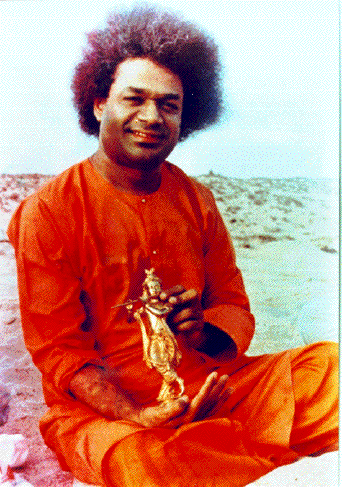
Bhagavan stepped out of the car and waded into the sea. After some time, He sat
on the beach, and all of us sat around Him. On the one side a dozen individuals
sat: on the other sat Mother Eswaramma with a few women. Bhagavan began
building a mound of sand in front of Him and drew something on top of it. After
a few minutes He announced, "Now it is ready." We kept quiet,
wondering what was ready. Bhagavan pulled up His sleeve, pushed His hand into
the mound, and took out a statue of Lord Krishna in pure gold, weighing about
two kilos. The statue was given to one of the lucky devotees there.
In the early 70's,
compared to the present times, a much smaller number of devotees came to
Bhagavan. Bhagavan used to explain higher spiritual matters to them
collectively and individually. One day as I was sitting alone at the Lotus Feet
of Bhagavan, He was explaining in detail the significance of Thath Thwam Asi
(That Thou Art), implying that the essence of "This" and
"That" is One. After about half an hour, my gaze turned toward my
lap. There, to my utter amazement; was a lovely red apple from Kashmir. It was
my favorite variety of apple. Nobody had entered the room, and I had not felt a
sensation of anything being placed in my lap. I asked Bhagavan in surprise,
"Where did this apple come from?" He smiled sweetly and said,
"You did not have any tiffin (afternoon snacks) today, so I thought that
you might be hungry." His thoughts can take the shape of concrete objects.
I tried to put the apple in my pocket, to share it later with my family.
Observing this Bhagavan said, "No! No! It is meant for you. Eat it right
now." Bhagavan brought out a small knife and cut the apple into pieces,
and I ate it immediately per His Divine Command. When Bhagavan wills something,
it is immediately completed. There is no gap between the thought and its concretization.
In Brindavan we
normally stood in the compound of Bhagavan's Temple (Mandir) along with
the students. One day Bhagavan came near me and gave me a wet cloud of earth.
"Take it and keep it in your hand," He said. "This, too, is
God." I held it tightly in my fist. Bhagavan went out to give Darshan to
the devotees and returned after about twenty minutes. He came straight to me
and asked me for the piece of earth. He took it from my extended palm and blew
on it, and it was instantly transformed into a small Shiva Lingam (an
oval-shaped crystal). Bhagavan handed it to me and asked me to wear it around
my neck. I noticed there was-no home in it, but before I
could point out the fact, Bhagavan looked at me and said; "There is no
hole in it; give it back to me." Bhagavan blew on it once more, and a hole
appeared in it.
On another occasion,
we were standing outside Trayee Brindavan (Swami's residence in
Whitefield, Bangalore). As Bhagavan came out of the Temple, He handed me a
small tulasi leaf. I held it in my hand. After giving Darshan, He went straight
into the temple. I was quite perplexed. I wondered what I should do with the
perishable tulasi leaf. Bhagavan was leaving for Puttaparthi within an hour.
Walking. back to my cottage, I turned and saw the students and some of the
elderly devotees entering the Temple. When I got inside, Bhagavan called me and
asked about the tulasi leaf. Fortunately, I had it in my hand. Before
everyone's eyes, Bhagavan's Divine Breath transformed it into a golden tulasi
leaf. He. then broke the golden leaf, and inside it was the original green
leaf. We all stared at this phenomenon with wide eyes. As if that was not
enough, Bhagavan again blew on it and, lo and behold, the golden leaf
disappeared from the palm of His hand-in its place lay, once again, the
original tulasi leaf!
In order to progress
from the stage of conceptual comprehension to the stage of apprehension of
Brahman, one has to abide in it by remaining immersed in the state of pure
Consciousness until the sense of separation from the Self is dissolved. The
great Atman, being Awareness itself, cannot be treated as an object. What
cannot be treated as an object will remain beyond the grasp of the intellect.
Bhagavan often says
that the sky is one, but stars are many; the earth is one, but countries are
many. He emphasizes the oneness of everything. At times He says everything–meaning
the world – is nothing. Conversely, nothing-the void behind it-is everything.
He wants aspirants to travel from animality to humanity and from humanity to
Divinity. He stresses practice of Purity, Unity, and Divinity. So far, history
has not recorded any spiritual being who has brought about the international
integration of humanity on such a large scale as is being witnessed in
Prasanthi Nilayam under the Di vine umbrella of Sri Sathya Sai Baba. People
from all parts of the world gather around His Lotus Feet and live like brothers
and sisters. Many overseas devotees are serious seekers of spirituality. If one
takes a walk in the evenings in Prasanthi Nilayam, one will see some people
singing Bhajans (devotional songs), others sitting in meditation, and many
individuals studying spiritual books. The different religions are only different
pathways leading to the one single goal of God realization. Bhagavan says,
"God is as far away from you as you are from your own Self," implying
that Self and God are identical.
To know the Truth of
one's Being and to Be, it is known as release from bondage. The knot of the heart
is destroyed when ignorance is destroyed. This is why the mind should be
withdrawn from all external objects and turned inward. It is indeed the good
fortune of the present era that God has appeared in a human form in order to
dispel the ignorance, by destroying the "I am the body" notion of the
seeker. He reveals His automatic Divine-Activity to point out the indwelling
Divinity, veiled from us because of our ignorance–only to augment our faith in
Divinity.