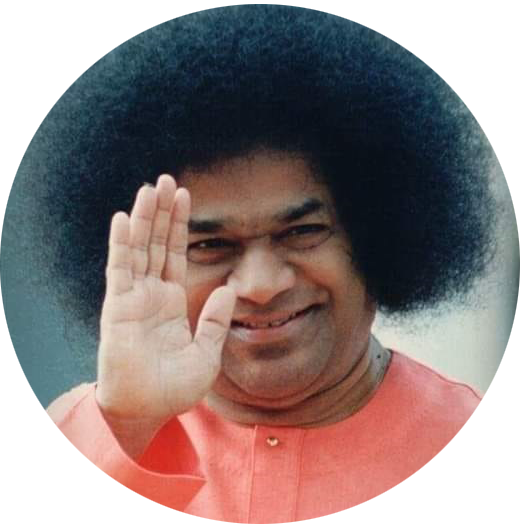
The Dharmic Challenge – Putting Sathya Sai Baba’s Teachings into Practice
Compiled & Edited by Judy Warner
Excerpts shared for educational and spiritual purposes with reverence to the author. This is a non-profit project dedicated to selfless service.
MY BATTLE TO SURRENDER
Jack Scher
I spent the last seven weeks with Swami, where He
thrashed and trashed my tangled karma, unravelling the very fiber of my being,
renewing all that I had learned to call "me." I know now, that in
order to follow my dharma, I must control my appetites and desires, accept all that happens, and
surrender my will to His will. Above an, I must trust Baba completely, trust
that He loves me. Then, basking in His light, I can be more loving to those
around me.
In many ways, at age 67 I still act like a voracious,
deprived child. My father died when I was 5, and my mother remarried when I was
8. Shortly thereafter, she was stricken with polio, which left her paralyzed
from the waist down. My whole family was focused on my invalid mother's needs.
There was just no time for me, no time for anyone to properly love and care for
me. I grew up feeling deprived, angry, and rebellious. I felt like an
indentured servant, as if I were there only to serve my mother's unrequited
appetites. I was forced to look outside myself and the home for approval. As an
adult, when I found the recognition I sought in a successful career in medical
publishing, I thought that I alone had overcome life's trials, tests, and
hardships. Little did I dream that, all this time, God had had me under His
wing, taking care of my every need.
I first came to Sai Baba in 1985. I was 58 years old
and I thought that now, having retired, I was reaping the rewards of my own
efforts and good fortune. When I learned of His words, "Not a blade of
grass moves without My will," it was extremely difficult and even
disappointing for me to accept the idea that God had made all my
accomplishments possible. I had to erase. the pride I had taken in my efforts,
and I was fearful of losing the confidence I had earned from the battles I
thought I had won; my sense of personal satisfaction from my perceived
achievements was at stake. Giving all this up meant having to learn to accept
the concept that, at the very least, my success was due to the miraculous
combination of His grace and my efforts.
One of my greatest challenges has been to understand
the doctrine that I am not the doer, as well as to accept and live by that
doctrine. For me, there seems to be a paradox surrounding the concept that
everything is His will, and yet it takes a combination of His grace and our
personal effort to make things happen, as Baba says very emphatically.
I am beginning to realize that this partnership, or
wedding, between effort and grace actually occurs on some other level. For
instance, how does having an interview with Baba come about? First, you have to
be in Prasanthi Nilayam. Do you get there because you choose it or because He
has brought you there? Baba says that no one comes to Him unless He calls them.
Let's skip that hurdle and assume that you are there. Only Swami Himself will
decide whether to come over to where you are sitting. Did He or did you choose
where you would be sitting?
Whenever He comes toward me, I strain to catch His
eye, to plead and appeal to Him for attention. But, again, does He motivate me
to move like a puppet on a string, as I reach up poised with a letter hoping to
embrace Him with my adoration? We think we have to do something, when in fact
all He wants is our love; He says that, as the Lord of the Universe, He has
everything else.
On one miraculous day, He stopped and asked,
"Where are you from?" and my heart leapt into my mouth. It took an
enormous effort to say "Virginia." What part in that play did I have?
My Lord Sai Baba stood before me in all His glory, and He and He alone chooses!
I must remember this, for my very sanity; I must give up thinking that I have
any role in this selection.
In the past, I have bathed and dressed carefully,
hoping in some way to appeal to and attract the Lord. Now I see that I must
bathe and dress carefully out of love and respect, but not to attract Him. He
would be attracted by nothing less than an open, loving heart. If I can only
accept that He and He alone is the doer! What a tremendous relief it would be
to surrender and accept totally that all is His divine will.
As I breathe deeply, enjoying the embrace of His protection,
my monkey mind goes back to work, asking about my partnership with the Lord of
the Universe. I know that my dharma is to do my duty, to perform every
act with the right motivation. I must trust my heart and not my mind. I have
been taught that desire and attachments are the traps that lead to anger and
sorrow, that true surrender to His will is the royal road to happiness. Yet I
keep. coming back to the question of how and when I am to do my share to keep
my part of the bargain. I now know that He writes the script, and He is both
the producer and the director, but how and when am I to act in His play? What
is my role? When, if ever, do I come on stage? True, I am just a puppet, but if
I am required to put forth an effort, how do I find out when and how to fit
into His drama? I know that I am not supposed to just sit back and expect that
Swami will take care of everything. Yet ¥ soon as I say that I know that He
does and will take care of everything. To put it plain and simple, when and how
do I make, an effort?
My habits and the way I solve problems are very deeply
ingrained. For most of my adult life, I worked or fought my own way to the top,
or so I thought. The motto on my graduation ring from New York University was “Prestare
Est Prestarus” (To persevere is to succeed). In spite of my rebellious
attitudes, I accepted this rule, even lived by it. Whenever I felt insecure or
undeserving, I worked harder, believing that, if I put out my best effort, I
could assume my victories were well earned.
Because hard work seemed to deliver, I became
dependent on it. My trust centered upon mobilizing everything I had to plan
creatively, and then to follow through relentlessly until my goal was achieved.
I played the game like any businessman, overlooking small slips in personal
morality to win the-prize. However, in spite of my enormous drive to overcome
my childhood deprivation, I never once was ruthless, nor did I ever purposely
hurt anyone.
Anticipation was a central source of pleasure for me.
I would enjoy planning how to win almost as much as the victory itself. Even in
my personal life, the dream of how and what I would be doing was sometimes more
delicious than the actual experience. I enjoyed living part of my life in the
future. The important thing was that my modus operandi worked; I trusted and
depended on my proven methods. Now, with Swami, all of a sudden I was learning
that my entire approach to problem-solving was wrong. I realized I was not
really responsible for my success and that I owed it all to Him, to God!
When I am sitting at Swami's feet at Puttaparthi, it
is not too difficult to accept that God does it all, especially when He seems
to be showering me with His grace, but when I am back home I can easily forget
this. It is terribly hard to break old habits, especially when they have worked
so well. I remember the first time I came to Puttaparthi, sitting day in and
day out, week in and week out, feeling acutely the deep pains of personal
rejection. Each day; Swami would walk by and seemingly ignore or look through
me. I was the invisible man bemoaning my fate. Nothing I did helped. It was
clear all was in His hands but, at that time, I only had an inkling that He,
and only He, controlled everything.
Slowly, I began to realize that I was suffering so
much because I refused to give up my old techniques for winning. He was
grinding me down, bringing me to my knees, teaching me that anticipation is a
killer. I had to let go. At darshan, I would put my head down when He was still
on the women's side and begin to pray, “Baba, please just smile or stop
or say something; please show me that You love and accept me. I will give up
everything; I will surrender all my desires for an interview, just for Your
smile.” My dream was for me to be sitting there with my head down and
suddenly to feel His gentle hand touch the top of my head, and then to look
down and see the bottom of His brilliant orange robe, His small feet poised
directly in front of me. Well, it never worked. All my self-control and
discipline vanished as I sensed Him approaching; my past training and
dependence on expectations was too hard to throw off. Almost against my will, I
would find my head rising and I would cautiously look in His direction. Then I
would get caught in the throes of desire, and my dream would collapse.
On my first trip, I made eliminating anticipation and
desire my mantra. Over and over I would silently repeat, “Anticipation
does not work; anticipation is harmful; anticipation causes pain; anticipation
is the mother of desire. Desire is the all-consuming tragedy in my life; I must
eliminate desire; I must be empty to be free.” There were many
variations, but the theme was the same: eliminate anticipation and desire – and
surrender. During this first trip, I began to understand these truths, but I
didn't realize they were just the tip of the iceberg. The real task lay before
me.
On many subsequent trips, I would eventually discover
and realize that is was doership that was the culprit. It is only now, after 10
years and 11 trips to Swami, experiencing His love and His relentless lessons,
that I am just starting to know and accept that He and He alone is the doer. If
I had surrendered earlier, I would have felt like I was relinquishing my life.
Now, I am starting to see that my real life and purpose for existence is just
beginning.
On my most recent trip, on the very last day, I went
outside the ashram to purchase a few more Baba photographs to possibly use for
the covers of some of the Sai books we were publishing. I selected about 10
photos from two shops on Chitravatri Road. They were all 7 inches by 10 inches.
However, at the last minute, a larger picture caught my eye. It was too large
to fit in the shopkeeper's paper bag, so I rolled it up gently and went back
inside for bhajans.
In between darshan and bhajans, Swami decided to walk
around, taking letters, chatting with His students. As He moved in my
direction, the thought occurred to me that, perhaps, if I held up the photo
with my pen clipped to the top, He might decide to stop and give me the
unbelievable joy of signing the photo. As He came closer, I cautiously held up
the photo, silently pleading in my heart, “Swami, please sign this. We
are leaving tomorrow.” At that very moment, He stopped, turned and
looked over toward me. I was sitting about eight rows back from Him. My prayer
was that He would signal me to come forward. Instead, looking straight at me,
He said, “When do you leave?” I said, “Tomorrow,”
and He started to walk forward towards me. The sea of men in front of me
parted, so He was able to walk up to me directly, smile, and lovingly sign the
picture. Tears of joy clouded my eyes as I gratefully looked up and lovingly
touched His foot. My love and gratitude knew no bounds.
Rejoicing now as I stroke the loving memory of this
event, I dare to ask myself, what role did I play? Where was my personal
effort? True, I went out and purchased the pictures, but who chose that photo
too big to fit in the shopkeeper's bag? Who or what force motivated me, while
sitting so far back in a sea of men, to hold up the picture and ask for His
grace to sign it? Only He, the Lord of the Universe, deigned to answer my
prayer. He bestows His tender, loving grace when and where He chooses. The joy
that came when He stopped and graced my picture with His signature was His to
give and mine to receive. My role in His play was to be there and to know,
accept, and understand that He put me there. Whatever outward actions I took
were in response to Him. The sooner I accept and understand that He and He
alone is the doer, the sooner will I find my own peace and happiness.
I surrender all at His feet. My part of the bargain in
this game of effort and grace is to keep the doors to my heart open, to act
with love as my motivation, to appear at times to be a partner in the doing but
to know deep down inside that He an-cl-only He is the doer, and to celebrate my
total surrender to His will.
Yet how do you hold on to that clarity· and remain
calm and composed when the whole world seems to be rigged against you? For
example, our departure plan was to take the morning flight from Puttaparthi
directly to Bombay right after darshan. This way we would avoid the long and
tiring taxi ride to Bangalore and avoid worries that the mid-day flight from
Bangalore to Bombay would be cancelled. We would arrive in Bombay just about
noon, with lots of time to rest in a hotel, shop for a few last-minute gifts, and
arrive well-rested for the 11 p.m. check-in for our flight to Rome. Instead,
our plane from Puttaparthi was grounded in Coimbatore, an out-of-the-way
stopover on our flight to Bombay. We were told there was a problem with the
hydraulic system and a replacement part was on its way from Bangalore. It was
not yet 10 a.m., and I was still floating in a blissful state from the morning
darshan. Besides, we were in Swami's hands; what could go wrong? By noon, I was
getting a little less complacent; the news from the check-in counter was the
replacement part was due any minute and the repairs would be completed in
half an hour.
Sometime after 1p.m., I began to feel that it was
necessary for me to investigate further and to see if this was one of those
times for me to exercise the effort part of my partnership with God. Sure
enough, the duty officer told me the plane would be grounded until the next
morning and that all the flights from Bangalore to Bombay were fully booked and
wait-listed. At this point, I temporarily forgot my training and my faith that
Swami would take care of everything. I pleaded with the duty officer to get us
on the next flight to Bangalore, which was scheduled to depart in 10 minutes.
Baba was with us! The officer agreed to change our
tickets. We ran across the tarmac, waving at a luggage tractor carrying our
four bags, hoping they would get our bags on the plane to Bangalore.
Breathlessly we boarded and, in 40 minutes, we were in Bangalore, an hour too
late for the midday flight. We begged and cajoled and most of all prayed at the
different airline counters, but there just were no seats available for the last
flights of the day to Bombay. Our best hope was Indian Airlines, where the duty
officer said he would try to get us moved up on the waiting list because of our
need to connect to an international flight.
I was totally exhausted; my patience and forbearance
were nowhere to be found. My only thought was, how could we be sure to get on
the Bombay flight? I thought I would try to offer the duty officer a bribe. I
knew this was wrong, but I felt desperate. I see now that I had completely lost
my belief that everything is His will. In spite of all those lessons and my
insights into the underlying principles of this game of life, I was trapped
again into thinking that I was the doer. My wife, Judy, was horrified at my
suggestion that we attempt to bribe the officer. She reminded me of the many
painful lessons I had just learned, of how the way we act is more important
than the end result. She said that I was now, hopefully, spiritually clean; it
was unthinkable to consider offering a bribe. Immediately, I knew she was
right, and I just sat there in the airport lounge, ashamed that I had even
considered such a thing. Mind you, I have no experience in bribing, but I did
feel terribly let down and fearful that we would miss our flight to Rome.
At 3 p.m., we were told to return at 6:30 p.m. to see
if our waitlist position was cleared. We considered going into town for a few
hours, but I was too anxious. Finally, I realized that we had to surrender to
this, and I began to try to find some of the trust in Swami that had somehow
vaporized. Judy went over and asked the duty officer if he would help us store
our bags in a safe place so that we could go into Bangalore for a few hours. He
smiled and said he would be glad to help. For some unknown reason, Judy said
ever so gently, "It would be so nice if you could sign the ticket over
now." Although she had asked him to do this several times in the last
hour, somehow this time the man simply said, "Yes," and dutifully
signed the magic letters OK on the tickets. I almost cried with relief. Swami
had been there all the time. I had just lost my way and could not remember how
to find Him.
Our flight to Bombay took off on time, and we were in
the international airport by 10:30 p.m. We were not well-rested, as we had
planned earlier, but we were terribly grateful as we boarded our 2 a.m. flight.
On the plane, too worn out to sleep, I quietly
wondered why Baba wanted me to have this tumultuous exit. Was it to remind me
that without Him life is unbearable? Did He create these painful trials to keep
me focused on Him? Or were these difficulties just more tests to see if I had
really learned the lessons I had so proudly proclaimed I knew and understood?
Was the purpose of this hardship to get me to remember what I had learned? If I
had had an easy departure and slipped right back into my worldly life, I may
have forgotten these lessons. Or, suppose it was a miracle. Baba decided to
save our lives. He knew that if the plane to Bombay took off it would crash due
to a defective part, so He made the technicians aware of the fault and saved
us. Perhaps it was just His way of keeping me close to Him, because He knows
how adversity makes us turn to Him, at least when we have the wisdom to know
and remember that He is the doer.
Whether this was a miracle or not, I was more than a
bit disappointed that I failed my first test so miserably. There was no excuse;
to think that I considered bribing the duty officer showed how little faith I
had in the Lord, and since I am part of Him, how little I had thought of
myself. I had not yet learned that all is His grace and that I must surrender
to whatever He has in store for me. I thought I had resolved to surrender, to
know that I am not the d9er, and to trust that all is His will. He quickly
taught me that l. have a great deal more work to do, that aside from
understanding with my head, I must begin to understand with my heart if I am
going to live in this new and wonderful way.
I am still very shaky from this experience. I am no
longer proud that I know the truth and have found important answers to life
but, rather, I am humbled by the task in front of me. I now know that the first
thing I must do when things seem to go wrong is to sit down, take a deep
breath, and pray to Swami. In spite of what will take enormous effort and
resolve on my part, I am determined now to follow my dharma and really trust
that He is the doer, not I!
Two weeks after that trip home, I awoke suddenly in
the middle of the night. It was as if a veil that hid my ability to see the
truth had been removed. I lay there, all my previous conceptions shattered by
my mind's clarity. I imme1iately understood why I had struggled so hard in my
battle to surrender and accept that all is His will: I dreaded giving up a far
greater attachment that was the very underpinning of my existence.
I had refused to admit that I do not have free will. I
see now that my struggle with His doership was a paper tiger to keep my real
terror at bay. I was feebly attempting to deny the obvious: We Do Not Have Free
Will. For years, I had read everything I could find on what Baba has said about
free will. There was always an element of doubt until that moment that allowed
me to hide the truth from myself. I desperately wanted free will in order to
avoid feeling powerless and without control. It was as if were, fighting for my
very life. I needed free will to justify right and wrong, good and bad, praise
and blame, karma and, last but not least, why we are rewarded when we are
productive. Now, I have to give up these grandiose pretensions.
The real test of dharma comes when we know that we
have no free will and yet we are still responsible for our actions, that we
readily accept His doership, and yet we also embrace His basic rule that
everything that happens is the result of the combination of His grace and our
efforts. So we still have a paradoxical partnership where we must do our duty,
where we must do our very best. We must act as if we had free will, and yet
know, trust, and love that all is His will.
It was at this point that Baba decided that I needed
further confirmation that we do not have free will. Swami arranged for me to
hear the touching story of how a loving devotee prayed that Baba would withdraw
this free will which we have been given. The story tells how shortly after the
man's prayer, Swami motioned for him to take padnamaskar. In an
extraordinary gesture, the devotee refused and prayed again for the answer to
his plea about free will. Swami lovingly patted the man on his back and gently
said, Bangaru, nothing is free will, everything is My will. This was indeed the
very answer for which I had so long been searching.
Now, I am beginning
to glimpse what I really am - His glorious instrument. My sole purpose in being
is to find my own path to my own Divinity. Service is the route I have chosen.
I will love and serve my fellow man and through them, hopefully, I will find
Him inside myself. I see now that, in the end, our final surrender is really to
ourselves. Only when I can face the fact that, ultimately, we have no free
will, will I be able to relinquish the battle and finally begin to surrender.