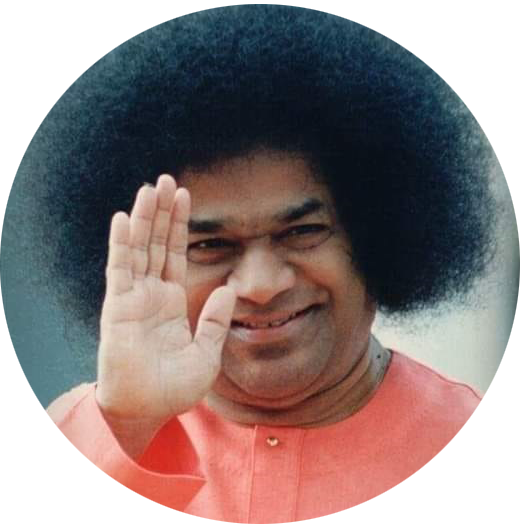
The Dharmic Challenge – Putting Sathya Sai Baba’s Teachings into Practice
Compiled & Edited by Judy Warner
Excerpts shared for educational and spiritual purposes with reverence to the author. This is a non-profit project dedicated to selfless service.
WATCH
Judy Warner
Swami tells us
to W-A-T-C-H our Words, Actions, Thoughts, Character, and Heart. This is not an
entirely new concept for me. I grew up with these high ideals. My father, a New
York State Supreme Court Judge, made obeying the law, telling the truth, and being
honest in every way a very real part of my life. I remember that my father
wouldn't even take a pack of cigarettes from a friend for fear they would want
a favour from him. As a judge's daughter, I was expected to carry on this
legacy.
Since coming
to Sathya Sai Baba, I have been shocked at myself for displaying, from time to
time, questionable behavior and, even more, for my desires to be dishonest in
quite a few situations. The amazing thing is that it is in the ashram where
these temptations are the strongest. Not at home, but right there in the Abode
of Peace! Why there, you may ask? I think it is because the need to be
physically close to Swami is so strong that I rationalize my poor behaviour. I
simply forget, when I see Him walking among us, that He is omnipresent.
On one of my
first visits to Baba, a good friend of mine was assigned to a tiny room with
six other women. When their bedding was laid out on the floor, there wasn't
even a space to walk. She was very upset and told me of her suffering. About a
week later, all of her roommates were leaving. She was very happy because they
offered to leave the room key with her without informing the office.
“Keep it,” I said. “Spend a few days on your own. The office won't know.” Within an hour, I realized what I had said. I searched the ashram until
I found her and told her, “What I said to you
was not dharmic (right action). I’m sorry. And it wasn't any of my
business either. I just got caught up in your suffering because we're friends.” Of course, she understood. I never asked her after that what she chose
to do as it had nothing to do with me. The second time I remember being
dishonest was also on one of my early trips. For the first few years, if my
husband and I couldn't get a room in the ashram to ourselves, we lived in the
village where the accommodations are more comfortable, but the vibration is not
sacred. I was never comfortable with this, but did it anyway. When we were
leaving that time, I went to the ashram accommodations office to get vibhuti.
The man asked me, “What room were you
living in?”
“R2 D6,” said I, using the number of the
ashram room my friend was staying in.
I was totally
devastated by my lying. It just flew out of my mouth. Furthermore, I didn't
even need vibhuti since Swami had given us an interview that year and
had given us many small vibhuti packets. I was upset with myself for a
long time. Finally, I realized what this lie was telling me: I had felt guilty
about living in the village and, from then on, I needed to live inside the
ashram, no matter what the accommodations.
Swami tells us
we must not be animals but first must rise to at least the human level, and
then finally to the divine. When I watch people, even those I know, jump lines
in the ashram to get in front of others, I am amazed. Seeing people do this
makes it harder for me to abide by the rules. I want to rationalize that it is
okay to do this in these circumstances and this culture. But I remind myself
that who I am today is what I will become tomorrow. I have thought many times
of jumping lines, especially during festivals when it is very crowded. I keep
hearing in my mind, “Do unto others as you
want them to do unto you,” so I try not to fall
prey to this “animal tendency.”
The procedure
before darshan is for men and women, each in their own section, to line up in
rows. Then the first person in each line draws a numbered chit out of a bag,
which determines the order that the lines go into the temple grounds. During
darshan, when Baba comes out to walk through the crowd, take letters, give
blessings, and talk with people, often people stand up, blocking those behind
them so they cannot see Him. Or they come from the back, climbing over rows of
people, to give Swami a letter. I, too, have wanted to do this. I have watched
myself for years, witnessing my own desire to think of myself first.
One morning
during the Christmas season, as large numbers of us were lining up, a woman I
know(who lives in the ashram now) was
too late to get in the regular lines. However, she wouldn't get in the late
line, where there were already about 50 people and which always goes in last.
Instead, smiling sweetly and talking in an ingratiating manner, she stood near
the seva dais (service volunteers), who wouldn't let her in to the other
lines. It was as if she felt she were more important than the other 50 waiting
women and, therefore, didn't have to be subjected to the same rules. Just as
the numbers were being picked from the bag, a seva dal noticed a woman with a
large pocketbook and told her she couldn't go into darshan with it, and to
please leave her place in line. Then she signalled to my friend and told her to
sit in this woman's place. My friend was very happy and had no apparent guilt
feelings for going ahead of 50 people. I just watched. “This is Swami's play,” I thought. “But where is truth, where is dharma?”
All of a
sudden I saw she was getting up. Her number had been picked; she would be in
the first row! I heard her say, “Thank you, Baba.” Of course, she was
right. It is all His doing. But what about the dharma on this worldly level?
When I see
behaviour like this rewarded, I find it very confusing. So confusing, in fact,
that I have given up trying to understand. I am learning slowly, very slowly,
to accept whatever happens as His play. Baba taught me a lesson that really
helped me with this.
I was in
darshan in Madras, seated toward the front but way on the side, not near the
aisle where Swami walks. I was sitting nextto an Indian woman and her
handicapped son. I offered her some vibhuti, which she took with
enthusiasm and, with abandon, she smeared it all over her son's twisted legs
and torso. We smiled happily at each other, feeling our shared love of Sai.
A hush fell
over the auditorium. Swami was walking in from the back. Suddenly, this woman
took a letter from under her sari, gestured for her son to stay, and proceeded
with great determination to climb over about 25 people to get to the centre
aisle. I watched, rivetted to her need to get Swami's help for her son. She
arrived at the centre aisle just in time to give Baba her note. I was deeply
moved. For the first time, I knew that I could not judge from the outside
whether someone was acting correctly or not. I had to stop judging and, again,
mind my own business - leaving everyone to their own dharmic choices and
challenges. I realized that there is another legacy I have inherited - the Judge! This one has to be gotten rid of! If you think I've been hard on
others, imagine how strictly I must judge myself.
The morning
darshan of New Year's Day, I was in one of the last lines to be seated. I was
stuck in the comer farthest from where Swami walks. I found a vacant chair in
that comer and thought to myself, "I might as well sit here. Maybe the
person won't come and I'll be able to see something. If she comes, wherever I
end up sitting couldn't be worse than where I'd be now." I sat comfortably
for about 20 minutes, noticing that the aisles were completely filled up, and
there was hardly a space on the ground. At 7 a.m., a ripple ran through the
crowd; Baba was coming. At exactly the same time, from the other direction, an
old woman, bent in two, was slowly moving in my direction. I wasn't sure if
this was her chair or not, but knew I would give her my seat. I immediately got
up for her.
Angry voices
shouted, “Sit down!”“Sit down!”“Down!”“What does she think she's doing?”“Where are you going?” as I tried desperately to find a place to sit - anywhere - to get out
of the. way. No one would move an inch, but they continued shouting. Finally, I
spotted a ditch near a tree and headed in that direction. A woman had her leg
stretched out with her foot resting in the ditch and, when I indicated that I
was going to stoop down while leaning against the tree, she complained
bitterly. With great reluctance and a dirty look, she removed her foot.
I remained in
that painfully cramped position, unable to see Baba, until I was sure He was
out of sight to the women's side. Barely able to struggle out of my contorted
posture, I began to move again to try and find a seat on the ground. Again
voices rose up, "Sit down!" "What are you doing?"
"She's jockeying for a better position!" I couldn't believe the fury
against me. Everyone actually believed I was looking for a better place when I
was looking for any place. Finally, an Indian woman picked up her child
and placed her on her lap, giving me a tiny space to squeeze into. I was
completely demolished, ready to burst into tears. I had ruined everyone's
darshan, and everyone had misjudged me.
Controlling my
tears I realized, “This has got to be
some lesson from Swami. I've never seen so many angry, selfish people all at
once. This must have happened for a reason.” By the end of the day, I had two incredible insights.
Just before
leaving for India, I had said to my boss at the hospice where I am bereavement
coordinator, "All the people I work with are always worried about what
their neighbours think about them. Not me." I bragged, "If I feel I
am doing the right thing, I do it. I never worry what someone will think of
me." I found out with this darshan experience just how deeply I do care
what my Sai sisters think. I was hurt and distraught that they saw me as
selfish and self-serving. It is clear to me now that I care what everyone
thinks about me, not only my neighbours but people I don't even know. Painful
as this lesson was, it was an important one.
Although I
have always listened to and been supportive of the people I work with, I never
really understood this concern. Now I do. I hope now when this issue is brought
up, I am able to have real compassion for those I am serving.
I also
realized again that you cannot judge from the outside what motivates a person.
No one saw me get up and give my seat to the old woman, so they all assumed
that I was selfish in trying to improve my position. Clearly, this was not the
case.
I have also begun to understand that when I am judging
others or myself, I am often making comparisons. I see that comparing myself to
others is a form of jealousy. If I am content with who I am, where I am placed,
would I ignore my neighbour's feelings in order to get what I want? I don't
think so. As long as I have any jealousy, I cannot be totally dharmic. As a
matter of fact, as long as I have any of the impurities 1 in me, I cannot act
in a completely dharmic manner. For instance, when I told my friend to keep the
key, I was feeling anger for her suffering. When I lied to get more vibhuti,
I was feeling greed.
Of course, it
is clear there is always something to be learned from these experiences, and it
is clear we cannot judge what is really happening. I can only judge my own
actions and be responsible for myself. It is impossible to judge the actions of
others, because there is no way to know what is motivating them.
I have
discovered that every situation where I do not act in a dharmic manner, it is
because I have been motivated by self interest.
The times when
I do something spontaneously, forgetting myself, it can be truly a perfect
action even though it may appear wrong to those watching. These are the actions
that flow from Him, not from my own needs, desires or will.
One morning at
darshan, I saw a beautiful example of this. An Australian group had been called
by Baba for an interview and were sitting on the veranda. Baba came up, looked
them over, and went into His room. This was the moment that He would have sent
any of them off the veranda if they were not to be there. All of a sudden, two
women got up and left the veranda because they realized, I learned later, that
this was not their Australian group.
Frankly, I
don't think I could have left once Swami had approved me. Too much greed! Yet
it was obvious to me they did the dharmic thing. When I look at this action, I
cannot see pride, jealousy, anger, hatred, lust, greed, or attachment of any
kind only right action that apparently flowed from Him.
At home in
Virginia, the work I do in hospice helps to keep me ever watchful. As I see
people die, it brings to mind the constant question, “Am I living my life in
the right way for me?” This means, “Am I following Swami's teachings? Am I
doing the work that is my duty? Am I doing it in the right spirit – dedicating
everything to Swami with no eye on the fruits? Is the path of active service
still my path, or should I now be leading a quieter life?” And, of course,
the age-old question, “Who am I?” Working in hospice brings these larger
questions out front for me to constantly examine.
Recently, I
had a dream in which a man was telling Swami how much he loved Him and how much
he wanted to serve Him. After a long speech to Swami, he finally asked, “What kind of service should I be doing?” Swami smiled and, indicating to
the man not to worry, said, “It is all illusion.”
I have been
thinking a lot about this. I believe Baba was saying two things to me: It
doesn't matter what you do but how you do it. And, of even greater importance,
we must get beyond these kinds of concerns and remember that we are God. The
acts we perform are just the acting out of our roles in the play of life.
Only continual
mindful awareness keeps me on the right track. It is the day-to-day challenges
that are the hardest for me, for I find it hard to be mindful all the time.
Quite often, I find myself falling back into old habits.
For instance,
remaining patient has been one of my biggest challenges. This is so important
because without patience it is impossible to act in an appropriate manner.
Swami tells us, "Patience is all the strength a man needs." When I am
working at the computer, I can get very impatient and annoyed when a program
I'm very familiar with all of a sudden won't work correctly. I can feel the
frustration rising in my stomach. I don't always overcome this frustration
immediately; I can sit there really angry. Then, somehow, exhausted from this,
I breathe and remember Swami. Then I'm able to pull back and remember that the
fruit of the work is his, not mine; and, for the moment, I am free.
“Above all, do every act as an offering to the Lord, without being elated
by success or dejected by defeat; this gives the poise and equanimity needed
for sailing through the waters of the ocean of life.”
–
Sathya Sai Baba
Judging
others, measuring what they are doing or saying as right or wrong, is still a
problem for me. Swami tell us, "All are good. If you see bad in them, it
is because there is bad in you ... " This judging of others happens
particularly with those I am closest to and therefore most attached to. An
example is that when my husband sometimes wants to watch a violent movie on TV,
I find my mind running a mile a minute. “How can he watch all that violence?
Baba says we must be careful what we put into our minds, and this is rubbish.
How can he not listen to Swami about this? What kind of devotee is he really?”
On and on these thoughts go. This serves no purpose other than to close out the
love I feel for him. And who am I to judge him anyway? Maybe he is detached
enough that he doesn't get affected by violence as I do. He has his own path
that is different from mine. After all, doesn't Swami know what he's doing?! I
have come to see that what I need at these moments is, first, to have
forgiveness and compassion for myself for making this judgment. Then,
automatically, I find that my love, compassion, and forgiveness return. What I
do now, the minute I see my mind go into a critical mode, is make myself move
to my heart, the place where there can be no judgment, only love and
compassion. This works! But it takes a watchful eye and a certain amount of
detachment.
Another trap I
fall into all too often is thinking, “I'm the doer.”
Krishna
proclaimed to Arjuna in the BhagavadGita, "Arjuna, you are only
instrumental in the propagation of my message. You are just an instrument in my
hands." This sense that' I am the doer happens in many areas. For instance
in my editing work, I can get attached to doing something my way. For example,
I want a story to be expanded as I want and in the way I want, and other
portions to be deleted that I don't think are relevant. My need to be in
control becomes paramount, so much so that, sometimes, I become overbearing.
The more out of control I feel, the more control I want. Now that I understand
this pattern, almost the moment I get bossy, I can stop. I think to myself, “I must be feeling out of control. That's why I'm acting like this.” Later, I realize, “Who is in control
anyhow? Swami, Not me.” I still fall into
the trap, but as time goes on, I am getting out faster.
I have learned
over the years that in order to have spiritual clarity, I must have a good deal
of my emotional agenda worked out. This is a never-ending process, but with the
help of the spiritual viewpoint, the emotions can be seen and experienced in a different
light. We can see everything as "grist for the mill" rather than only
as pain and suffering.
A few months
ago, I realized that I couldn't really listen to my clients at the hospice. I
was feeling sleepy during the appointments. Their pain was reflecting my own
and, therefore, sticking to me. This had never happened before, so I knew I had
to deal with whatever was going on inside of me. I'm not one to let things go
on for long; I'd rather meet the situation head on and go through the pain in
order to come out feeling alive and clear again. After a lot of deep work, I
felt centered and able to listen to my clients again without having their pain
affect me. I have always felt that my ability to be able to do this hospice
work is all Swami's grace. My small self could never listen to all the pain,
suffering, grief, and rage that I hear. Swami makes me stay clear and centered
and focussed on His presence in order to do His work.
It has become
clearer and clearer to me that being impatient, judgmental or feeling that I am
the doer, or having any form of selfishness, makes it impossible to be a
dharmic person. That is why it is so important to be ever aware and mindful.
How wonderful
that Swami makes us see every impurity of ours. In telling us to WATCH our
words, actions, thoughts, character, and heart, He makes us be meticulous
witnesses to ourselves. Then, He requires that we note our faults, let them go,
don't repeat them and, ultimately, forgive and love ourselves despite our
imperfections. Then, we can also love others. Hopefully, we can eventually
experience that we are God, and knowing this will make us see, as Swami said in
my dream, “It is all illusion.” This is a huge task. But what a wonderful gift to be given - to undergo
all these challenges at the feet of our beloved Sai.