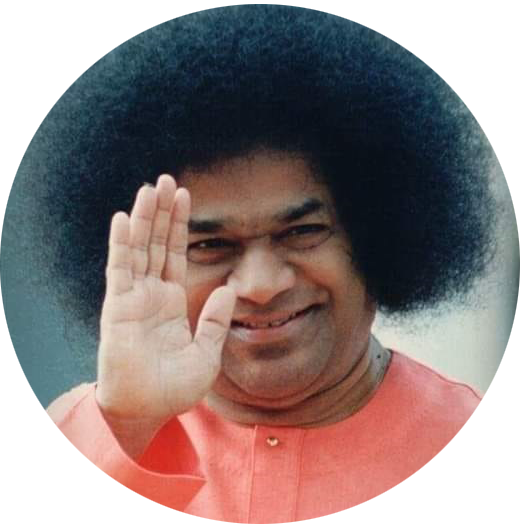
The Dharmic Challenge – Putting Sathya Sai Baba’s
Teachings into Practice
Compiled & Edited by Judy Warner
Excerpts shared for educational and spiritual purposes
with reverence to the author. This is a non-profit project dedicated to
selfless service.
THROUGH DHARMIC DILEMMAS
Lt. Gen. (Retd.) M.L. Chibber, Ph.D.,
Dr. (Mrs.) R. Chibber
“Let every human being remake himself. Let us understand that we live
not for money-making, no for fulfilling our wants, not for scholarly and
intellectual talents, but for spiritual development.” – Sri Sathya Sai Baba
It was a dharmic
dilemma that brought us to Sai Baba in 1979. The dilemma, perhaps, was just an
excuse. The time had come for us to be eligible to receive His direct guidance
in understanding the purpose of human birth. I realized this when I once
grumbled to Swami in 1989 about the fact that I had been in Bangalore in
1945-46 at the Army Officers Training School. We complained, “Swami, why did
you not let us come to you then?” With a twinkle in His eyes, all He said was, “Yes,
yes, I used to see you from a distance!”
We have been
spiritually inclined since our childhood. We inherited this tendency from our
parents. After Rameshi and I were married and had children, we would spend our
leave trekking to places like Amarnath, Gangotri, Badrinath, and Rishikesh in
the Himalayas. We also visited shrines of all the faiths of India. We went to
virtually all the learned gurus in the country. We did derive much benefit. Our
faith in the power called God, symbolized by Lord Shiva, was reinforced. But
there was something lacking.
When we look
back on the decades until 1979, when Baba finally called us, we find that
whenever we prayed ardently to Lord Shiva, we invariably got whatever we asked
for. But then our prayers were for mundane worldly things. I now understand why
Swami did not create the opportunity for me to go to him in 1945-46, or for
that matter in 1974 when he visited Amristar and I was commanding the
Army Division there. Obviously, we were not yet ready for the spiritual
education Swami imparts.
In 1979, I was
promoted to the rank of Lieutenant General and placed in command of the
country's counter-offensive force. It is a most satisfying job for a
professional soldier to lead a force of 200,000 men and all the military
hardware needed for a rapid and effective counter-strike in case India was
attacked.
Knowing our
interest in spiritual matters, a staff officer in my headquarters gave me a
copy of Howard Murphet's book Sai Baba, Man of Miracles. My wife also
got another book from her brother. When we look back, we realize that our time
to come to Swami had finally arrived. We faced two dilemmas, two acts written
by the Author in the drama we call life.
The first was
related to improving leadership in my counteroffensive force. This triggered
research. Fifteen years of long quest, trials, and experimentation culminated
in a book I wrote entitled Sai Baba's Mahavakya on Leadership. 1When
Baba wrote the Foreword and the Afterword for the book, I realized the working
of His guiding hand through those fifteen years of endeavor. This first dilemma
was based on my ignorance that I (the versatile commander!) could
"fix" the problem of improving leadership. Not knowing that effective
leadership is a byproduct of spiritual growth, I felt at a loss when faced with
the marginal results of my efforts in this field. I did not know whether to
give up the effort or to continue. The puppeteer (Swami) anonymously made me continue.
The second
dilemma related to my being appointed to a high powered committee to revise the
parameters for higher command in the Indian Army. It is this second problem
which developed into a serious dharmic dilemma[1]. A person has his dharma as a human being, a son, a mother, a father, a
brother, a sister, a spouse, a worker, a friend, a leader, a citizen, and so
on. Dharma implies that a person has only duties and obligations. As Swami so
often explains, rights flow out automatically from one's dharma well-performed.
There are absolutely no rights divorced from duties and obligations in
the Indian spiritual and cultural heritage. The words of Swami on this score
are categorical and unambiguous:
I realized
this when I once grumbled to Swami in 1989 about the fact that I had been in
Bangalore in 1945-46 at the Army Officers Training School.The dilemma
arose from the unwritten purpose of the committee to which I had been
appointed. It was informally conveyed to us that we were to dilute the very
stringent standards laid down for selection for higher command appointments in
the Army. There was clamor from the officers in the Army to make it easy, and
the then-hierarchy of the Army was merely responding to this demand. To give
respectability to this step, a committee of five professionals with good
reputation had been appointed.
The history of
war has repeatedly taught a lesson: If you dilute your higher command, you
build a disaster in war. However, Army hierarchies repeatedly succumb to
pressures and erode the parameters, which should stay inflexible. Dilution
normally occurs during long spells of peace.
When the committee met, it was clear that three members were fully in tune with the unwritten purpose of the committee. One was
silent. I expressed my reservations against the dilution but agreed to examine
the statistics and other inputs that had a bearing on the problem. In a series
of meetings, a vast plethora of figures was presented by whiz-kids. Listening
to the statistical acrobatics, I recalled my eminent professor of mathematics
in college. He started the class on
statistics by a quip, “There are lies, damned lies, and there are
statistics!” By the sixth meeting, the member who was acting as secretary had
prepared the draft report. Its conclusion was that the committee unanimously
recommended all the dilution measures that the Army hierarchy desired. I flatly said that it was not
possible for me to sign a report that in the long run could result in a
setback in war. I explained to them the recent British experience between World
War I and World war II. The British had diluted their criteria and the result
was that "intelligent, hardworking, and pliable officers" forged
ahead. Most of the battle disasters in the first two years of World War Il that
the British suffered were largely due to this fact. Intelligent but pliable
officers, unfortunately, do not win battles;
character invariably beats cleverness. The meeting was adjourned.
Aftera few days, it was
discreetly conveyed to me that either I sign the report or else it would be the
end of my military career. Here was a first-rate dilemma: In the remaining six
years of my service I could most certainly rise up to be Commander-in-Chief of
one of the regional armies in India; or I could be ignominiously vanquished.
The dilemma was extremely distressing. Should I choose what is best for my career or should I perform my dharma?
About seventeen years earlier, I bad faced a similar
situation when I was a major. The
then-Chief of General Staff of the Army got extremely upset with
something I bad recommended. Reading between
the lines of my note, he felt I was casting aspersions on his courage. I
was marched up before him. He fretted and fumed and ended his ranting with the
words, "I will have you thrown out of the Army!" I was a bit
surprised that he should perceive a meaning that I had not at all intended. I
had just returned from a year's training at the Staff College in England and
was on the fast track for advancement in the Army, and now I was on the brink
of being terminated for something very trivial. I was certainly worried. So, I
went home and shared the problem with my wife. She was a pillar of strength.
She is a medical doctor and she said, “Don't worry, I will set up a medical
clinic and, if you help me, we will have a roaring practice.” Then she added
with some amusement, “Even though I know fully well that you will do the
roaring and I will do the practice!” Fortunately, some well-wishers intervened
to explain the truth to the Chief of General Staff and the storm blew over. So,
I knew my wife would be with me when I faced this new dharmic dilemma.
It was at this
time that Swami came into our lives in a big way. Reading Howard Murphet's book
was a great eye-opener. Then, with the help of the Sai Samithi, my staff
officer assisted my wife in arranging a bhajan in the Army House. The
vibrations, the disciplined precision, and the love pouring out of Sai brothers
and sisters who helped in this bhajan conveyed to us that we had, at last,
found the way home.
The dilemma I
was facing became a small routine problem. I wrote out a well-argued and strong
dissenting note for the report and sent it off to Army Headquarters. A sense of
great relief and joy for having done my dharma engulfed me. I forgot all about
the problem and got busy training my force.
Then things
started happening. We felt Swami's instant help in various mundane problems.
But the biggest surprise was that I was selected to become the Adjutant General
of the Indian Army. I instinctively knew the divine hand was in this
development. Within two weeks of taking over this crucial appointment, and at
my wife's determined insistence, we flew down to Bangalore and drove to
Prasanthi Nilayam for Swami's darshan. This was our first, and a most
elevating, visit to Swami. The impact that the sarva dharma logo carved
on Swami's door made on me culminated in the establishment of the Army
Institute of National Integration, which offers training programs to
familiarize Army officials with the rudimentary teachings of all faiths. The
Institute is helping enormously in a multi-religious, multi-ethnic, and
multi-lingual country. Lots of wars have been fought in the world due to
ignorance of this inherent harmony. It took four years to get this implemented,
but whatever Swami inspires, eventually succeeds.
Swami also
granted us an interview. He materialized a medallion and asked me to always
keep it with me: "It will protect you." Only after a few years did I
fully comprehend the meaning of this simple sentence spoken so casually.
As the
Commander-in-Chief of India's Northern Command, I had a fairly hectic three
years of no-war-no-peace involvement in various small and big local operations
and battles. After retiring from the Army, we once again visited Swami. I had
already picked up from the market a stainless steel ring with Swami's portrait
on it. During an interview He noticed the ring and asked, "Where did you
get this ring from?" I replied that I had bought it in the market. He told
me to take it off, and it was passed around to all the devotees. When it
finally reached Baba, He blew on it, and it became a beautiful silver ring
which He put on my finger. At this moment, my wife intervened. She was sitting
very close to Baba. She said, "Swami, you, are very partial to men. A few
years back you gave him a medallion and now you have given him a ring. I am the
one who brought him to you and you have given me nothing." Having said
this, she took off her simple marriage ring and held it out to Baba. He smiled
and said, "Wait, wait."
Later, when we
went to the inner interview room, Baba was oozing with love. Placing His hand
on my wife's head like a loving father, He said, "I have already made you
a sumangali, what more do you want?" She understood, but I did not
have the slightest idea what the Sanskrit word sumangali meant.
That evening
while waiting in the darshan line, I asked some of the older devotees the
meaning of the word and told them the story of the interview. They were amused
at my ignorance and explained to me, “Swami must have postponed your 'going up'
to prevent your wife from becoming a widow.” It was then that numerous
incidents during operations when I could have been blown to pieces flashed
across my mind. I remembered how He had given me the silver medallion with such
a casual remark, "It will protect you."
Two days
later, much to the joy of my wife, Swami materialized diamond earrings for her.
While Swami was putting them in her ears, she quipped, “Swami, this Army guy
never gave me any diamonds!” To this, Swami replied, “You must understand the
meaning of diamond. It means die-mind.” Then with a mischievous twinkle in His
eyes, He looked at me and inquired, "Are you feeling jealous because I
have given diamonds to your wife and only silver to you?" I said I was
quite happy with whatever He gave me. "No, no, give your ring." After
the ring was passed around among the devotees, He blew on it and it became gold
with His beautiful portrait. Later, in the private interview room, He asked me
with some concern if I would rather have stones in the ring instead of the
portrait. Of course I was more than happy with what I already had.
Swami gives us
this demonstration of converting energy into matter (like vibhuti and
trinkets) and on occasions, reconverting matter back into energy, for a
purpose. It is to help us understand that He and we are all divine. Once this
understanding dawns on us and we move toward experiencing our reality, then we
do not have to make an effort to live a dharmic life; it will come naturally to
us.
His therapy is
different for each one of us. It is based on the balance sheet of karma and
on the level to which each one of us has evolved. But the goal of the therapy
is the same for all of us: to understand our reality and then help us
experience it, to help us grow and be what we really are - divine. Swami has
very clearly explained it:
“Transmuting "man" into "God" and experiencing that
ananda and bliss is the one and only achievement for which life is to be
devoted.”
–
Sri Sathya Sai
It was almost
ten years after we came to Him that He decided to give me the major dose of
spiritual therapy. He called us for an interview. It was the usual group of
about 25 people. After distributing vibhuti to the ladies, He sat down
on His chair. Then He looked me straight in the eyes and said,
"Spirituality is very easy. All you have to do is to understand and then
experience that 'I am I." I nearly hit the roof. He made it sound so
simple, whereas saints and sages have spent lifetimes in penance. I was also
foggy about the real meaning of "I am I" Then He went on to explain, “If
you think you are Ramaya or Ratan Lal or Chibber, then you are deluded.”
Every act of Swami has a deep meaning. When He gives a therapy, He also
arranges for help. Slowly, step by step, we were helped during the next few
years to comprehend the deeper meaning of “I am I.” Swami in His
various incarnations had tried to teach this fundamental truth to mankind: all
that we perceive is the temporary projection of the one formless reality which
is omnipresent, omnipotent, and omniscient. It is this truth that has been
articulated thus:
I am that I amis the Biblical articulation; I and my Father are
one, said Jesus;
Ik Onkar (All is One), said Guru Nanak;
Annal Haq (I am the Truth), articulated a Muslim Saint,
Mansur Al Hajj of Baghdad;
So Ham (I am That), the Perennial
Philosophy; in Sanskrit termed the Sanathana Dharma. Even today, with
information technology at its height, we are still having difficulty
comprehending this basic truth. Without this basic understanding, our attempts
to live a dharmic life become a struggle at best or a mere slogan at worst I
recall an interview with Swami which we had the good fortune of having with Dr.
John Hislop' and his wife. Swami was, as usual, in His expansive and loving
mood. He asked John if he was facing any problems in America. “Yes, Swami, how
to satisfy devotees who want proof that you are God.” Swami looked at John for
a moment and said, “I am love; tell them that.” He had summarized
His famous advice:
“Duty without love is deplorable. Duty with love is desirable. Love
without duty is Divine. Duty implies force or compulsion while love is
spontaneous and expresses itself without external promptings.”
–
Sathya Sai Baba
There is,
however, a linked problem. It is difficult enough to believe that Swami is God,
but the truth that we are also God is incomprehensible to many of us. Yet Swami
repeatedly tells us that not only He, but each one of us is divine.
There are numerous devotees who are highly evolved and understand this truth
and live their lives the way divine life should be lived. But there are also a
large number, like me, who are a bit foggy about all these higher philosophical
assertions. It is for this reason that in almost every discourse by Swami, He
emphasizes that everything is a form of God; that everyone is divine; that all
is one. In spite of all of this, the main spiritual questions that aspirants
ask are directly or indirectly related to this fundamental truth. Repeatedly,
these questions come up for discussion during the daily lectures that are
organized for devotees at Prasanthi Nilayam and Brindavan. When we carefully
read Swami's discourses, we notice that, again and again, He makes three
declarations to drive home this fundamental truth. In fact, He very often
reiterates these declarations even during interviews.
The first
declaration is "I am always with you. I am all around you. I am on your
right, on your left, in front of you, behind you, above you and below
you." Many people understand the import of this declaration, but then
there are others who start wondering: Swami certainly has a very extensive aura
and what He says would be true when we are in Prasanthi or Brindavan, but how
is it possible when we go back to Delhi, New York, Tokyo or Rio? The doubt
lingers on.
The second declaration He makes is “you are in Me and I am in you.”
Again, to many of us, this assertion causes confusion. We wonder, how can this
be possible? I remember an incident in April 1993 in Kodaikanal. That year was
a time for the overseas devotees. Almost every single day, Swami gave a
discourse, and He had instructed that priority should be given to overseas
devotees for entering into the small hall. A tall American became friendly with
me. We would discuss spirituality, dharma, ethics while waiting long
hours on the darshan lines. One day, Swami repeated this declaration. When we
were leaving after the discourse, this American tapped me on the shoulder and
said, “General, I don't get this. How on earth could I be in Swami and He in
me? I am seven feet tall and Swami is just over five.” All I could say was,
“Oh, Ted, He was talking spiritually.” But what was the spiritual
message in this declaration? I had no crystal clear comprehension.
The third
declaration He makes causes the maximum confusion in the minds of many of us.
He looks you straight slowly and very, very deliberately, “You are God. I am
God, so are you. We are one.” I spent a good deal of my adult life looking
for God in the form of Shiva in the Himalayan peaks and shrines. Many of us
imagine God sitting somewhere up in heaven with His supercomputer, punching in
every good or bad deed of ours. Then He eventually decides if we will go to
heaven or burn in hell. And here is Swami telling us, “You are God.” It
shatters all our paradigms. Swami, in His compassion, asked my wife and me to
stay on near Him for almost a whole year in 1993. It gave us time to
contemplate these declarations. I realized how ardently and desperately many of
us were trying to understand and experience these basic truths that Swami
conveys. He also explains to us that these declarations are meant to “put you
on the direct flight to your destination.”
The supreme
dharma of a human being is to move to our destination, to return permanently to
our source. But we have to be perfectly clear: What is our destination? What is
our source? Swami gives us crystal clear directions:
“Destroy the identification of the self with the body. Get firm in the
belief that all this is Paramatma and nothing else. There is nothing else to be
done except bowing to His Will and surrendering to His Plan. This is the sum of
your duty. Your primary duty should be to become the masters of yourselves, to
hold intimate and constant communion with the Divine that is in you as well as
in the universe of which you are a part.” – Sathya Sai Baba
When we pray
to Swami for guidance, He invariably responds. I would like to share the
experience of how He resolved my dilemma on these three fundamental
declarations.
It all
happened in August 1993. I was to interact with the devotees during the
lectures that were part of the daily routine. I felt an inner compulsion to
focus on these three declarations. But how? I did not know.
Two days
before I was due to speak, I woke up, as usual, very early in the morning in
the guest house in Brindavan. Sitting in bed for contemplation, I prayed to
Baba: "Swami, do please guide me to explain your three declarations in
some simple way, so simple that even a' slow kid' like me would
understand." Having thus prayed, I turned around in my bed to face Baba's
house, Trayee, as if Swami's presence was confined to that little building!
That is what the force of habit does to us. I sat quietly, I do not know for
how long. Suddenly, like a flash, Swami put a thought into my mind - ice
cubes. It was another riddle. What had ice cubes to do with divinity? I was
completely confused. But then, over the years, I learned that when I am stuck
and pray to Swami, “Please handle it, Baba, I just cannot,” He shows the way.
[1]The best explanation
of dharma for me was by a Polish lady journalist, Taya Zinkin. After
working in India for a few decades she built the meaning of dharma into her
description of a true gentleman, a sthithprajnya (a person of steady
wisdom as described in the BhagavadGita). To practice dharma is to “have
a sense of duties and obligations of one's position whatever it may be.”