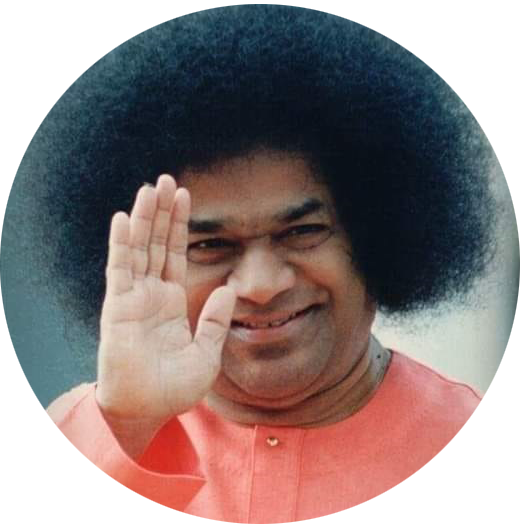
Transformation of the Heart
Stories by Devotees of Sathya Sai Baba - Compiled and edited by Judy Warner
Excerpts shared for educational and spiritual purposes with reverence to the author. This is a non-profit project dedicated to selfless service.
CAN GOD HEAR ME?
Jack Scher
When I was a little boy they told me, "Be good or
God will punish you; God is watching you all the time. He can see everything
you do; you can't hide from him." They told me he looked like a man, but
you couldn't see him. I thought he had to be very large, big enough to see
everyone on earth, very strong to be so powerful because he could do anything,
and very old to be so wise.
They said, “Close your eyes and pray to him.” So, I
got the idea that it really wasn't important to see him. It seemed as if
praying was like making a big or very special wish. First, you had to ask for
forgiveness; you had to say you were sorry for all the bad things you had done.
I would name the few that I remembered and then ask for forgiveness for all my
other sins.
The good part about praying was being able to ask for anything
that you wanted. I would lie in my bed and think about all the things I would
like to have and then ask for them. If there was something I wanted more than
anything else, I would get down on my knees and clasp my hands together. I
wasn't even very disappointed when nothing seemed to happen; I would just
continue to hope and pray and ask for more.
Somewhere I got the idea that asking for things just
for myself was wrong. So I would pray to God to bless my mother, my father, and
the whole family. In that way I was included. I went on like this for years.
Praying became something I had to do before sleep. I had to do it just in case
it might work and also to protect myself if there really was a God watching.
My father was an orthodox Jew. He took me to the local
shul where the women sat upstairs. The men sat below with their little
black skull caps and silk striped tallithim. They rocked back and forth,
moaning their prayers in some low, foreign, rhythmic cadence. There was nothing
I could understand, but I knew it was important to be in the temple, just like
making sure to say my prayers each night.
My father died suddenly when I was 5. Many men came to
the house to say kaddish. I was given a book, a skull cap and tallith,
told to face east and pray: Shma Yisroel Adaunai Eloheynu... Repeating
the magic words I thought something special might happen; but God did not come,
nor did my father.
Three years later my mother remarried and was
paralyzed by polio. My stepfather was a Christian Scientist, and he believed it
would help my mother if I went to his church. Here they taught me about Mary
Baker Eddy and the Ten Commandments and how to sing “Onward Christian Soldiers.”
My mother had a Christian Science nurse plus a little old lady dressed in black
who would come to the house to read the Bible to her. But their prayers were
never answered. My mother remained paralyzed from the waist down until her
death twenty years later.
My Aunt Bertha was a potential source of spiritual
guidance. She had a doctorate in philosophy and lectured coast to coast about
the “Oneness of God.” She had a large following during the 1930's, particularly
among women's groups. She wrote a number of books. I remember one called
Joseph, He Has Never Left Us. It was dedicated to my father, her brother. The
cover had a picture of a naked man crouching in the distance with a spiral of
smoke rising from the top of his head and going up into the sky. My parents
thought she was crazy, and I was forbidden to see her because she made it
clear 'that she didn't approve of my mother's new marriage. I continued to
meet her in secret because she was the only person I had ever known who loved
me unconditionally. However, I never was interested in, or followed, her
teachings.
I grew up then without any real concern or belief in
God. When I got to college, I was briefly interested in understanding how the
world began. There were three basic arguments or propositions:
1. The world always was and always will be.
This was impossible. Surely there must have been a
time before the world began.
2. The world started itself, and it is finite, or it goes on forever.
This was also impossible. The world had to start
itself with something, and where did that “something” come from?
3. The world was started by an outside source, probably divine and
therefore unknowable.
Another impossibility. If God started the world, where
did he come from? Who or what started him?
I learned that when you have several arguments of
equal impossibility, you use Occum's law of the razor. You choose the simplest.
I was never satisfied with the concept that the world always was, nor was I happy with a
belief in a God whose existence was impossible to prove and depended entirely upon
blind faith!
By the time I graduated from college, all thoughts of
God had receded to an unconscious level. Perhaps because of this loss, I had an
overwhelming fear of dying. Without God, my death meant total obliteration. The
idea that I would never breathe, feel, see, touch--or more importantly, know
myself again, consumed me with an unrelenting fear that fed on itself No one
else seemed to have my degree of concern. Yes, they knew in the end they would
die and that there would be nothing left, but since there isn't anything that
you can do about it, you might as well forget it and concentrate on the
present.
I remember our day is of time, of hours – and the
clock hand turns, closes the circle upon us: and black time-less night sucks us
in like quicksand, receives us totally-without a raincheck or a parachute, a
key to heaven or the last long look.[1]
Psychotherapy didn't help. The therapist said my fear
was due to the fact that I wasn't getting enough out of life, that the fear
would go when I became more involved in living. Then there wouldn't be any time
to think about dying.
The best consolation my psychiatrist could offer were
the tales of the Kalahari. This nomadic African tribe is constantly on the
move. When their people get too old to travel, they voluntarily stay behind
knowing they face certain death from starvation. As the old people sit and wait
to die, they somehow make their peace with this earth life . . . and their eyes
tum blue like the sky above them.
I tried to accept that we are here for just one brief
moment. My goal was to live each day fully, try to be happy and, above all,
make a lot of money. My fear of death took a back seat. It only surfaced when I
was sick, had a pain of unknown origin, or learned that someone I knew had
died.
Within twelve years I had become one of the best paid
medical advertising space salesmen. I was married and had three children. At
age 39 I decided to quit my lucrative job and try to become a publisher. Life
seemed too short to live and die just to make money. The whole experience was
like a dream; one successful medical newspaper followed another; I was listed
in Who's Who and became a millionaire. My only problem was I still didn't
believe in myself It took years of psychoanalysis to finally accept that I
hadn't fooled anyone, that I won because I worked hard and was good at what I
did.
When I was 19, I promised myself that if I ever really
made it in this world, I wouldn't hang in there trying to have more money or
more success. Instead, I would quit and enjoy it. At age 49 I sold the company
and was completely free to do anything I wanted.
In 1976, five years after my divorce, I met Judy, the
woman who is the love of my life. For seven years we played at discovering
what the world has i:o offer. I thought I was very happy, but I was drinking
too much and smoking too much marijuana. I left New York, built a beautiful
geodesic dome in Virginia, and started doing research in parapsychology. I
thought I had everything I needed except, perhaps, eternal life!
I took several courses at the Monroe Institute in an
attempt to have an “out of the body” experience. If I could only get out, this
would prove that I was more than my physical body. I didn't make it; but
somehow in the process, I started to be more open. I realized the only way I
could continue to grow was to suspend judgment; and the people who did get out
seemed to have similar experiences: Love is the answer to everything, and we
are energy personalities incarnating for the purpose of growth and exploration.
A whole series of synchronistic events began to disassemble and restructure my
belief systems. Reading Seth, reports of near death experiences, chance
meetings with healers, channels, people with spiritual guides-I was surrounded
and I liked it.
I first heard about Sai Baba from a friend who is a
psychic healer. She had several of his pictures around the house. She said he
was her Master. I never asked her any questions. Another time she gave a dinner
party where I met a man who had just returned from Baba's ashram. Again, I
didn't even ask who he was. Clearly, I wasn't ready. They say the only people
who come to Baba are those whom he has called.
In October 1984, Judy and I picked up two Baba books:
Sai Baba, The Holy Mari and the Psychiatrist, by Sam Sandweiss, and Avatar, by
Howard Murphet. We were both more than enthusiastic to make India our next
trip. Judy, while happy with her life, yearned to feel connected to the God
force. I liked the descriptions of Baba's Christ-like existence and the
miracles. My casual thought was if someone like Jesus was really alive and
walking the earth, then what could be better than checking him out.
I felt some trepidation before we left. I loved what I
had read about Baba, but he had so many rules: “Do Good, See Good, Be Good”;
“Work is Worship”; “Duty, Devotion...” I kept finding it difficult to remember
the word “Discipline”!· I was afraid; I really didn't think Baba was God, but
suppose he was and he captured me? I'd have to do all those things... “Watch my
Words, my Actions, my Deeds.” My whole life would change.
Just before we left, I saw Baba in a dream. He looked
at me very sternly, and in a deep. voice said, "What do you want?" I
said that I wanted to know that death is not the end after that I will have a
continuing awareness of myself after death.
To say that life in Baba's ashram is austere reflects
a newly found gentleness in my thinking. I was angry, hopeful, disappointed,
fascinated, and sometimes very lonely. Most of all I wanted a personal
interview. I longed for Baba to tell me things about myself that would prove to
me that he was God. Each day, twice a day, I would line up and wait. Whenever I
was lucky enough to sit in the first row, my fatigue fell away, and the trees
seemed to_ sway and dance in the breeze. Baba would come so close I could reach
out and touch him, but he never even looked at me. I watched as eager devotees
grabbed at his footprints in the sand, joyfully throwing the holy sand on their
hair, heads and children; and some, even eating it. What did I have to lose? I
sprinkled some on my head too.
Judy tried unsuccessfully to be helpful. "Baba
knows what is best; perhaps you just aren't ready for an interview." This
kind of talk was infuriating. Everyone always had positive answers as to why
things didn't go the way I wanted.
I saw the Australians with their green and white
scarves, the Argentines all dressed in pale green, the Nepalese all wearing
their funny little hats. It seemed that groups had the best chance for an
interview. We even considered forming a group of lone Americans.
I tried the mandir. The vibrational sounds from the
bhajans are supposed to transport and nourish the soul. Instead, I sat there
all scrunched up, knees and bodies prodding me from every direction. The walls
were lined with statues of animals and pagan looking gods, huge life-size
pictures of Baba and Shirdi Baba framed in gold looking down at us, and hanging
overhead were several giant hotel chandeliers. I was surrounded by a sea of
shiny black heads all singing, clapping, and joyously chanting their hymns to
the Lord. Why weren't they all Jews, singing Jewish songs?
Baba sat there on a red throne, his hand keeping a
rhythmic beat to, the sound. In my agony, with all the heat, I looked at him
and smiled. He was only 59, one year older than I was and he had some twenty
million followers. If he wasn't God, he certainly was doing well!
Later that night I met Jon Gilbert. I had first heard
about him in Murphet's book. Jon's story was particularly moving and meaningful
to me. Most of Murphet's-reports of Baba's miracles related to Indians. Here
was Jon, an angry Jewish boy from New York (like me), who had been miraculously
cured by Baba. Jon told us that he had ·gotten sick again and. had returned to
the ashram. Baba was helping him, but he was also taking some medication. He
said he had volunteered for work in the kitchen pulling bean sprouts. He would
say “Sairam” each time he pulled a sprout. Baba says that repeating the name of
the Lord is a short cut to divinity.
I was shocked to find Jon looking so pale and deathly
thin, saddened to find him back here and sick again, confused because it seemed
that Baba had failed him. When I told him about my mandir experience, he was
sympathetic. He smiled gently and asked me if I had met Drucker. “Look for Drucker;
you're going to like him.”
He was right. Drucker is a God intoxicated man; his
love for the Lord is infectious. Drucker said, “Don't waste your time here
trying to figure out if Baba is divine; look for the divinity in yourself First you must have
faith in God and then you may have an experience. Many people come here and
feel nothing at darshan and go home with nothing. They are looking for the
experience first, then they will believe. You must have faith first. Jump in
with both feet.”
Drucker was a turning point for me. The magic of the
place started to take hold. I would sit smoking outside the main gate watching the beautiful
beggar children play, the roosters on top of the laundry shed, the funky cafes,
the goats, cows, bullocks, donkeys, and hairless dogs wandering the street. The
little souvenir store shacks lit at night by a bare bulb, all blaring out
Indian bhajan-like music. Surely this must have been the way it was two
thousand years ago.
Finally, Baba came by at darshan and not only looked at me, but in a stern
voice asked, “Where are you from?” I was so shocked I blurted out “New York,”
instead of Virginia. He just nodded and stopped again nearby asking another man
the same question. The man said, “El Salvador,” and Baba beckoned him to go for
an interview. I thought, “Well, he probably needs it more than I do.”
Another time Baba stopped in front of· me and I gently
reached out and touched his foot. It just felt smooth and warm, but no great
rushes of feeling or revelation came. He even took one of my letters, but the
only miracle I saw was his constant manifesting of vibhuti. I saw many
people who had rings and pendants that Baba had made; they all had wonderful
stories.
One personal leela from Baba was my discovery
that during bhajans I could close my eyes and suddenly the whole scene I had
been watching turned into beautiful shades of intense rose, pink, mauve and
orange. At first, I thought it was an after-image, but the scene kept changing.
The audience would fade, and I'd see huge palaces with gigantic walls and
turrets. When Baba came outside, I could close my eyes and the whole scene
would turn into a soft and yet vivid pink. He lit the sky with his presence.
I also started to see an eye. It would suddenly appear
in front of my closed vision, sort of between my real eyes. I found that I
could bring it in so close I could see the capillaries. I would stare at the
pupil, looking for a message from the Lord. Is God watching me? The eye looked
very familiar, the shape, the lines... yes, it was my very own. It was
comforting. I had a new friend and focus for meditation.
One day at darshan I saw Drucker in the distance
tending to a sick man on a stretcher. I strained but couldn't see who he was.
Nervously I looked around for Jon Gilbert, but he wasn't in sight. Baba came
by, stopped, chatted with Drucker, and then moved on. A group of men I
recognized then came up to Drucker and together they carried the man out.
Later I learned that Jon had died. I was told that he had a beautiful death;
all of his friends gathered round his bed chanting “Sai Ram.” Jon died with a
gentle smile on his face.
Tears welled up in my eyes; I cried uncontrollably.
How could Baba let him die? How could death be beautiful? Judy said later, “You
don't know about Jon. You don't understand what happened in his life or about
his past lives.”
I sobbed, “No I don't, but I do know Jon wanted to live; that's why he
was here; that's why he said one thousand Sairams a day every time he picked a
bean sprout. Certainly he had karma; he was in a lot of pain, but he wanted to
stay alive and pay his dues. If Baba is God, why didn't he let him live? I am
tired of all these Indian miracles. I'm not going to read the books anymore.
I'm fed up.”
There was a funeral service. The people who knew Jon
met at the Ganesha Gate. Drucker led the procession out of town, men and women
walked separately, all carrying incense. Drucker and the bookstore man, Burt,
chanted the vedas. I liked their deep awesome sound; it reminded me of
Jews dovening.
We walked to the grave site, a deep hole in the sandy
dry riverbed. I was startled to see that I knew most of the people who were
there. I stood next to Massimo. He once gave a stranger his place in the first
row at darshan. There was Robin, a man I used to watch play with his beautiful
young blond son. So many faces that I had met or watched during these past
weeks all people I had written about in my journal.
The heat was unbearable. Drucker put on a gold and
white yarmulke. He said we were there, not to mourn Jon, but to celebrate the
Lord. He told how Jon had come as an angry young man in 1973, a terminal case
with Hodgkin's Disease, how Baba had cared for him and given him eleven more
years to develop spiritually. We said kaddish and sang Jewish songs; and
Drucker passed around Jon's vibhuti box which was filled with Jon's
ashes. One by one we sprinkled them into the gaping hole in the ground.
That night, in the middle of the night, I woke up
suddenly. I could see Drucker with that gold yarmulke on his head. I asked
myself, "How often does a man die here? How often does a man die here and
have a Jewish funeral? How often does Drucker, a man I know, conduct the
ceremony? How often does a man die here that I know!" At that moment all
of the faces of all the people from the funeral suddenly came to life like
characters in a movie. I sobbed with joy. This was Baba's divinity play. Baba knows
me. He cares. He orchestrated the whole scenario for my learning, for my
benefit, so that I could understand and lose my fear of death.
I felt, at last, I had made a dent in my protective
armor.
There were even moments when I thought Baba was God;
but in the next instant I would ask myself, “How could God's eyes be bloodshot?
He coughs, he sweats...”
Kasturi says that Baba likes to chum us up. Baba likes
butter. The only way you get butter from milk is to chum.
As we left Puttaparthi, I was feeling very clean after
being. without marijuana and alcohol for almost a month. No promises: I didn't
even tell Judy; I thought I would just see how it felt to go without them for a
while. We stopped off in Hawaii and stayed at a beautiful beach resort where I
would normally start drinking before noon. I used to have at least two or three
ve1y large drinks before dinner, then a half bottle of wine with my meal
followed by white brandy. In between I'd be smoking a joint, just to feel a
little more out of it ... I liked the feeling of drifting off into a deep
sleep. Strange, considering all my fears about my life being snuffed out.
I stopped completely, cold turkey; it was effortless.
At first, I didn't feel very different. I was just pleased with how easy it
was.
Judy was overjoyed. She had never
told me, but before going to see Baba, she had prayed to him saying, “Baba, if
you are all these books say you are, I only want one thing-to have Jack stop
drinking alcohol and smoking marijuana.”
I began to notice a few subtle changes, like deciding
not to lie anymore; or I'd find my feelings just welling up inside me, find
myself crying while telling stories about some of my Baba experiences.
It was very gradual. I read many more Baba books,
started listening to bhajan tapes; and I actually began watching my words,
thoughts and actions. When I felt impatient, I would remember waiting on a line
at the ashram and start repeating, “Sairam, Sairam” over and over again. I'd
forget to say thanks for my food, so much so that I had to promise myself that
if I forgot again, I would have to get down on my knees to give thanks.
I was, and still am, of two minds: mine, and the monkey's. Sometimes I
talk about Baba as if he were God. I tell my children that God has incarnated
as a human to light the lamp of love and bring back a rebirth of spirituality.
My son Adam brings me up short by saying, “Well Dad,
you always have been into power!” My children are- young adults. They are
pleased that I no longer smoke grass and drink, but they find all my talk about
God too much.
Adam says, “Why does he need a bodyguard, you know,
the big guy who keeps the people back? If he's God; why can't he hold them in
line with his mind? Why doesn't he get on television, appearing on every
channel at the same time? Then everyone will know he's God!” I tell them it is
not possible to prove that Baba is divine, that you just have to accept it; but
sometimes I wish it were possible.
Other times my kids ask, “If Baba is God, then why
doesn't he do something about all the wars, famine, injustice, and suffering?”
I try to tell them that Baba is here to raise man's
spiritual consciousness, that then, and only then, can there be peace and
harmony. Baba says that if he were to simply wave his hand and make everything
perfect, we would soon return to the same conditions we have now. He says it is
up to us to find our own spiritual rebirth. Sometimes I wonder why Baba can't
or won't include the perfection of human consciousness in this wave of his
hand. Perhaps if he did, there wouldn't be any reason for us to incarnate.
I want to live by Baba's five principles of truth,
right conduct, love, peace and nonviolence. I have started to pray and say the
gayatri mantra each morning and before sleep. When thinking bad thoughts, I
catch myself, and say “Sairam.” I used to love to gossip, but now I stop
myself, at least most of the time.
I truly believe that our ego and attachments are the
root cause of pain and suffering. Without attachments we can loosen desire;
without desire we can be free of anger, hate, jealousy, greed, envy and pride.
Without our egos, we can be humble and hopefully seek and find God. Baba says
that he knows our past, present, and future. Then how can there be free will?
Where is the basis for praise or blame? I liked my old rules. It took me a long
time to feel good about myself. Now that I have finally gotten a sense of pride
from worldly success, it seems it wasn't “me” or “mine” at all – but it was
God's grace.
I've read that the only choice we have is to tum
towards God or away from him. It's really not a bad trade off because if I
place myself in God's hands, then I am protected; I don't have to spin the dice
anymore. I am his! But if everything has been decided, then why try and do
anything? The answer seems to be that being human, or in a physical body, means
that most of us will not always tum towards God, so we need to live our lives
as if we had free will.
Baba says, “Life is a challenge, meet it. Life
is a game, play it. Life is love, enjoy it. Life is a dream, realize it.”
Baba tells a story about a dog entering a room where
all of the walls are mirrored. The dog seeing many dogs, barks. When a man
enters the same room, he sees his many reflections. He takes pleasure in
discovering the different aspects of himself Baba explains that in the world we
see billions of people and objects appearing to be different. He says that
these differences are like the reflections in the mirror; they are illusory.
Baba says there is great joy in getting acquainted with, and learning to love, the
many aspects of ourselves in the people and objects around us. He says he is in
our hearts; I hope to find him.
Baba says, look at the ocean. See the waves swelling,
rolling, breaking into foaming sur£ You see different forms: water, waves,
foam, and bubbles, yet you do not question for an instant that all you see is
one ocean. You can understand because of the brief span of time it takes for
the different forms to merge and blend as one. If only we can make a leap of
faith, we will know that everything is his creation and that we are part of
him. To see ourselves as separate is to miss the joy of knowing that we are
him, that we are all divine; surely then, we can see and love ourselves in
every person, blade of grass, and star in the universe.
My values continue to change. In all my life I have
never done any service work. I have never intentionally hurt anyone, but doing
good for others was an activity I either ignored or hoped others would handle.
At Baba's 60th birthday, I was asked by Hal Honig, a Regional Director, if I
would try and set up a Baba Study Group in Virginia. I hesitated. I didn't want
to say yes and then not do it. You can get in big trouble lying to God! The
more I thought about it the better I liked it. Here was a built-in opportunity
to test myself, to find out if I could make it on this spiritual path. I
welcomed the idea of meeting and being around Baba people.
I always liked the quote: "Hands that serve are
holier than lips that pray." Now I would have my chance; only this time I vowed
not to run this group like one of my former corporations. I hoped to do the
work with love and trust that Baba will do the rest.
I no longer feel I have to make it happen. Our study
group started out with twelve, and now we are down to seven regulars. Our first
service project was to build a vegetable garden at “Liberty House,” a local
nursing home for the aged. I was a bit nervous seeing the majority of the 109
patients in wheelchairs. As a child I had to push my mother everywhere, and I
guess I didn't get enough, or at least I didn't do it with love, so now Baba is
giving me another chance. On our very first day I sat with an old patient who
just liked to sing hymns. We sang “Onward Christian Soldiers.” I remembered it
from the time my stepfather made me go to the Christian Science church.
Soon another old man, looking depressed, joined us. I
asked him how he felt and he said, “Not good, a man just died.” I nodded
trying to offer some comfort, but I wondered, how come the first thing out of
this man's mouth dealt with my own fear of dying? In the next second the man
started to tell me how afraid he was of losing his money. Again, the man had
tapped directly into my own major concern with money. At that moment I smiled,
realizing this was surely Baba's way of saying hello and indicating he was
indeed watching.
Another of Baba's teachings, putting a ceiling on my
material desires, is slowly becoming a part of my life. I still buy too many
things, but more and more I ask before making a purchase: do I really want it,
does it serve a meaningful purpose, does it hurt or deprive anyone? I truly
want .to give up being attached to things. My goal is to treat objects as if
they were rented furniture in a beautiful hotel room – enjoy, and yet walk away without regrets at check-out time.
When I was a child, I think I gave up God because there
didn't seem to be any way for him to see and know everything and be everywhere.
Now I'm told that Baba is omniscient, omnipresent, and omnipotent. He 'knows
everything'; he is everywhere, and he is all powerful Why not? Certainly, the
Lord is more than a giant universal computer. It seems I've come full circle,
and it's with a great sense of relief that I can begin now to "Let go and
Let God." I'm ready to be captured, ready to stop talking and just do the
work I should be doing.
In Vedanta and Sai literature there are many
references to bliss and the joy of becoming one with the Lord. The only
liberation I want is complete freedom from my old fears of death. Merging is
like a raindrop falling into the ocean-it's gone; it's not a drop anymore. I'm
not yet ready to give up my still precious sense_ of self awareness. I don't
want to be the sugar; I want to taste it.
Baba says, “Enjoy”
and “End Joy.”
Slowly now, when I think about dying, I imagine
peacefully letting go and leaving my body. I keep hearing him say, “You are not
the body; shed it like a worn-out overcoat.” And I'll think, “That's what I
want to do, go out smiling with Sai Ram. on my lips.” But suddenly my old fears
leap out: “Suppose it's all a hoax-that you just die, squished out like a fly,
zapped into oblivion?”
Then I laugh, “Even so, there isn't a better way to
live than following Baba's teachings.”
I believe I know now what I want to become. One...
Who has no hatred towards any being, is friendly, kind
and compassionate;
Who does not feel that anything belongs to him, And
bears sorrow and joy with equanimity.[2]
You may wonder: “Why would God pay any attention
to me? What could I possibly offer to Him that He would accept when the entire
cosmos is already His? If even angels and gods cannot see Him, what chance is
there for me?" But such self-demeaning and belittling thoughts will get
you nowhere. As long as you think this way, you will be unable to earn the
grace of God and be fit to serve Him. Give no place to such displays of
weakness. You must install God in your heart and say to Him, "Beloved
Lord! I know You occupy the entire universe, but You are also here in my heart.
With all my power I will keep You here, firmly established within me. You are,
it is true, the greatest of the great; but You are also the smallest of the
small. In that minute aspect You reside always in my heart." If you have
this firm faith in yourself and a steadfast resolve to fix God unalterably in
your heart, you will surely attain Him.”
–
Sathya Sai Baba
[1]Walter Benton, This ls My Beloved (New York: Knopf,
1943).
[2]The words of Sri Krishna in the Bhagvad Gita.