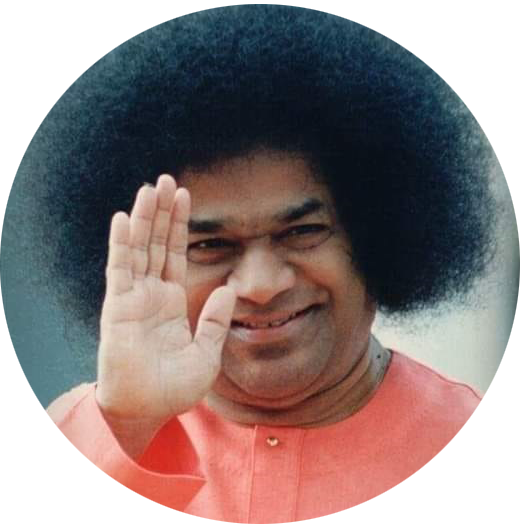
LOVE IS MY FORM– A Biographical Series On Sri Sathya Sai Baba
Excerpts shared for educational and spiritual purposes with reverence to the author. This project is a non-profit initiative, offered as a labor of love and selfless service.
INTRODUCTION TO THE VOLUME THE ADVENT (1926-1950)
- Dr. R. S. Padmanabhan
Dr. R. S. Padmanabhan first met Sathya Sai Baba when he was 21 and Baba
was 18 years old. An eminent dentist, he is an office-bearer in the Sri Sathya Sai
Seva Organisation and assists Baba in carrying devotees' letters during darshan
at Brindavan, Bangalore.
It gives me great joy to write a few reflections upon the release of
this biographical series on the great World Teacher, Sri Sathya Sai Baba, by my good friend, R.
Padmanaban. This volume does not rewrite Baba's early biography. Certainly, it
adds many wonderfully credible primary accounts. These include the testimonies
of old classmates-some of them living in areas unvisited by vehicles-who, as I
am informed, recalled the boy Sathyanarayana with tears streaming down from
their eyes. The marvelous, unique photographs (most never before seen, except
by a fortunate few) visually support the passionate accounts of the legendary Professor N. Kasturi in
Sathyam Sivam Sundaram. The photographs and text relating to the first few
years of Baba's life, which He Himself has said were those of lee/a (Divine
play), involved extensive travel to the homes of many devotees in far dung
parts of South India. An enormous effort has been made to record as many as
possible of these leelas of the early life of Bhagawan Baba.
Obtaining photographs of Baba from the early days beset the researcher
with difficulties galore. People of the era lacked proper photographic
equipment. Most of the photos taken were by amateurs with box cameras. As there
was no indoor lighting then, photographs were taken outdoors. In addition, the
extreme climatic conditions of South India damaged those photographic negatives
that managed to survive. Moreover, Baba was somewhat camera-shy. Those
devotees, who were thus privileged to possess those rare impressions that had
been taken, led quiet lives, and tracing these people back for generations,
from the known leads was a labyrinthine task. Enhancing the damaged photographs
digitally was another labour of love.
The first volume is called The Advent and covers the period from His
birth in 1926 until 1950, His ashram, Prasanthi Nilayam, was inaugurated. It
celebrates the advent of a great soul; it celebrates the advent of a new way of
celebrating love and its expression in life; it celebrates the advent of a
purposeful mission on the face of the planet-Baba's ashram, Prasanthi Nilayam.
The Advent traces the early years of Sai Baba-when He did not proclaim any
gospel of love for the masses but provided an opportunity for people to relate
to His loving 'play' or 'divine sport'. Baba's life itself, formed His
message-living and spreading love, profusely blessing the lives of others – with
love.
The Advent is special in many ways. It provides an impressive line-up of
eyewitnesses. Not only does that provide the advantage of using primary
sources; it also brings before the mind's eye the actual happenings as they
were - for some of us, triggering off a sentiment we were once so familiar with,
in those good old days. The story speaks for itself, without a narrator's
commentary intruding. This makes the text more reliable and authentic. We are
immediately confronted with a series of things that actually happened - facts
carefully sifted from the web of legends and myths that have already started to
form around them. Further, the attempt to 'bend' time, as it were, in the
narrative, removes the coldness of the distant past from the events and yet
makes us wonder at their strange mystery.
The photographs in this book transport us with a sense of immediacy to
those times. We see Baba growing up in front of our eyes, in these photographs.
Of course, it is more the growth of His glory. We see pictures of the names
that we read about in the text, and they, too, come alive. Together, they
create a 'felt experience,' and, deep within us, we know that all this is real.
The book also brings to light the unique relationship that Baba had with
the devotees of those early days. He lived with them; He sang with them; He
played with them. They have lived long enough to see His vision come true. They
have lived to see Him celebrate life, as an expression of love. They have lived
to see the Divine Self expressed through the Human. Even today, these devotees
remember their experiences as though they took place only yesterday.
I am tempted to share with you my good fortune of belonging to this
select group of 'old' devotees. I say it not with pomposity, but with the joy
of speaking His glory, and with gratitude for the difference He has made in my
life. In 1944, my uncle, Seshagiri Rao, my cousin Sundaramma, and my other
relation, Savithramma, were drawn to Baba's mission of spiritual, educational
and service activities. Subsequently, as dedicated devotees, they spent their
lives with Baba. In those days, Baba used to come frequently to Bangalore and
regarded it as His second home.
I had just completed my dental education and started practising
dentistry, in the early part of 1944. On Sundaramma's appeal, I visited Baba's
Bhajan session on a Sunday morning, in the first week of December, at the
residence of a devotee in Chamrajpet. Although I had gone there rather
reluctantly, I was, to my surprise, called for an 'interview’.
To this day, I feel a thrill when I recall that interview. Inside the
room, I experienced the Divine Presence of Baba. He spoke softly and lovingly
to me, told me all about my life and my future, assuring me that He would
always be with me and guide me. He produced Vibhuti, gave it to me and
smeared some of it on my forehead. I was wonder-struck and could not utter a
word. I just surrendered my ego and doubts and took padanamaskar. He
then told me that I would be married in February of 1945. That was a shock and
not very pleasant news for me, as I had just started my practice and had yet to
settle on my own. I was only 21 years old. I pleaded that it would not be
possible for me to agree to marriage, as I was not well set in my practice. He
simply said it would happen, whether I liked it or not, and that he would take
care of everything-which He did and is doing, even to this day. Kamala, who was
to become my wife, also had an interview in December of 1944 and was told that
she would soon be married to a dentist-in spite of her protest to the contrary,
as she was only 15 years old at the time. We were married on 15 February 1945
and have been in His care, ever since.
Baba has taken such good care of my family and me, over the past five
decades, that it would fill volumes to relate all of our experiences. I cannot
find words to express my gratitude to Baba for all that He has done for our
family. My wife and I have been supremely privileged to serve Him all these
years. Nothing has given us greater joy.
But, to those whom time denied the darshan of the beautiful Avatar in
His younger days, what could be holier and lovelier than to imprint the
pictorial and biographical treasures, that this pioneer endeavor offers, in
one's heart? In addition, of course, let the inner joy blossom into good
thoughts and the practice of Baba's teachings. That, indeed, will please Baba.
That will make your life His message.
May this worshipful work serve as a beacon to light the pathway to a
divine feast, for those many souls who hunger and thirst for spiritual joy.
THE FIRST TWENTY-FIVE YEARS of the life of
Bhagawan Sri Sathya Sai Baba had its peaks and its troughs. Filled with a sense
of wonder and unmistakable glory, the life of the young Sathya Sai Baba was
supremely divine, yet undeniably human. Through it all, there was an
undercurrent of an extraordinary mission-something that found recognised
expression in the ensuing years.
The journey from boyhood as Sathyam to young adult as Bhagawan Sri
Sathya Sai Baba had been both inspiring and profound. As a little boy, he had
pranced about the backstreets of Puttaparthi and had been the hero to his
peers. His acts of compassion, his precocious nature and his high-minded
religious attitude had set him apart from the rest-yet made him acceptable. At
school, he had been a student of normal intelligence, but his intense psychic
abilities had landed him into trouble, on more than one occasion. He was the
butt of his classmates' jokes. He had not been outgoing like most of his
friends, but rather withdrawn. His preoccupation with worship, rituals and
music sometimes had made others feel that he was often too genteel and not one
of them. But the young boy also had the uncanny knack of picking up a good
following. This became more evident when he was found to have been a poet par
excellence; his compositions and dramatic performances winning kudos, even from
the elders.
The formation of the 'Pandari Bhajans' group was the first genuine
expression of his ability to appeal to the religious sentiments of the masses
at large, winning not only their love, but also their admiration. The winds of
change had begun to blow. Village Andhra was once again being swayed by the
lilting music of devotional singing. The 'Bhakti' Movement was in for another
renaissance.
Unfortunately, a humble origin exacted a heavy toll from him through
suffering at the hands of misguided elders. A family and a village steeped in
tradition and superstition could not initially accept that Sathya was an
extraordinary boy. He was a challenge to their wits, a test to their patience,
a foil to their foibles and sometimes a source of untold misery. Neither had
they ever experienced any child like Sathya before, nor was there anything in
recorded history or memory that could be taken as a parallel. One cannot help
but sympathise with Pedda Venkama Raju and Easwaramma for what they had to put
up with. Yet, one cannot help but recognise what Sathya was up against as well.
The bastion of a somnambulist society needed a hard beating to be felled.
Contrary to popular belief Sathya did not have to wait for the scorpion
incident to let the divinity in him surface. Quite early, from the Bukkapatnam
years themselves, the latent divinity was already yearning for self-expression.
Great creative surges overtook him. He had no formal musical training, yet
those round (elders and peers) recognised that he was a gifted and technically
superior singer. He never studied dance and yet his performances even equalled
the great professionals of the day. His poetry scalded the egos of the guilty
and helped sell pharmaceutical products. Some elders even saw his poetry as
that of a rebel-in-the-making.
And he was a rebel. He refused to conform to a loveless society, for he
could only conform to the source of all love, God Himself. To do this, He had
to be a God himself.
Sai Baba of Shirdi was revered in the Marathi and Telugu speaking lands.
Many, who had been to Him before He left His body, had returned with the good
news of His message of Shraddha (firm faith) and sabburi (patient
piety). He was worshipped in small pockets of the erstwhile Madras province.
When the young Sathyanarayana Raju initiated the worship of Sai Baba of Shirdi
at Uravakonda, he helped the people strengthen their spiritual bond with the
Shirdi Master. He helped them re-establish their sagging spiritual ties with
their own selves and thereby prepared them for spiritual life. Raju's own
loveable nature greatly helped in this regard. The high receptivity of these
people made them view his trances and out-of-body visitations as quite normal.
His materialisations, though regarded as out-of-the-ordinary at an early stage,
were routinely taken for granted by his childhood peers.
The momentous events that took place on the day of his Annunciation, in
October, produced mixed feelings in people. That day the loveable Sathya was
lost to the world and the adorable Sathya Sai Baba was found. For Sathya, it
was his final assault on familial attachment. For others, it was an upgrading
of attachment to devotion. In retrospect, both seemed ultimately inevitable.
The Pravesha (Immaculate Conception) and not Prasava (ordinary
conception), that Easwaramma had talked about, had taken place again. He was a
new person altogether, as though there had been a new 'entry,' hence, a new
'being'. He was the embodiment of a free spirit, carefree and yet caring,
non-attached and yet loving. From that rebirth, until 1950, was perhaps the
most enchanting phase in the life of Sri Sathya Sai Baba. He was an enigma to
reckon with, being many things rolled into one-a prankish teenager, a fledgling
guru, a reluctant messiah, an enchanter, a wonder-healer, a darling and
hallowed presence and a definitive teacher. His Form was that of Love.
The saga of Sai Baba's courtship with the world at large defies
narration. Such parallels can only be found in religious mythology. Cobblers to
kings craved His company. Wives left behind their husbands to relish His
darshan. Husbands abandoned their responsibilities to be in His presence. For
children He was an enchanting role model; for elders He was the most-loved
relation in the family. Doors of houses always remained open for Him. Villages,
towns and cities were mesmerised by His visits, and princely states felt
honoured by his presence.
On his return from Uravakonda, Baba was a powerhouse of energy. Special
efforts had to be made to restrain Him. One day, Easwaramma's brother,
Chandramouli, tried to restrain Him by catching hold of his hand. Baba tried to
make Him let go. In the process, the sleeve of Baba's shirt was torn. He wept
and asked His uncle to procure for Him a new shirt. The next evening, a mobile
fair visited the village. Chandramouli asked Baba to pick up a piece of cloth
for His new shirt. Instinctively, Baba picked up an ochre-coloured cloth and
asked for a long shirt to be made. Ochre is the colour associated with
renunciates. Baba, who had apparently renounced the world, wept over a torn
shirtsleeve and then chose the garb of a renunciate!
For a few years, Baba would sleep for hours on end. He would cover His
entire body with a bed sheet and sleep for days, going without food. Subbamma
would ask, "Sathyam, what has happened to you? Why don't you come and
eat?" He would immediately push the bed sheets aside and ask her to smell
His palms. The palms would smell of very tasty food!
Not interested in feeding Himself, He often 'willed' to feed multitudes,
and the serving vessels apparently never became empty. He would suddenly arrive
at some devotee's house with a number of other devotees. The host or hostess
would panic, but Baba's love would save him or her from dishonour. The guests
would always return home, well fed with His miraculous food.
He was very frugal about His own food. He would accept anything, if it
was given to Him with love and devotion. Shanta Krishnamurthy would remember a
time when earlier she had bought some masala dosas from a nearby restaurant,
and she had to serve Him those, as there was nothing else at home. P. V Krishnamurthy's
account of how Baba would come from behind and stretch out His little hand in
front of Krishnamurthy's mother when she was serving morsels to her children,
has been recounted earlier. When devotees brought food for Baba later, in the
Puttaparthi Mandir, He would merely taste it and request that it be distributed
as prasadam.
However, there were those occasions when He even accepted poisonous food
which was served to Him by people who wished Him dead. Baba Himself narrates an
occasion when a Brahmin lady from Puttaparthi invited Him over and fed Him with
poisonous vadas. Baba ate all of them, with relish, just to teach the lady a
lesson. He forbade the others to do the same, however. His body turned blue
because of the poison, and He vomited out everything and saved His body from
danger. On another occasion, He even warned His teachers V C. Kondappa and B.
Subbannachar about an intended attempt to poison Him with similar vadas. His
forewarning turned out to be true!
Baba's day in the Mandir was spent mostly in the company of devotees. He
would sing with them, talk with them, take part in making garlands, even climb
ladders to tie festoons and play with them. His life was inseparable from
theirs. There was even an interesting tradition in which devotees would put
across their pleas to Baba, through the singing of devotional songs. Baba would
immediately reply to their prayers using the same medium during the bhajan
session. He would receive devotees at the entrance of the old Mandir and see
them off each time they left to return home. He would call people in for an
'interview,' anytime they wanted one. He would help devotees carry their bags
across the Chitravathi and also carry across young children, like Padma and Kusuma.
He was so fond of devotees that He would almost dance in glee whenever a group
of ten to twenty devotees arrived. There were also times when He would turn His
face away, while bidding them goodbye as they left, to shed tears in secret.
In the early days of limited resources, He would keep one set of His clothes
under the mattress to be 'ironed'. When an important dignitary like a doctor or
a lawyer arrived, He would wear those pressed clothes.
He also wrote a letter to Thirumal Rao, explaining His travails in great
detail-all about an occasion when He continued to help a few devotees.
This brings us to a very important aspect of His personality-the
wonderful relationship He had with His devotees, especially those who wanted
Him to become their ultimate 'refuge’. He always helped them with their chores:
cooking, fetching water and looking after their children. After a bhajan
session, He would often escort them back to their own villages. He would carry
a hurricane lamp, to light the way and a stick, to ward off the many snakes
that infested Puttaparthi in those days. He would see them off safely back to
their villages, before returning to retire to the Mandir.
In the Puttaparthi Mandir, there was Konamma, who had lost her husband
very early in their marriage. Distressed, she had decided to end her life. She
had walked into a dark forest at night, found a poisonous snake and managed to
get bitten by it. Yet someone woke her up in the morning. Baba had saved her
life and had given her refuge. She remained to take care of Baba's food, until
her death.
Sometimes Baba used to tell Bhujjamma (Sundaramma): 'You take care of my
food, and I will take care of your children.' And He did so. There was another
aged lady, Bayamma by name, who used to take care of Baba's food and the food
of the devotees in 1945-46. Baba would run up to her, sit on her lap and caress
her wrinkled cheeks. She would be reading the Bhagaivad Gita and Baba would
take away her spectacles. She could see nothing much without them and would
plead with Baba who would then return the glasses. He would ask her, "Why
do you read the Gita?" She would reply that she wanted to become
liberated. Baba would stand with his face very close to her face and say,
"I am that Krishna [that sang the Gita]. When I am here right before you,
why should you read the Gita?" Bayamma could only offer silent prayers of
gratitude for her singular great fortune.
Even the great lady Sakamma was not spared from Baba's jokes. One day
she entreated Baba to rest in the afternoon. He seemingly agreed to her
entreaties. When she retired, Baba placed two pillows and covered them with a
blanket to make them look like a sleeping person and left to play with the
children of the Kuppam family.
Sometimes they would swim, climb trees or just play in the sand on the
banks of the Chitravathi River. He played thayam/pagadai (board
games) with them and always won. He made shadow images of various birds and
animals and humoured the young children. Afterwards, when He returned, He would
rub His eyes and yawn, saying that He had a good sleep. Sakamma once more was
caught in His web of illusion.
He was never tired of saving devotees. When Karnam Kamalamma was
proceeding to Anantapur to fight a court case related to her property, her
enemies followed her in another bus. They wanted to produce false witness and
stall her from getting any benefit. A snake appeared on the road just in front
of their bus and began dancing there. When the driver stopped, the snake
entered the bus. Kamalamma's enemies were detained for more than a hour, until
the snake left. By the time they resumed their journey, the court had already
pronounced its judgement in favour of Kamalamma. On her return to Puttaparthi,
Baba told her of the snake episode and revealed that He had appeared there in
the form of a snake to save her.
In the Puttaparthi Mandir, while sleeping in the open quadrangle among
the devotees, He would suddenly get up and say that He had gone and saved a
devotee in distress. This was a frequent affair. Navaneetham Naidu's sister,
Jeevamma had once invited Baba to visit their house. Baba agreed, but did not
turn up on the appointed day. Meanwhile, a calf came and ate all the food kept
in the house meant for Baba to bless as prasadam. The lady beat the calf and
sent it away. The next day, Jeevamma invited Baba to come and have prasadam
Baba lifted His robe and showed the marks of a beating on His back. 'This is
enough, I don't want any more,' He said. This was just another reminder of the
Shirdi Avatar under similar circumstances.
When Subba Rao of Bukkapatnam wanted to perform the annual memorial
rites for his deceased father, no Brahmin accepted the invitation to visit
their house, as the family followed Baba, who was not a Brahmin by caste. Baba
then asked Subba Rao if he would like to see his forefathers-father,
grandfather and greatgrandfather. He assured him that the family ancestors
would themselves come as Brahmins and accept his memorial services. At midday
three tall Brahmins appeared from nowhere and said they had come from Guntur.
They had the same name as that of the family ancestors. They helped perform the
ritual correctly, partook of the offerings and left. In this way, Baba helped
the Subba Rao family to uphold its family name.
There were numerous other ways through which He revealed His Divine
nature-and all of them for the singular purpose of building faith and love.
Once He asked Saradha Bhai, Dr. Satish Bhonsle's mother, "Do you want to
see the Ganga?" He then rubbed His big toe on the ground and up sprang a
spring. During the Second World War, film rolls were in short supply in India.
Baba materialised film rolls for M. L. Leela, whenever she visited Puttaparthi.
Once, when Krishnamurthy was about twelve years old, Baba visited the Kolar
Gold Fields, where He was being driven in a jhatka (horse-drawn carriage). On
the way, He did not sit quietly. He threw handfuls of sweets, flowers and
coins, making the children in the streets run all around, picking them up. The
police thought that He was a black magician or an exorcist and feared that He
would create trouble. They stopped the carriage in an effort to arrest Him.
They even put handcuffs on His wrists, but the handcuffs broke. Then, feeling
that He was Divine, they let Him go!
In other moments of intense spiritual elevation He revealed that He was
the Sai Baba of Shirdi come again. Such moments were quick and casual and only
the sensitive caught the purport of His actions. He once tied a piece of cloth
around His head, like Shirdi Sai Baba and asked how He looked. He observed,
"At Shirdi, I used to smoke (the hukkah); here, I eat betel nut." He
told the Subba Rao family of Bukkapatnam, "I visited your families in the
Shirdi Avatar. I'll be visible to them in the Prema Sai Avatar, too." When
V C. Kondappa's book was released, Baba asked M. L. Leela to read relevant
sections aloud. When the section on the life of Shirdi Sai was being read,
Baba's form changed to that of the Sai Baba of Shirdi. From the crowd, Leela's
father, Lokanatha Mudaliar cried, "Hey Sail Hey Sail" and ran to
embrace Him. It took some effort to separate the two.
His trans-corporeal journeys were sources of great concern for the
devotees. When He was in the middle of a conversation, He would suddenly go
into a trance. There was no fixed time or situation for this. If any devotee
suffered from a severe ailment, pain, anxiety, incurable disease or any
handicap for that matter, He would just leave His body and go to that place
where there was suffering. His body would become stiff; He would become
unconscious and He would often pull on His hair and stretch it into His mouth.
The abject sufferings His physique went through was taken on by Him in order to
help His devotees through their misery. And He accepted their suffering gladly.
All His efforts were directed at connecting people's lives through His
love. This connectivity touched the inner space of their being, thus awakening
their consciousness to a higher level of attunement with their own innate
divinity. His love was the binding force between God and man, between the
creating force of the Creator and the created wonder of Creation. This binding
force helped the devotees to recognise the oneness of all life, the oneness of
His purpose, the oneness of His being and the oneness of all avatars. This
oneness transcends the 'form' of existence to the formlessness of 'being'. It
transcends all limits in a manner such that His form and the boundlessness of
Love become one. In this love, He heals the mind, body and soul of those whom He
has touched with His Divine Love.
In a strange way Baba could be very stern in His love too. He would
create confusion and quarrels amongst His devotees so that they would relate to
Him exclusively. He would also ignore some of them at times so that their true
love for Him would increase. Many of His early devotees would apparently fall
out of His favour a charade He would enact to allow them to grow on their own.
Some of them would be fortunate to grow as fruit-bearing trees in the oneness
of creation while others would be consumed by their own confused disbelief.
But the curious and humane in Him were never lost. As recounted earlier,
in His curiosity to witness the behaviour of urban people, He cleverly
disguised Himself in the shirt and trousers of Bhaskar of Bangalore and walked
about Commercial Street. In the early days, Bhaskar, while talking to Baba in
Telugu, would often mix in a few English words, just to tease the young Baba,
and Baba would playfully hit Bhaskar on the back of his head. As Baba grew from
an adolescent to a young man, on a few occasions Bhaskar shaved Baba's face. He
even assisted in giving Him the ritualistic oil bath. At Puttaparthi, when Baba
was once exhausted, Bhaskar carried Him on his shoulders from the Kalpa Vriksha
hill to the plains and thence across the Chitravathi.
Baba was very camera shy. He would look down when asked to pose for a
photograph. Many a time the photographer had to request that He look into the
camera. When people tried to take His photo without His permission, they would
often have very strange experiences. Either they would not find the film roll
loaded in the camera-that is to say, the film would be missing-or they would
end up getting blank negatives and nothing else. Sometimes the film rolls would
come into His Hands, straight away. Dr. N. Jayalakshmi would say later,
"We have seen this happen even to expert photographers-if they had not
obtained Baba's approval beforehand-when they just would not have any success
in their attempts to photograph Him."
Who would believe that this young Baba was one who never lifted His face
to talk to womenfolk? Even so, He spoke to them with warmth and love. He was
accessible to anyone and people could ask Him questions, when He willed it so.
He talked less to strangers, but when He began a conversation, it was as if He
had known the person for a very long time. Introductions had become
superfluous. He would accept garlands from both men and women-all were allowed
to put garlands around His neck. But when He heard some people commenting on
the desirability of Baba allowing women to garland Him, He immediately stopped
the practice and bade the women to give Him garlands in His hands, instead.
Yet it was He who encouraged young men and women to get married. As a
youngster in His twenties, He became like an 'elder' relative, inspecting and
approving matrimonial alliances, supervising family weddings and blessing
couples with prosperity and progeny. He seemed curious to know the marriage
customs of different cultures and traditions. In 1944 He wrote to Narasimha Rao
Naidu, who was much older than He, that He had selected a girl for him in
Machilipatnam.
As the years went by, the playfulness decreased and a more purposeful
reformer emerged. Yet He remained all Love. His message to the vast gatherings
of people on festival days only spoke of this great 'life of love' that He
Himself reflected through His activities. Whenever He had any project in mind,
He never lost sight of His purpose and always went all out to achieve it.
Perhaps the greatest of such projects was the establishment of Prasanthi
Nilayam, which was indeed a rare achievement in those days. Single-handedly He
arranged everything-something quite remarkable in the normal circumstances of a
young man in rural India at that time. He had a mansion constructed for
devotees, made by the best craftsmen of the day. He had an attractive guest
list, one that puts to shame some of the best event-managers of today. He
achieved His purpose on the inauguration day, by filling the hearts of all
those who loved Him with immense joy and devotion.
Many of His devotees expressed the fear that He would become distant
once Prasanthi Nilayam was established. Yadalam Venkataramanappa is reported to
have said: "Now You have a temple like a cinema hall. Soon You will have
all sorts of rules and regulations. It will be difficult to meet You. There
will have to be prior appointment or information of arrival sent in
notes."
But that was not to be. His heart always melted for the love of His
devotees. He rarely made a distinction between those who were rich and those
who were poor. Narayanaswamy of Bangalore visited Puttaparthi in December of
1950 with his family. When he approached the Puttaparthi Mandir, he was asked
to stop there and to go no further, as there was no place available in
Prasanthi Nilayam. Narayanaswamy was not happy to do that, so he proceeded to
the new Mandir. When he reached Prasanthi Nilayam, he was told the same thing.
However, Baba stepped out onto the balcony and told Seshagiri Rao to permit
them to stay in the portico. There were about ten people present. Devotees were
talking about paadapuja. Narayanaswamy did not know anything about it;
but gathering some information, he went to Bukkapatnam and bought some fruits,
turmeric powder and camphor packed in an old newspaper. When he returned from
Bukkapatnam, he saw a rich family, well dressed, carrying special plates of
fruits and other items for paadapuja. Soon Baba came out and asked the
rich family to leave all the fruits in the Bhajan Hall and to give
Narayanaswamy a special plate to do paadapuja. Narayanaswamy did not
know how to do paadapuja. Baba told him to place the plate on the
ground, which he did. Baba then put His feet on the plate and asked
Narayanaswamy's family to wash and wipe them. With love, He taught them how to
love and worship Him through the ritual of paadapuja.
Baba was to tell some devotees then, "I have no connection with
anyone at Prapancha (worldly) level; My connection with you is only Adhyatmic
(spiritual), which is permanent. You people have enjoyed me. You have had
the sweet sugarcane juice. The residue is not sweet. You need not come to Me.
Enjoy Me from your homes.''
The devotees of Sri Sathya Sai Baba, in those wondrous first twenty-five
years, have been granted tremendous grace. Their external relationship with
Baba has been always unique. Their own inner experiences have firmly
established their faith in Him. They have always regarded Him as their loving
God. Now they live in the memories of those days, as if it all happened only
yesterday. He has affected their lives in such a manner that even today they
still live in love, taking the 'every-day grind' in their stride. They can
never forget the beauty and the love that they experienced and continue to
experience Baba. He is always fresh and new, whatever His physical age. Such
experiences are available to one and all, especially to those who yearn to know
God, for God is Love, and Love is His Form!