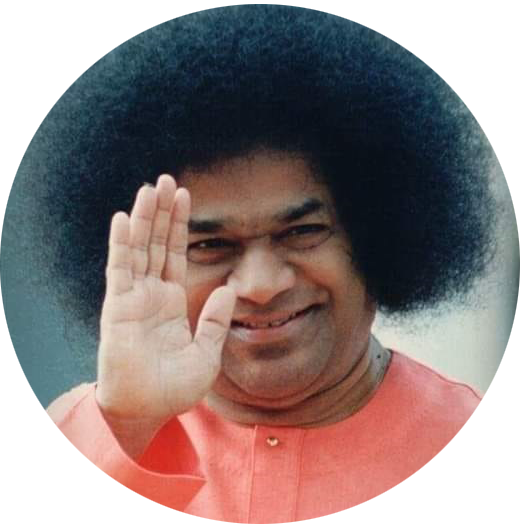
Years later, Vengamma (1910-), Easwaramma's youngest sister, would
remember a similar, though different, acccmnt of this mystical experience: Pedda
Venkama Raju owned a few cows. One day, Easwaramma went to collect some grass
for the cows, from the fields across the Chitravathi River. It was hot and she
was very thirsty. She collected the grass, made it into a bundle and was returning across the
Chitravathi riverbed. She put the bundle aside and sat down to rest on the
riverbank. She dug a hole in the sand to get some water. Some dirty water
surfaced, which she threw away. She then scooped up some clear water with both
hands and was about to drink when she saw a luminescence merge into the surface
of the water and finally become a part of it. She did not know what to do, and
was very thirsty. Thinking of God and keeping faith in Him, she drank the
water. The luminescence was so powerful that, in spite of the glare of the hot
sun, she could still see it. She returned home and reported the incident to her
mother-in-law.
Shortly thereafter Easwaramma found herself 'expecting' again.
When the time of her delivery approached, several wondrous inexplicable
events begun to occur in the family of Pedda Venkama Raju. The house contained
several musical instruments for Pedda Venkama Raju's dramatic rehearsals. In
the middle of the night the tambura (a string instrument) would start twanging
on its own-as if being played by an invisible but dexterous hand-and the
Maddala (drum) would beat rhythmically, as if keeping time with the tambura. It
was also said that Kondama Raju heard the child talking when it was in the womb
of Easwaramma.
All these mysterious occurrences were to presage some extraordinary
event. The wise men of the village discussed the nature of these phenomena
unable to determine their portent, which only added more to their enigma. Pedda
Venkama Raju sought out a venerable sastri (scholar) in Bukkapatnam (a
nearby village), in whose wisdom he had faith. The sastri stated that
these occurrences were auspicious omens: they signified the presence of Shakti,
a beneficent power that would confer harmony and joy on the family.
The twenty-third day of November, in 1926, was still Karthika Somavara
(a Monday of the Holy Month of Karthika), in the year called Akshqya - the
'Never-declining, the Ever-full,' an occasion devoted to the worship of Lord
Shiva. That day was made even more auspicious by the coincidence of the
ascendant star of Ardra (Orion constellation) with the month and the day. Not
to miss the benefit of Shiva worship on such a rare heavenly confluence, the
villagers began chanting the names of the Almighty Lord from very early
morning.
Easwaramma, too, was performing the final part of her Sathyanarayana
worship, although her labour pains had begun. Nothing would distract the devout
lady from her religious vows. When the pains grew insistent, Lakshmamma, who
had gone to the priest's house at four in the morning, to carry out her
religious duties, was informed that her daughter-in-law would give birth any
moment. The messengers urged her to hurry home; but, determined in her piety,
she refused to be hurried. She sent word that she would come only after the
rituals were completed and would bring offerings sanctified by the ceremony,
for her daughter-in-law. Such was the pious old lady's faith in God: she was
certain that Easwaramma would give birth only after she arrived. Lakshmamma
finished the ritual and went home, bringing her daughter-inlaw flowers and
consecrated water. Only then did Easwaramma give birth to a beautiful baby boy,
filling the entire family with delight.
Easwaramma spent her confinement in her mother's house
at Karnatanagapalli village. Her mother's family maintains that Sathya was born
there. Since the two families had always been very close and resided in
adjacent villages, it is quite possible that they might have mistaken one for
the other. Moreover, the flooding of the Chitravathi made movement from one
bank to the other a frequent affair. The third day after the child was born,
the family feared that the Chitravathi River would flood, and Easwaramma moved
to Puttaparthi with the child.