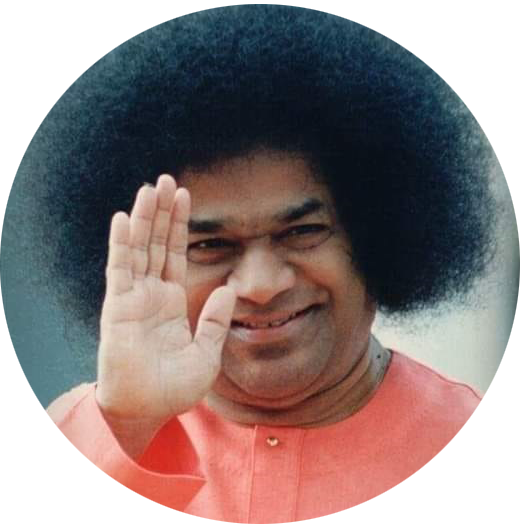
A Life Saved in Bhopal
How Swami assumed multiple forms and "stole" a revolver to prevent a tragedy.
How Sathya Sai Baba Assumed Multiple
Forms to Save a Devotee
Swami Satchidananda,
a distinguished monk of the Divine Life Society, Rishikesh, and a close
disciple of Swami Shivananda Saraswati, narrated this extraordinary incident in
the divine presence of Sathya Sai Baba. He recounted it on 29 June 1957, during
the inauguration of the Tapovana (Meditation Grove) at Puttaparthi. This
incident convinced Swami Satchidananda beyond all doubt of Bhagawan’s divine
nature. Prof. N. Kasturi has recorded this episode in his book Sathyam Shivam
Sundaram, Volume I.
One afternoon, Swami Satchidananda was present in Baba’s room at a bungalow in
Kodaikanal. Baba was reclining peacefully on His bed when suddenly He stood up
and shouted in Telugu, “Don’t shoot!” Immediately afterward, He collapsed onto
the bed and entered a deep state that appeared like a trance—more accurately
described as a trans corporeal journey.
Baba’s body became rigid and remained in that condition for nearly an hour.
When He finally returned to normal consciousness and resumed control of His
physical form, He looked at those around Him and urgently instructed that a
telegram be sent to an address in Bhopal. He dictated both the message and the
address. The telegram read:
“Don’t worry; the revolver is with Me – Baba.”
Swami Satchidananda expressed concern that the postal authorities might refuse
to transmit the telegram because it mentioned a revolver, an item covered under
the Arms Act. Others present also shared this doubt, and a discussion followed.
Baba insisted that the message must go immediately. To avoid complications,
Swami Satchidananda suggested replacing the word revolver with instrument. Baba
agreed, knowing that the recipient would understand the meaning. The telegram
was then dispatched swiftly to Bhopal.
Although everyone was eager to know what tragedy had been averted, Baba
declined to reveal any details. On the fourth day, however, a letter arrived
from Bhopal and was read aloud to all present. The letter declared that Baba
was indeed the same Lord Vishnu who saved Gajendra and Prahlada, and the same
Lord Krishna who rescued Draupadi in her hour of despair.
The writer of the letter was a senior government officer whose wife was an
ardent devotee of Bhagawan. A veteran of the Second World War, he was deeply
distressed by administrative changes following the reorganization of states,
which had resulted in junior officers being promoted over him. Isolated,
humiliated, and without anyone to console him, he fell into utter despair. His
wife was away at her parents’ village at the time.
Overcome by depression, the officer resolved to end his life using a revolver.
He fired one test shot to steady his hand. Just as he was about to fire the
fatal second shot, he heard Baba’s commanding voice shout, “Don’t shoot!”
At that very moment, there was a loud knock at the door. Standing outside were
three visitors: an old college friend, the friend’s wife, and a chaprasi
carrying a trunk and a holdall. Baba had appeared—not in His own form—but
perfectly disguised as this college mate, complete in every detail.
The officer hurried into the bedroom, placed the revolver on the bed, covered
it with a sheet, and returned to receive the visitors. The “college friend” was
cheerful, lively, and full of warmth—exactly the personality needed to lift the
officer out of his despair. Gradually, through conversation, humor, and shared
memories, the officer’s suicidal thoughts dissolved completely.
After about forty-five minutes, the visitors prepared to leave, saying they
would stay elsewhere since the lady of the house was absent. Despite the
officer’s repeated requests for them to stay longer, the three departed—along
with the trunk and holdall—bringing the mysterious visit to an end.
Once they left, the officer rushed to the bedroom, only to find that the
revolver had completely vanished. Alarmed and bewildered, he locked his house
and rushed to the address where the college friend claimed he would be staying.
There was no one there. The visitors had vanished without a trace.
Returning home, the officer was still struggling to comprehend what had
occurred when another knock came at the door. This time it was the telegraph
messenger delivering a message from Kodaikanal:
“Don’t worry; the instrument is with Me – Baba.”
Swami Satchidananda concluded by stating that this incident surpassed even the
Parakayapravesam described in the Puranas. Parakayapravesam refers to entering
an existing body, but what occurred here was Kayasrishti—the instantaneous
creation of three bodies, endowed with perfect individuality, memory, voice,
mannerisms, and personality, all acting flawlessly.
Such an act, Swami Satchidananda affirmed, is possible only for an Avatar.