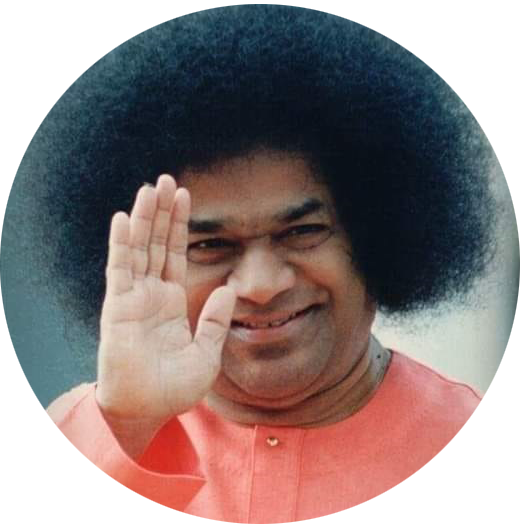
Sai Inspires – Prof. G. Venkarataman Guru Poornima Special Offering
(Daily Episode)
Part 16
When dirty water gets
mixed with milk, the milk has to be boiled to make it pure. Likewise man has to
undertake various types of Sadhana to purge his mind of impurities. Exercises such
as meditation, chanting, etc. can only provide mental satisfaction. It is only
when the Heart is allowed to melt in the heat of Divine love that the pristine
effulgence of the Heart would be able to reach out. Just as the Sun's rays can
burn a heap of cotton if the rays are concentrated by passing through a lens,
the rays of the intellect will destroy one's bad qualities only when they are
passed through the lens of Divine love.
–
Divine
Discourse, October 24, 1992.
REFLECTIONS
Sai Ram. I am sure
most of you must have heard the word sadhana, especially since sadhana camps
are held all the time. Most of you are also probably under the impression that
sadhana means some kind of spiritual routine, exercise, drill, etc. In a sense they
indeed are. Yet, in the above Sai quote, Swami’s focus is on purity. What
exactly does Swami mean? Let’s explore.
Swami reminds us
often that all humans are a composite of three distinct entities, namely the
gross body, the subtle mind and the causal Atma. Bearing that in view, we shall
now ask three questions in relation to each of these? These would be:
• Where does the
entity come from?
• How does it get
impure?
• If it gets impure,
how does one clean it up?
Let’s start with the
body. The body easily gets dirty in many different ways, for example when one
goes out to play tennis or cricket or whatever. One also knows how to clean it
up – all it needs is a good soap, a shower, and vigorous scrubbing. Next let us
consider the Atma. In this case, we have an interesting situation. Since Atma
is God and since by definition the God cannot ever be contaminated with
impurity, the question of the Atma within getting dirty does not ever arise;
that being the case, the issue of cleaning up also becomes irrelevant; in other
words, the three questions I raised earlier simply do not apply to the Atma or
Conscience. We just leave it alone; that’s all we have to do.
That leaves the mind,
and sadhana is all about 1) cleansing a dirty mind and 2) thereafter trying to
maintain its cleanliness. Those are the things we must try to understand, in
the context of the Sai quote we started with. In His remarks, Swami Himself
refers to some of the drills people usually resort to in the name of sadhana
such as chanting Vedas or reciting various slokas and what not. Alternatively,
they engage in all sorts of rituals or even so‐called meditation. Can these
drills be useful? Yes, they can. But are they guaranteed to produce results? No
unless they are practiced with the requisite mental discipline.
This is where one
ends up with a sort of catch‐22 kind of situation. I mean you practice these
drills in order to attain mental purity; but you need mental purity in order
for these drills to be effective! Stated that way, it would appear that one is
sort of stuck, going round and round a loop. Is there no way out? Yes there is,
and that is to get God directly involved with our cleansing job. How does one
do that? That’s what we shall examine next.
Let us start with the
obvious fact that since all of us have come from God, He is at once our Divine
Father as well as Divine Mother, that is to say some aspects of His
relationship with us would be like that of a father while the rest of it would
be like that of a mother. The point I am making is that He always loves us.
However, most of the time, that love may not translate into direct personal
attention. Swami gives a good example. He says a mother has two children, a
girl aged thirteen and young child aged two. The mother loves both but the older
girl would get little personal attention; rather, she would be given a lot of
household tasks, and at times she has to also care for her baby brother. And
when the mother is free, she dotes on the baby, hardly paying attention to her
first born. This does NOT mean that she loves one child more than the other.
Not at all. At the same time, the little boy manages to attract the mother, and
get all the help from his mom. Humans, says Swami, must use the same strategy,
and God is quite amenable to that.
What exactly do I
mean by that last remark? To appreciate that consider this observation Swami
makes towards the end of the quote we are discussing. Just as the Sun's rays
can burn a heap of cotton if the rays are concentrated by passing through a
lens, the rays of the intellect will destroy one's bad qualities only when they
are passed through the lens of Divine love.
In translation that
means:
O humans! Relate to
God in such a way, that you begin to directly experience His Love in profusion.
And when that happens, all the impurities in your mind would just sublimate and
disappear! That’s how you make your sadhana deliver the goods! Understand?!
So now the question
becomes: “How does one make God give special attention?” Well, how did
the baby boy in my example do that? Did he read any best sellers books on how
to win influence? Did he attend any crash course on personality development?
None of that. He simply let loose his innocent baby charm. When he smiled
sweetly, the mother just could not resist picking him up and fondling him. So,
if we want God’s direct and personal attention, we have to do something like
that. But it can’t be with smashing, toothpaste ad smiles; what exactly we have
to do to become dear to God has been clearly explained in the 12th Chapter of
the Gita, concerning which Swami has delivered any number of Discourses Himself.
So, some homework is needed!
The bottom line is:
The best way to make one’s sadhana succeed is to make God Himself our coach.
But God is not so easy to get, unless some down payment is made, and it is the nature
of that down payment that is described in the 12th Chapter of the Gita, as also
in Swami’s Gita Vahini, for example.
By the way, also ask:
“When mother fondles her baby boy, does the older girl feel jealous?” If she
does we can easily understand why, but if she does not, why would that be?
Think about it, and also ask whether there are people who feel very happy when
God gives personal attention to others rather than themselves! Nice exercise I
would say!
Thank
you and I hope you found this useful. Jai Sai Ram.
Part 17
God's love is pure
and simple. His greatest gift is His love... Do not calculate what you have offered
to God in terms of money or otherwise. Whatever you offer, consider only the feeling
with which you offered it. Even a small tulasi leaf offered with love becomes a
great offering to the Lord. Offer anything with a full and loving heart. By
offering with love, you become the embodiment of love... Identify yourself with
the name and form of the Divine of your choice. You may carry on all your
normal daily duties, but keep in mind always the name of the Lord. That is the
injunction of Lord Krishna.
–
Divine
Discourse, August 25, 1997.
REFLECTIONS
Sai Ram. The above
Sai quote is extremely important because it illustrates several important truths
that most of us hardly understand or bother about. Before I start discussing
the implications of the quote itself, let me start with some background.
Swami reminds us
again and again that in His Ultimate aspect, God is Infinite, Eternal, Formless
and Nameless. If one has to worship God, this is the way one really has to. However,
it is a tough job to worship the Infinite and the Formless; if you and me were
to try that, we would find it simply impossible. In fact, it would be worse
than asking a five‐year old kid to straightaway do a Ph. D. in mathematics.
Keeping such
difficulties in mind, Krishna offered a simple alternative to Arjuna about getting
started the easy way. Translated to our language, it means the following: Join kindergarten
first; study hard and work your way through school and college; after you go through
all this, you would be ready to enter a University to do a Ph. D. Obviously,
that was not the way Krishna said it, but Swami did say something similar in
His most memorable Discourses on the Gita delivered in 1984. By the way, in
that series Bhagawan gave 35 Discourses and together, they form the treasure of
the Kali Age. One of these days, we hope to offer it as a comprehensive
package, complete with interpretation and all that.
Meanwhile, getting
back to the remark of Swami that I just referred to, what He actually means is
the following: Start by worshipping God with Form; it could be any God with
Form you like – Rama, Krishna, Ganesha, Shiva, Jesus, Buddha or whatever;
doesn’t matter at all.
OK, we accept that;
after that what? How must one worship this God? It is in answering that question
that Avatars play a key role.
Swami says that one
could start with standard, regular, ritualistic worship. In the Indian tradition
that would include chanting Mantras, offering various items as Naivedyams as
they are referred to, and ending by waving incense and the flame, followed of
course by the singing of Arathi. However, all this is but the beginning. Few
remember that, that is why they go on doing this sort of thing all their lives,
till it becomes a drill and set routine. Once that happens, worship operates on
auto‐pilot, with the mind free to wander all over the place. At that stage the
worship ceases to have any meaning, at least for God.
You might ask, “If
there is that danger, why then did Krishna advice Arjuna to start by
worshipping God with Form?” For several reasons; firstly of course, a God
with Form is easy to visualize and relate to. Thus, when going through the
rituals, one’s mind is expected to be focused all the time on the Form of God
one has adopted. Focusing the mind thus, one must then saturate it with the
feeling, “God, I love and adore You and am doing all this just to please You.
Look, here is a beautiful rose that I have got specially for You, which, I hope
You would like; please accept it. Next, here is something I have cooked; please
accept it since I prepared it solely for You and with so much love.” That is
the way a devotee worships when he feels a strong one‐to‐one relationship with
God. And that happens when the devotee does not see a mere idol before him but
God as he visualizes. The point really is that Form is a means of building up
one’s Love for God in a very personal and intimate way. That Love can be called
intimate only if God dominates the devotee’s life, is always present before his
mind’s eye, making him hum bhajans while talking a walk, and so on. Remember
Swami saying, “Start the day with Love, fill the day with Love and end the
day with Love?” That is what worship must do to the person.
Saint Tyagaraja who
lived between 1767 and 1847 was one such person. Early in life, he adopted Rama
as his favorite God, which happened after he completed chanting the name of
Rama 90 million times! Of course, he started this chanting very early in life
and boy, did his life change after that? You bet it did. Every morning,
Tyagaraja would wake up Rama with a song specially composed by Him for this
purpose. He would then get ready for the regular worship which he would go
through as if Rama was directly before him and receiving it all. After that he
would then sing for Rama for a while, then offer food and allow the Lord some
rest. And so on, the day would pass, till Rama was put to sleep at night!
Incidentally, in all this, Tyagaraja composed hundreds of amazing songs that
came straight from his Heart.
No wonder he
subsequently became one of the great pillars of classical South Indian Music known
as Carnatic Music; his songs remain highly popular and are adored to this day. Understandably,
you might shake your head and mutter, “Come on! This is the 21st century, the
twitter age when life moves at jet speed and one has juggle with the i‐phone
for personal work, the Blackberry to be in touch with the office 24/7, the
i‐pad and laptop and what not. Maybe somebody took care of Tyagaraja’s meal
ticket; I would starve if I tried anything like that,” so on the argument
would go.
Everyone knows that
kind of counter‐argument and I really do not have to go through it. As a matter
of fact, anticipating such objections Krishna said over five thousand years
ago, “Dear devotee, don’t be scared! I really do not wish to be an obstruction
to your normal life. There is a simple alternative, and maybe you can give it a
try. This way, you can jolly well go through life as you ought to, and yet
remain devoted to Me. Want to hear about it?”
Actually, this is an
ideal recipe but since it is old, most people have forgotten it altogether. Swami
has therefore revived under the banner, Convert Work into Worship, and made it very
simple.
Swami says: “You are
a pilot. I know it is a tough job and you have to concentrate a lot. So, just
say a small prayer before take‐off. After that, you can be busy about flying.
And just before landing, say another small prayer, thanking God. This way, the
entire flight of 3 or 5 hours, gets credited to your Bhakti account. How about
it?”
If you are a doctor,
He says similarly, “Offer a small silent prayer just before surgery and one
more after it is all over while the patient is being wheeled away to the ICU.
You are through, because your entire surgery which is really My work being done
for Me by you, becomes your worship of Me!” So, you see, the busiest person
on earth can still be an ardent devotee of God when he/she does all the work
not only in a sincere and truthful manner but also as an act of worship.
The doubting Thomas
might still argue, “Listen, I feel this is all trickery. Take the doctor. He
just prays for one minute at the beginning and a few seconds at the end giving
thanks. Fine. But do those sixty to ninety seconds of prayer convert the entire
3 hour surgery into worship? I do pujas and I know what doing puja for 3 hours
means. I feel there is a shady conversion or exchange rate operating here,
which is totally unfair to us, the loyal and disciplined devotees.”
But Swami has the
answer. He says, “The worship of Form is merely meant to inculcate love. If it
ends in making you believe that God is just that idol and nothing more, then
you have got it all wrong. Forgetting that God is Omnipresent, you have reduced
God to a mere idol! On the other hand, using the idol as a stepping stone, you
must see God everywhere. When the pilot concentrates on his flying, he is
serving Me through the passengers; that is how he sees Me everywhere. Likewise,
when a doctor is performing a surgery and is intensely concentrating on it, he
is really seeing Me in the patient. This is how his work is transformed into
worship. This is how the devotee must take Sathya and Dharma from
the pujaroom to the class room, the court, the office, the bank or
wherever it is that he is serving. And remember, Krishna told Arjuna, “When you
fight, think of Me and do so; thereafter, this war ceases to be a fight over a
mere kingdom; instead, it becomes a war against adharma with you being a
soldier of God! If it were not so, do you think I would be here acting as your Charioteer?”
With all that
preamble, let us return to the Sai quote and pay particular attention to the following
words which we read earlier:
You may carry on all
your normal daily duties, but keep in mind always the name of the Lord. That is
the injunction of Lord Krishna.
That exactly is what
I was trying to explain, by mixing the pilot, the doctor and the Gita together.
Just imagine what a change there would be if even 30% of the people in the
world did their work in this spirit. There would be a sea change; so much less
of corruption and so much sincerity in work and the quality of service
rendered. Also, so much courtesy and kindness offered to those served, and so
on. Children and old people in particular, would receive so much special
attention instead of being pushed around. In other words, this simple injection
would do so much to improve the social climate, reducing tension as well as
stress in the process.
This is what Swami
refers to as practical spirituality. Rituals are fine for a start, but one should
not get stuck in them forever, refusing to see God beyond the idol worshipped.
If the world is to be improved – and who can deny it needs fixing – then one
must move on from mere worship to work and do it in the spirit of worship of
the Omnipresent God. I have done my reflection and now, it is your turn to
reflect on what I have said! Thanks for reading. Jai Sai Ram.
Part 18
The individual, the
society and the nation constitute an inextricably linked organism. The peace
and welfare of the nation depends on the peace and progress of society, which,
in turn, are dependent on the peace and good conduct of individuals. Unless
individuals develop mutual regard and tolerance, and cultivate equal‐mindedness
towards each other, there can be no peace and harmony in the community.
Material progress alone cannot bring about peace, harmony and happiness among
people.
–
Divine
Discourse, May 12, 1984.
REFLECTIONS
Sai Ram. The above
Sai quote highlights the Universal strand in Swami’s teachings. From ancient
times, gurus in India have always stressed two aspects relating to
spirituality, firstly that God is Omnipresent, and secondly that life must be a
journey towards God, meaning that one’s ultimate goal must be to merge with God
who is Omnipresent. Swami also says the same but with one important difference
which is very vital for this day and age; and that really is what this quote is
all about.
For a minute, let us
set aside this quote and take a minute off to reflect on the birth and the subsequent
evolution of our Universe. What we know about all this at the present time can be
stated briefly as follows:
• Roughly about
13.8 billion years ago, there occurred an event usually referred to as the Big
Bang, which signaled the birth of the Universe we all are in.
• At that time came
into existence, both space and time as we know them. While space kept
expanding, time flowed [whatever that means!]. Together, this expansion and
this flow formed the framework for the evolution of the Universe.
• To start with, this
evolution involved exclusively the development of inert matter, beginning with
sub‐atomic particles then moving on to atoms. Then huge gas clouds began to
form, largely made up of hydrogen atoms which then began to shrink on account
of gravity, leading eventually to the birth of stars. Next, stars came together
to form galaxies and so on.
• Via such process,
in one particular galaxy called the Milky Way, which is but one of the billions
of galaxies in our Universe, was born about say five or so billion years ago a
star that we now call the Sun. Along with the Sun came into existence also a
set of planets, and one of them happens to be the earth in which all of us
live.
• On this earth,
about four or so billions of years ago, life appeared for the first time, of
course in a very primitive form. In due course, life forms evolved into more
and more complex forms with humans appearing last in the chain called evolution
of species.
• Believe it or not,
the beginning of the last stage – that is, the evolution of humans occurred
about barely fifty or so thousand years ago, when they began to spread out of
Africa into Europe, Asia, and Australasia. Finally, about fifteen thousand or so
years ago, the first humans are supposed to have crossed over from Asia to
North America, past the Bering Strait.
• All that we read
in history books about the growth of human civilizations, etc., occurred during
the last ten thousand years or so, that’s all. Just to get a fix on this,
remember that agriculture which is such a huge part of human activity today was
discovered/invented, call it what you will, only about eight thousand or so
years ago.
How do you like that
rapid‐fire survey of history of the Universe and living species telescoped into
each other? This might seem like an unwanted digression but there is a deliberate
reason why I went into it; and that reason is contained in the very first
sentence of the quote we are discussing. If evolution of the Universe is a
carefully structured sequential process that connects entities all across the
Cosmos, so also there exists an invisible thread linking all aspects of humans
from the micro to the macro.
The important point
about this invisible thread is that a) it is Divine, and b) it runs through every
one of us also. Thus, all of us are bound together by a powerful Divine bond,
even as the flowers of a garland are held together by a thread that is not
visible.
Let us examine this
interconnectivity across human society a bit further. Historically, humans were
strict loners to start with. At best, each caveman had a female companion and a
family; together they moved as nomads and their only objective was survival.
After the discovery of agriculture, families came together to form small
communities and began to live in settlements called villages. Soon, slowly but
surely, division of labour also crept into life.
When people came
together, there were also conflicts, one reason being property. Two adjacent
villages, for example, might quarrel over issues connected with land and water.
At the same time, security issues also compelled people to come together. For
example, to confront problems posed by wild animals. Thus began two trends, one
which brought people together, largely for reasons of growth and security, and
another which drove people apart on account of individual or group selfishness
and self‐interests. With this background, let us go back to the very first
sentence of Swami’s quote. He says:
The individual, the
society and the nation constitute an inextricably linked organism.
Based on my lengthy
preamble, this should now be clear. We should also remember that this statement
is not only powerful but also highly pertinent in today’s world when
hyper‐individualism is often the order of the day. Many, and this includes not
only the wealthy but also plenty of young people, tend to feel that they are
entirely self‐made and therefore owe ‘nothing to nobody’. In other words, in the
name of individual freedom and liberty, they claim lots of rights as well as
freedom but refuse to recognize that they have any obligations whatsoever.
Such aggressive
thinking is born out a sense of power, and we see this even in the servants of
such high people. The driver of a rich man, for example, feels greatly
empowered when he sits behind the wheels of his boss’s Benz or BMW, and often
drives as if he owns the road. Even ordinary truck drivers who are by no means
rich, often do the same. Why?
Because the power of
the truck seeps into their mind and unconsciously makes them also feel
powerful. That’s why we have so many road accidents in India. If you look at
the statistics, you would be horrified. India has far fewer highways than the
U.S and far fewer trucks too. But if you look at the number of traffic deaths
per road mile per truck per year, you would find this country claiming the
dubious honor of a top position. Why? The answer follows. Swami says:
Unless individuals
develop mutual regard and tolerance, and cultivate equal‐mindedness towards
each other, there can be no peace and harmony in the community.
That’s obvious but
who cares? Vehicle drivers do not care for pedestrians and there are so many
vehicles these days. Equally, groups of devotees would be standing in the
middle of the road merrily chatting away, hardly bothering about making way for
vehicles that have genuine and legitimate reasons to move. True, such mutual
disregard does not blow up into conflict, but when it gets magnified and
results in the exploitation of many by a few, then mass unrest erupts. History
has shown this again and again, but we seldom learn the lesson.
Why? Because, our
focus is seldom on the inner meaning and the deeper significance of Swami’s
teachings, rather than on the superficial aspects. Again and again, Swami tells
us:
Material progress
alone cannot bring about peace, harmony and happiness among people.
Indeed, if we look at
material consumption, things are reaching an alarming state. Quite apart from
that, Swami’s point is that the more we are intent on acquisition, the less
time we have for God. Oh yes, we drive down, have darshan, get His blessings,
go back and fly away to Timbuktu to attend an important business meeting or
whatever. But do we take a minute off to reflect on why a Ceiling on Desires is
really important? If none of us are bothered about how peace and harmony can be
truly promoted, how can peace and harmony prevail? Are they supposed to drop
like manna from heaven? No way!
Rain and snow may
come down from the clouds above. But peace and harmony have to come from within
our Hearts. Unless we set aside more time for our Hearts than we are doing now,
in the true sense of the word that is, we would only be keeping peace and harmony
away. Is that what Swami really wants of us?
Think
about it! Jai Sai Ram.