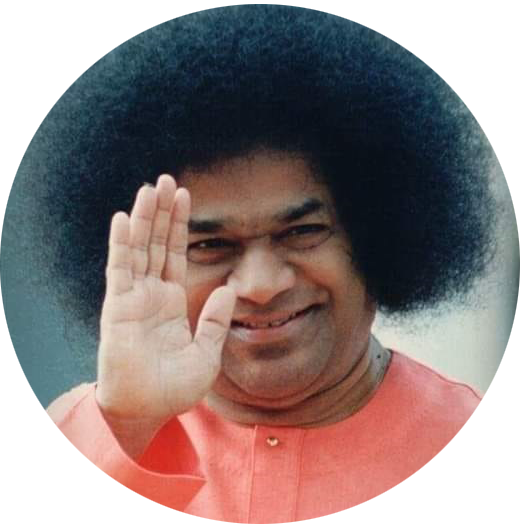
Ones of Divinity – compiled from the talks given by Ratan Lal (1918-2006)
SURRENDER
What the devotee
calls Surrender
The man who does
inquiry calls spiritual Wisdom.
Surrender is often
considered to be the supreme spiritual discipline. What is surrender? It does
not mean giving up worldly possessions, although there is a lot of sense in
offering what one has in excess to alleviate the sufferings of the poor and for
other good causes. Surrender of the mind means giving up the bad tendencies,
prejudices, and biases which are all conceptual limitations of the mind. Once
the sense of individuality, which causes the sense of separation from God or
Divinity, is surrendered, one obtains liberation. Then it is natural to accept
every happening as the Will of God, meant for one's own good. As Bhagavan Baba
says, "I know how, when, and what to do with each one of you."
Surrender and love of
God are synonymous. Following the path of surrender, one must develop the
spirit of acceptance. We must accept that whatever happens must happen. It is
the reaction of our past actions, which even God does not change. We must
develop the attitude that whatever happens is for our own betterment.
Everyone wants
unadulterated and permanent happiness. This can be obtained if one is free from
ego awareness. It is difficult for everyone to give up worldly attachments.
Surrender, or renunciation, does not mean abandoning one's property. In
surrender, what really matters is surrendering one's mind to God or guru, while
remaining in a state of acceptance. What does surrendering one's mind mean?
First, one must understand what one is referring to when one uses the word
"mind." The mind is an endless series of thoughts which have been
created by one's desires. The mind has the power to think, feel, and act. When
one surrenders the mind, one does not lose this power. One simply gives up the
bad tendencies, the prejudices, and the sensual limitations of the mind. Along
with surrender, one must develop faith, devotion, humility, honesty, and a
total and complete obedience to the commands of the guru.
Believing that one is
a limited being is what creates the problem of bondage. It is like the wave
feeling separate from the ocean. It makes no sense, because the wave is part of
the ocean. If one breaks down the walls in a room, unlimited space appears. In
the same way, if one destroys wrong knowledge, Reality will shine on its own.
One does not have to do anything other than to destroy the wrong knowledge.
This wrong knowledge is one's belief that "I am this body." One
believes that the infinite Being is restricted to a finite body. The refined
intelligence or Consciousness lies beyond the inert and
gross matter.
When one identifies
with a particular body, one imagines that the infinite Consciousness becomes finite.
That is the personal "I." One must make it impersonal. By doing this,
one will realize that one's true nature is the omnipresent Consciousness. When
one surrenders the mind by renouncing the feeling of individuality and the
belief that one is separate from God, one will realize that there is no limited
"I." That is called liberation. From there on, with one's limited
will, one will accept God's will. If one is convinced that everything that
happens to one is for one's own good, one will not be upset with whatever
happens. First, one should open oneself to one's guru. One should trust him.
Afterwards, one should open to and expand into Consciousness itself. What the
devotee (bhakta) calls Surrender, the individual who does inquiry calls
spiritual Wisdom (Jnana). Both are trying to take the ego back to the source
from which it sprang and make it merge there.
Once, a King had a
Prime Minister who firmly believed that whatever happened to anyone happened
for their own good. One day the King asked his wise Prime Minister to bring him
a knife so that he could peel an apple. The Prime Minister immediately brought
him a very sharp knife. As the King was peeling the apple, he accidentally cut
his little finger. The Prime Minister then told him that whatever had happened
was for his own good, so he should not worry. The King was furious and ordered
the Prime Minister to be put into prison. The next day, the King went hunting
in the forest, accompanied by a large group of attendants. Ill–fated that he
was, he was separated from his guards and was soon lost in the thick forest.
While he was wandering around, he was captured by a wild tribe who thought that
he would be the best sacrifice they could offer to their goddess. A few minutes
before they were going to sacrifice the King, they discovered his finger was
injured. Since they could not sacrifice a deformed body and offer it to their
goddess, they freed him. When the King returned to his kingdom, he ordered the
Prime Minister to be set free immediately and called for him. After telling him
about his adventure, the King said, "You always assured me that whatever
happens to us is for our own good. Now I realize that my life was saved because
of my cut finger. But what good has it brought you to be imprisoned?"
"Your Highness," replied the Prime Minister, "If I had not been
in prison, then I would surely have accompanied you. Instead of you, they would
have sacrificed me."
Surrender may seem
easier for some people because they believe that once they have said "I
surrender" to the Lord, they are free to do whatever they like. That is
not surrender. True surrender is to give up the ego-to be completely without
likes and dislikes, admitting one's own inability, and dependence upon a Higher
Power. The extinction of the ego will bring about a state that is not different
from spiritual Wisdom (Jnana).
Consciousness is not
an object to be theorized. The only language known to the Self is silence. It
can be felt only when the mind is free from thoughts and when its attention is
turned toward its source. In the beginning, concentration is imperative to hold
onto a single thought. Finally, even this thought vanishes. What is left then?
The answer is Being-Consciousness. That is the Truth.
Nobody doubts his or
her own existence. No outside confirmation is needed to know that we are. The
continuity of one's being is the essence of one's nature. That is the Ultimate
Truth. The French philosopher, Descartes, from whom· modern philosophy emanated,
exclaimed in his famous dictum, "I think, therefore I am." The truth
is the other way around, "I am, therefore I think." The "I"
-thought, which is itself only a thought, is there because of the existence of
Consciousness. Nothing is apart from Consciousness. One may call it the
Ultimate Power. In order to realize this fact, the mind must be silent. Truth
is not reached by conceptualizing new theories over the relatively real. Being
in the state of Self is beyond both know ledge and ignorance. To know the Self
is real knowledge.
In a film, we see
heroes and villains performing on the screen. We get so engrossed in the film
that we ignore the screen. However, can we see the film without the screen? The
screen is its basis. In the same way, our True Self, or Consciousness, is the basis
of our daily life. It is present in the three states of mind that we undergo
every day. These three states are: (1) The Waking State, (2) The Dreaming
State, and (3) The Dreamless State. In the third state, the mind stops
functioning. That is why, when we wake up, we say, "I had no dreams."
The fact that we know we have been through a dreamless state is evidence that
Consciousness is there. In fact, one does not remember anything, which means
that Consciousness can exist without the mind and thoughts. Thoughts, however,
cannot exist without Consciousness. Consciousness is the foundation of all that
we see. The seen and the seer are contents of the mind. Consciousness has no
contents. The only thing we can say about it is that it always exists.
For any experience in
daily life, three factors are needed: the one who experiences, the act of
experiencing, and the object experienced. We should try to uncover the nature
of the first person, in other words, the subject of the experience. This will
bring us closer to Truth, because the apparent subject, in its turn, is only a
reflection of the Divine Atman. The thought "I" is the first person.
It is the first thing to arise from the Atman, and on this thought are strung all
other thoughts. The first person "I" is needed in order to experience
the second and third person, in order to experience anything. On this shadow,
the whole world is built up. How can we understand Truth if the subject itself
is not doubted? If this first person, he who understands, does
not really exist, can the reality of the experience be true?
We usually believe
that the experiences of the waking state are the touchstone
of Reality, although the criterion of Reality is Reality itself. It cannot be measured
with anything that arises from it. What is Reality? It is the Eternal Being,
which is not subject to change, decay, and death, which shines on its own. It
is the Light that does not need any other light to reveal it. It is
self-revealing and self-illuminating. It reveals everything seen through the
subtle organs of the intellect, the mind, and the body. This Light is the state
of Bliss. That is why it is characterized by the terms Being, Consciousness,
and Bliss.
Mention has been made
about the three states of mind, but what happens when someone dies? Is that a
different state of mind?
Who dies? The body,
whether it is cremated or buried, is not reborn. The mind, with its tendencies,
departs, so it is born again and again in the right conditions, at the right
time. If the tendencies become extinct then, one is not born again. One attains
liberation (Mukti) while still in the body. The body will go on acting
according to its karma, but there is no one now to experience it.
How is the goal of
Devotion "(Bhakti) the same as that of Wisdom (Jnana)?
One attains
liberation (Mukti) while still in the body. The body will go on acting
according to its karma, but there is no one now to experience it. Whatever the
means, the destruction of the sense of "I" and "mine" is
the goal. The destruction of one leads to the destruction of the other. In
order to experience the uninterrupted awareness, which is the core of one's being,
one may follow the path of Knowledge. This removes the sense of "I."
Alternatively, one may follow the path of Devotion, Surrender, which removes
the -. sense of "mine."
Then who or what can
destroy the mind?
The mind is the
instrument. The mind cannot destroy itself.
It is like turning
the thief into a police officer. Inquiry in the mind, with the mind, by the
mind brings the mind under the control of the Self. The same force that is
pushing from outside will pull from inside. By remaining still, the mind can be
absorbed in Atman. The practice and the goal are the same.
The mind is only a
bundle of thoughts that have been produced from the desires of the senses. Once
a holy man suggested to the speaker to put a photograph of the speaker on his
desk, and he instructed the speaker to repeat mentally, as much as possible, "I
am not this, I am not this." This, the holy man hoped, would convince· the
speaker that the infinite Self is not limited to a particular body. The most
common mistake is to consider the mind to be independent of the Divine Atman.
The mind imagines that it can function on its own and that it can understand
and judge the Atman, develop theories about it, and imprison it in the frame of
an idea. The pride of the mind or ego, the limited or personal "I,"
goes to extremes. This limitation has to be removed with some spiritual
practice. It does not matter which Spiritual Path one chooses. You may choose
the path of Action (Karma Yoga), Devotion (Bhakti Yoga), or
Selfinquiry (Jnana Yoga).
ls it possible to
extend the interval between two thoughts? Is not wanting to expand that
interval also another thought or -desire?
To want to know one's
nature is a desire, but there is nothing bad in that. What one should desire is
to keep the mind free from thoughts, i.e., to remain in the natural state of
the omnipresent Self. That which is eternal seems temporary to the mind. Put
this limitation aside, and this state will reveal Itself as It Is. The mind can
neither extend it nor can it shorten it. Do not let the mind intervene. Let
thoughts appear, but do not pay any attention to them or run along with them.
Every time a thought comes into your mind, which is a natural process, because
of the past tendencies, ask yourself, "To whom does this thought belong?"
The answer will be "To me." Afterwards, with a calm mind, ask
"Who am I? Am I the one who appears and disappears?" Whatever appears
and disappears is not Real. Just as persons carrying water pots on their head
are able to keep a conversation going while walking, there is a very simple
method that one can practice even when one is doing other things. The full
attention is not needed in order to balance the pots. In the same way, the
purpose of practice is not to be immersed in your thoughts or actions. While
attending to one's thoughts, words, and deeds, one should not forget that the
power to speak and think originates from the Self. When attention is focused on
this Reality, it does not matter how many thoughts come; the attention will be
settled in itself.
To surrender and
refrain from the feeling that "one is doing" leads
one directly to the acceptance that every single thing is a gift of God. Soon
one understands that one does not do anything. Everything simply happens,
that's all. The mind of the seeker vanishes. He loses the feeling of being
separate. He loses his identity, his ego. When the mind opens and remains
empty, he is filled with his guru's grace. The energy flows toward the mind in
a constant process of transmission.
When the intellect
stops being active, the experience of the Self, focused on the Self, will
remain. The Self sees the Self. This is the true experience of the Self, not
just an intellectual understanding. For this reason, practice is required. This
should be with the belief that one, as the body-mind complex, has the ability
to function only with the power of the Self. This belief will strengthen
through practice. This Reality is not in books or in words. It is in one itself.