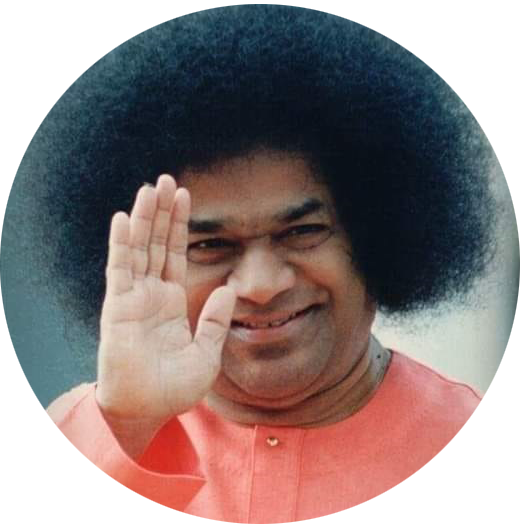
Ones of Divinity – compiled from the talks given by Ratan Lal (1918-2006)
CONTROL OF THE MIND
Meditation is the
means for recognizing the nonexistence of ignorance.
Vedanta advises us
that the mind should be controlled. The mind's nature is to think. Its tendency
is to go outward. It limits itself because of the notion that it is the body.
It must be educated to comprehend its true nature, which is Consciousness. Due
to its negative tendencies, this infinite Consciousness appears bound to the
individual body. According to Vedanta, the experiences that we have during our
waking state do not constitute Reality. The yardstick of Reality is its
permanence. The tendency to limit and individualize the infinite Self has to be
removed hy spiritual practices. When these weaknesses are removed, the mind
will preserve its power to think, feel, and act correctly. It will become clear
and balanced. It is unreal to limit the Self to names and forms, which
continually change and perish, and real to regard all as the Self. The
reflected light of the mind is necessary to perceive objects. To see the Heart,
it is enough for the mind to be turned towards it. Then the mind loses itself
and the Heart shines forth. Hold directly to the thinker, and he will
automatically sink into the source, which is Pure Consciousness. All that is
seen, including the seer, appears on the screen of Awareness, which is another
name for Pure Consciousness.
The mind is an
instrument used for turning towards God. However, one pays too much attention
to the mind's commands. For this reason Divine Baba says, "Love of God
reduces the mind's desires. One should not follow the mind continuously and
move far from the joy one could attain if one 'became' the Being that one truly
is." One ought to treat the servant as a servant, and not as a master.
Bhagavan often says, "Master the mind. Be a Master-mind!" It is not
even a matter of "becoming" what one is. One is already what one is.
To master the mind is to realize the value of what is already attained. It is
not gaining something new.
Atman is existence.
The "I" is permanent. It shines and reveals itself of its own accord
and reveals everything else around. It is the substratum of the intellect,
mind, and body. These can function only with the light of the Divine Atman.
Twenty years ago,
when Bhagavan Baba put the speaker onto this path of Self-inquiry, He said,
"Consciousness is Your Reality." This Consciousness is wholly
unrelated to the body and transcends all awareness of things and thoughts. It
is a matter of direct experience transcending knowledge and ignorance. The
normal waking experience is a triad· of the mind, involving the seer, the act
of seeing, and the seen. When one contemplates, one ignores the seen and the
act of seeing and concentrates on the seer. This transfers attention from the
object to the subject. To experience Consciousness, one must consciously
withdraw from all sense objects, all concepts, with single-minded attention. Once
the mind is quiet, one will realize the unity of all. The source of the mind is
Consciousness, but limitations are superimposed on it. One should shed these
limitations through spiritual practice.
To realize what one
really is, one has to bypass the mind. One has to move behind and beyond the mind.
It has to cease its efforts. The only effort required hy the mind is to find
its own source, which is the Ever-present Awareness. It is unaffected, unbroken
and unchangeable. When one sees a film, there are scenes ll1at depict a raging
flood or fire, etc. The screen itself remains unaffected. So also, one's likes
and dislikes do not affect one's real nature. The happiness and unhappiness
that one feels are joys and sorrows of the mind, not of our Consciousness.
One feels happy or
unhappy as, and only as, one attends to the dictates of the mind. That is why
Divine Baba says, "Love of God reduces the desires of the mind."
The mind is only an instrument or servant. By following the mind, one distances
oneself from happiness. Happiness is obtained by being the Self I hat one is.
That is why happiness is called "Being–Awareness–Bliss" (Sath–Chith–Ananda).
That happiness cannot be obtained from an external object. II can be had only
by abiding in the Self. It means the mind merges in its source.
Abiding as
Consciousness is the true state of happiness, and one becomes aware of it
intermittently. In other words, it is an interval between two thoughts. A
question may arise as to whether that interval can be prolonged by conscious
effort. The entire effort mind can do is to remain at its source. Full
attention must be fixed there. Then, no matter how many thoughts come and go,
one will not be affected. When one does anything –work, think, talk, etc., –
only partial attention is given to the action, thought, and word. The power to
do, think, or speak arises from our true Self. Once one is fixed to that
Reality, no matter how many thoughts arise, ultimately the attention becomes
fixed on itself. One is not the mind, so leave the mind aside. Then Consciousness
will be intuited as it is. When the intellect stops
functioning, the Self is focused on Itself. For this, conviction and practice
that one as mind-body complex is able to function only with the power of the
Self are necessary.
In the beginning, one
practices spirituality from the mental point of view, imagining God as an
outside object. Contemplation takes one to merge with God, and in that very
moment attention is taken away from the objects and gets fixed in the Heart,
which is the seat of the Self or Consciousness. The feeling of separation
disappears the moment one overcomes limitations through appropriate practice of
Selfinquiry, Devotion, and Love towards the True Self.
The Self is infinite
and not limited to a particular body. It is the limitation of the mind that
confines the infinite Self to a finite body. The mind is only a rection of the
Divine Atman or Consciousness. Imagine it to be independent, and it will sit in
judgment on the Atman. Such is the pride of the ego. One does actions mostly
for one's selfish purposes. Unselfish actions dedicated to God are better. Do
actions that tend to lead one towards Divinity.
People come to
Prasanthi Nilayam to get their spiritual aspirations fulfilled. Here, they feel
the impact of the vibrations and radiation of Bhagavan. They are able to gather
strength and concentrate on the spirit. No doubt, God is with all everywhere.
Until we are established in Him, we need the proximity of spiritual leaders and
Avatars like Bhagavan Sri Sathya Sai Baba.
Meditation is the
means for recognizing the absence or non-existence of ignorance. No one can deny
one's existence. Existence is Knowledge, that is Awareness. This implies
absence of ignorance. When existence is absolute, it is all right. When
existence is particularized, it is wrong. The world is seen or known through
the instruments of the body, mind and reflected light. When the mind is
illumined, it is aware of the world. When it is not itself illumined, it is not
aware of I he world. Thus, knowledge of the world is indirect, while the
effulgence of the Self can be directly intuited. Do not allow the mind to
anchor on conceptual thoughts. Fix the mind inwardly, toward the source of
light, and the objective knowledge ceases, and the Self alone shines forth.
Thus, by shutting off the external noise, one can hear the inner music of
Eternity.
Can Yoga be combined
with Self-inquiry? How do the different paths relate to each other?
Yoga means union. Who
is to unite with whom? The Self is never separated from Itself. If the mind is
in turmoil, the body also becomes upset. If the body catches a cold or some
disease, the mind is also affected. The interaction between mind and body is undeniable.
Therefore, Yoga should not be considered as merely a physical exercise. Yoga
should be taught in a very simple way, in order that the mind and body do not
get strained. The idea of Yoga exercises is to bring the mind into a peaceful
and relaxed state. The mind has to subside, to abide in the Self. The mind
cannot know the Self. The mind is the Self. This is union.
Four paths of
spirituality have been discussed, namely, Service, Yoga, Devotion, and Wisdom.
The supreme queries in all paths are: "Who wants to serve?" "Who
feels the sense of separation?" Who wants to love, be devoted?"
"Who wants wisdom?" Is there some separate entity? In the path of
Self–inquiry it is taught that there is no separate entity whose ignorance has
to be lost. The extinction of the ego is the culmination of all paths. Yoga, if
done regularly, is a very good exercise for health. Just as medicine is taken
regularly to cure a disease, and as one eats every day, so must one do with
regularity one's spiritual exercises, whether mental or physical.
Some individuals say
that Divine Baba has told them to teach how to raise the Kundalini. Baba has made
it clear that He has no intermediaries. The relation with Him is direct, heart
to heart. Bhagavan often says, "I know when, how, and what to do with each
one of you. People get misled because they do not have the correct approach to
Truth; they have not been exposed to the Divinity directly. Even if the
Kundalini, in which many people find interest, is raised to the center of the
head, ultimately it has to come down to the Spiritual Heart to have peace. The
Spiritual Heart, which is in the right side of the chest, is the 'seat of the
Self or Consciousness."
The highest
meditation, it is asserted, takes the form, "I Am Pure Awareness." It
is further explained that when one leaves aside the body and inquires, “Who am
I?" one stays as "I," which shines as the Self. Yoga is like
trying to control a turbulent bull through the use of force. Self-inquiry is
like subduing it by coaxing it with green grass. Hence, the great ones declare
this to be the most direct and the best means.
Many people ask the speaker,
"Have you realized God?" The answers, "I have realized" or
"I have not I realized" are both wrong. Atman is always real. Atman doesn’t
need one to make it real, to realize it. Reality is always real. Unreality will
always remain unreal. Atman is always the same-unbroken, unchangeable, unaffected,
permanent. It cannot be changed. It is revealed only when anything obstructs it
is removed.
Reality is always
attained. One great saint has written that there is great happiness in
discovering what is already there, rather than inventing something new. Here is
a story about ten persons who swam across a river. After reaching the other
side of the river they wanted to be sure that all ten of them had reached
safely. One person said, "Stand in a row." Then he counted:
"1,2,3,4,5,6,7,8,9 ... One is lost," he said counting everyone but
himself. "You do not know how to count. I will count now," declared
another person. He also left himself out. Each one of them took turns counting,
and made the same mistake of not counting himself, and came to the erroneous
conclusion that one of them was lost. They started crying. Then a wise man, who
was passing by, saw their plight. He said, "Stand in a row, and I will
count.'' He counted ten men because ten they were. Everybody was happy that no
one was lost. They recognized what was already there. To realize Atman is like
this-gaining happiness from rediscovering something imagined lost. Another
example is the woman who searched everywhere for her necklace. "My
necklace is lost," she said. The people around her told her, "You are
wearing it around your neck."
When something is
already there, the question of realizing it does not arise. Divinity is
permanently there, whether the wrong notion of you is there or not. The
ignorance has to be removed – by service, yoga, devotion, or other means. Some
people prefer meditation. Meditation (Dhyana) is not sitting quietly
with closed eyes; it is being free of thoughts, free from misery of mind. Dhyana
actually means Attention. The entire attention should be directed towards the
Self. Thus absorbed, for long intervals, the natural state gets perpetually
devoid of "I" – sense. Whatever is ever–present, its awareness is
called Self-knowledge. The state of meditation is always present. It is one's
true nature. Instead of meditating upon something external, to focus on
"That" is the highest meditation.