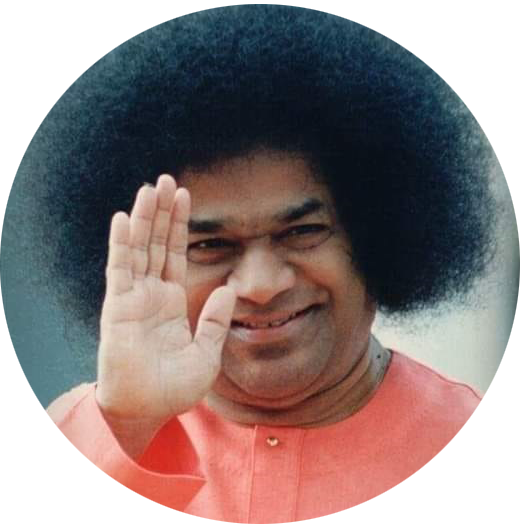
Ones of Divinity – compiled from the talks given by Ratan Lal (1918-2006)
VISION WITHOUT BEGINNING OR END
Whatever appears is
bound to disappear.
Hold on to That, in
which everything rises and sets.
Creation is not
independent of its substratum, just as a film cannot be seen in the absence of
a screen. The projection seems real, even though it is an illusion. The world
is so colorfully attractive that it is difficult to be distracted from it. It
is considered to be an illusion to enable people to turn their attention from
it to that which sees, the seer.
In the beginning, one
practices spirituality mentally. One imagines God as an object on which one
must meditate. One remains at this meditation and reaches the point of corning
near to Him. When this happens, attention is transferred from the object of meditation
to the Spiritual Heart-in other words, from the head to the heart. When
attention is finally centered on the Heart, which is the place of Being–Consciousness,
the merging with Reality, the true nature of man, is induced.
On one's voyage
towards the ultimate goal, there are various obstacles, of which the most
important are the tendencies (vasanas) of the mind. They make us imagine
that we are different from the Divine Atman. This feeling of separation
vanishes only with the practice of Self-inquiry, Devotion, and Love towards
one's true Self.
The tendencies can be
subdued and finally erased by thinking more of God than of the world. We will
reach the point where the mind, without losing its power to function in the
world, transforms into the Divine Atman. What it will lose is its attachment, its
narrow-mindedness, and its limitations.
People talk about
their experiences as if they are real. They are only mental illusions. When we
feel happy, it is because the mind has stopped for a moment and has remained
empty, without thoughts. Henceforth, one must realize that such states of
"elevation" and happiness do not come from external objects as such.
Without us even knowing it, the mind, in a fraction of a second, is immersed
into its Source and draws from it the bliss it experiences.
Visions may appear
and disappear. The following story elucidates the importance of fundamental
discrimination. A disciple of Sri Ramana ·Maharishi was praying in front of the
picture of his beloved God, Krishna. Suddenly, Ramana appeared next to him and said
to him, "If you want to see Krishna, repeat this mantra
continuously." He started repeating the mantra immediately. Nevertheless,
he had a few doubts and decided to visit his master to inform him about them.
"Bhagavan, was
it really you who taught me the mantra?" He asked.
Ramana replied,
"Hmmm-mmm."
"Shall I
continue repeating it?" The disciple asked.
"If your heart
orders you to," said Ramana.
From that moment, the
disciple dedicated himself to repeating the mantra with such diligence and zeal
that whenever he would see someone coming towards him to speak to him, he would
leave. He had great fear that he would have to interrupt, even for a moment,
repeating the sacred formula on which he had placed all his hopes. Finally, one
day the miracle happened. Krishna stood before him! He felt such joy in his
soul, the like of which he had never felt before. What he had desired for a
whole lifetime had become a reality. At his next visit to Ramana, he said to
his master,
"With Bhagavan's
grace, I saw Krishna."
"Ah, Yes! So
Krishna came?"
"Yes, He
appeared in front of me. Oh, what a joy! "
"And then he
left?" asked Ramana.
"Yes,
naturally," the disciple replied, a little surprised.
'.'Oh! Oh!" murmured
Ramana, with a smile.
The disciple
continued the mantra and his worship of Krishna with even more fervor. Who
knew? Perhaps someday Krishna would visit him again. Truly, again in the same
place, while he was offering flowers and incense to Krishna, he saw a figure in
front of him. What happened? It was not Krishna with His flute. It was neither
Radha, Krishna's beloved. In front of him stood Rama, with His bow and arrows
and accompanied by His brother Lakshmana. Completely perplexed, he consulted
the most renowned swamis (holy men) of Madras. No one could explain to him why
Rama had appeared, though all the time he had been praying and waiting for
Krishna. It was Krishna who had bewitched him. Why had Krishna played
with him in this way, he wondered. As soon as possible, he returned to his guru
and told him what had happened. He then asked, "Can you explain what
happened to me?”
Ramana only smiled
and said sweetly, "Krishna visited you, then went away. Rama did the same.
Why do you spend your time with gods who come and go? Have you not understood
that Japa, Mantras, rituals, and prayers are excellent up to a
point, but a time comes when you must abandon them all? You must take a step
further. In taking this step,· you will find the Real. Only when you have left
all behind, even the gods, can you have the vision without beginning or end,
the vision of the Ultimate Self."
From that moment, he,
Krishna's devotee, stopped worshipping His form. In the depths of
his heart now glowed the vision of the ever-present Reality. He had wanted to
see God. God finally revealed Himself so close that it was almost impossible to
address Him as "You." Henceforth, the "Only Light" shone
within the core of his Existence.
Completely free, the
Self has no need for anything else, not even for the intervention of the mind.
The mind must be eliminated, since it is only during the state in which there
is no mind that it is possible to have the experience of the real Self. It is
true that the Self relates to the body. Yet it also surpasses it, just as much
as it surpasses the mind and thoughts. One must prepare oneself for this direct
experience of the Self. Consciousness is to direct our attention to the
interval between two thoughts. Just as the example mentioned earlier about the
screen and the film, Consciousness exists without thoughts, but thoughts cannot
exist without Consciousness.
In one of His
interviews, Divine Baba opened his hand to show His palm and asked, "What
is here?" No one answered. Baba was requested to give the answer. He said,
"Everything is here." Then He added, "Whatever is there
(pointing out to the world) is nothing.” In other words, the seer is permanent.
The seen, is temporary. Whatever appears one minute and disappears the next is
only a mirage, an illusion. It is not real. That which appears seems real. When
it disappears, it ceases being real.
Most of the people
have the tendency to think that Reality is external to them. One attends to the
world by letting the mind stray outward. Spiritual practice leads one to
realize that the mind and body emanate from Consciousness. Whatever appears and
disappears, such as visions and thoughts, are external to us. Even the one who
is thinking can be observed as an object. When one knows that the external
world is a myth, it is easier to become detached from it. The stillness of mind
accompanied by Consciousness is the goal of all practices.