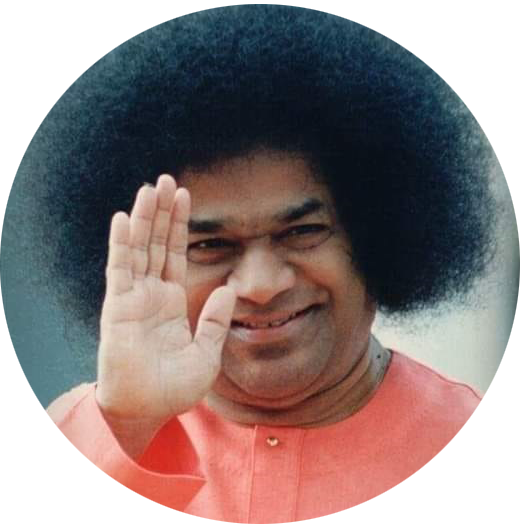
Sai Inspires – Prof. G. Venkarataman Guru Poornima Special Offering
(Daily Episode)
Part 13
True spirituality
emphasizes the truth that is common to all religions. One should not hate any
religion or ridicule any form of worship. One must recognize the unifying truth
in all religions. God is not separate from you. However, by regarding God as
separate from him, man resorts to various kinds of worship. In the present day
world, this type of Karmopasana (worship through action) is necessary.
But one should not be engaged all his life in this form of worship. Gradually
one should reach a higher level. Only then humanness gets divinized.
–
Divine Discourse, December 18, 1994.
REFLECTIONS
Sai Ram. Back in the
old days, Swami often used to say:
God comes down as man
in order to raise man to the level of God. So, understand clearly why I am here
and how I am trying to help you. Therefore, don’t waste this golden
opportunity, which comes less frequently than even the proverbial Blue Moon!
In the above Sai
Quote, Swami gives a simple formula for rising to the level of God. Few realize
that all of Swami’s teachings are extremely simple. However, so immersed are we
in worldly life, that we don’t even know what Swami expects of us. And if we
try to spend a minute or two trying to find that out, there is the cell phone
to make us forget God in a jiffy and pay more attention to some silly text
message coming from somewhere or the other.
Since everybody is
more comfortable with short messages, let me break down the Sai Quote of the
day into such short messages.
Message 1 from God
is:
People may follow
different religious faiths but all religions talk of God. They also say that
God created all beings. Clearly therefore, there is only one God for all.
Message 2:
Since God is only
one, His message also is only one; and that Message is referred to as
Spirituality since it deals directly with the Spirit or Soul within you.
Message 3:
That Spirit or Soul
within you is nothing but God; since there is only one God, the same God
resides in all Hearts, acting as a personal advisor to the individual
concerned.
Message 4:
Since the same God
resides in every individual, He gives the same advice to one and all. We may
make mistakes and understand it incorrectly. But God’s message to all is always
the same. And it is that message that is commonly referred to as Spirituality.
Message 5:
This is the summary
of all of the above and it says God is in you and you should not ever forget
it.
The question now
arises: “But what about religion? Whether we like it or not, most people are
born into some religion or the other, and they adopt the practices including
forms of worship, prescribed by the faith they belong to. Does not all this
clash with spirituality? How does one resolve all this?” Swami’s answer is
simple. He says effectively:
When you join a
school you are admitted to the lowest class. From there, you slowly make your
way to higher classes by learning new things, pass the high school exam, then
go through college and if you are bright, join a famous university like
Harvard, where you find people from many parts of the world. Similarly, when
you look at say the Atlantic Ocean, you find rivers from North America, South
America, Europe and Africa ‐ all empty into the same ocean. Once their waters
mix, their earlier identities cease to have meaning. In the same way, religious
rituals must be practiced mainly to seek the God within and realize that all
are children of One God and one God only. If this feeling does not grow, then
people would continue to be divided by religious differences which at times can
be so strong as to even lead to much violence. Millennia have been spent in
arguing about such differences and even wars have been fought to establish the
superiority of one creed over another. All that is meaningless. That is not what
God wants, and all such conflicts in the name of God are actually against God!
In the quote we
started with, Swami makes all this very clear. Just to remind you, this is what
He says:
But one should not be
engaged all his life in this form of worship. Gradually one should reach a
higher level. Only then humanness gets divinized.
That should make it
absolutely clear. Ritualistic worship is like using floats to learn swimming.
Once one has learnt how to swim, clearly there is no need any longer to use floats.
In the same way, at some stage, one must graduate from routine rituals to experiencing
God in His highest aspect by experiencing Bliss. That is the test of humans rising
from the level into which they are born to a level where they become one with
God. That is the meaning of humanness getting divinized.
All this may not be
clear right away but ought to be, provided one reflects deeply about all this.
Why don’t you then take some time off and do just that?
Thank
you and Jai Sai Ram.
Part 14
Man is the highest
object in creation. Man should not be a creature of instincts like the animals,
which are subject to Nature, but should become a master of Nature. He should progress
from the Nara (human) to the Narayana (Divine). An intelligent
human being should not regard himself as bound by Samsara (worldly
attachments). It is not the world that binds man. It has neither eyes to see
nor hands to grasp. Man is a prisoner of his own thoughts and desires. In his
attachment to the ephemeral and the perishable, man forgets his inherent
Divinity and does not realize that everything in the Universe has come from the
Divine and cannot exist without the power of the Divine.
–
Divine
Discourse, December 25, 1987.
REFLECTION
Sai Ram. In the above
Sai Quote Swami makes a most important point that we hardly ever pay attention
to or even bother to notice that it exists. These days, most people take it for
granted that this entire planet exists for them and them alone, and that they
can do what they want, irrespective of what it does to the millions of other
living species also living on the same planet, most of them for a much longer
period. I mean, we hardly care that tigers in the wild are being driven almost
to the point of extinction, even though they have existed for millions of years
while the human species has come into existence at best one million years ago.
In fact, humans as we now know, came into existence barely a hundred thousand years
ago, after which they spread all over, multiplied, and now, numbering a little
more than six billion, are threatening species not only on land but also in the
wide oceans, and polluting the atmosphere in a way that seemed unimaginable
barely fifty years ago. That is the context in which we should try to
understand the quote we are discussing today.
Let us read again
Swami’s opening remarks. He says:
Man is the highest
object in creation. Man should not be a creature of instincts like the animals...
I hope you paid
careful attention to the first words Swami says in the quote under consideration.
He reminds us emphatically that though we might have come late in evolution we
are in fact the most important entity created by God and placed on Planet Earth.
Having biologically evolved from lower species, humans too have limbs, eyes,
ears, nose, the sense of sight, hearing, smelling and so on. Like all living
species, humans are born, then grow and finally die. They also are governed to
a large extent by the survival instinct. But does that mean humans should also
live like animals? Now mind you, the phrase living like an animal is not meant
to be insulting to animals. Rather, the point being made is that life is not
all about being born, eating and growing, then becoming old and finally dying. Indeed,
if we look around, there is almost no place we cannot see proof of how much humans
have changed the planet, that too in a few hundred years. They have dug huge tunnels
through mountains and under the seas. They have built bridges across the widest
of rivers, and in a few places even across short stretches of the sea. They
have learnt to grow food which no animal species does, created huge cities,
landed on the Moon, can talk to each other if they are on opposite sides of the
earth, and so on. But in course of all this, humans are spending less and less
time asking themselves a few basic questions, and they are:
• Where did all
this awesome creative power come from?
• Does the Source
that bestowed us such powers, have anything special for us to do while on
earth?
A long time ago,
people had the leisure to reflect on such basic issues but alas, these days we
have more time for Facebook and Twitter rather than for examining what the
purpose of life is. Since we have forgotten that, Swami Himself reminds us what
it is. He says:
He should progress
from the Nara (human) to the Narayana (Divine).
What Swami means is
that every single human being has a Spark of the Divine within and is verily an
Embodiment of God, embodied with a human form. This form is quite unlike other forms
in what it can do. More than anything else, humans alone can contemplate on the
purpose of life and appreciate that the blessing of life has been given for us
to realize that from God we have come and to God we must journey via life. That
is the reminder Swami is giving us.
OK, but do we do
that? Hardly ever; instead, we give a thousand reasons about how we are tied up
by family, business, politics and what not. Basically we say, “Listen, I am
tied up with all these commitments. How do you expect me to meditate on God and
journey towards God? What happens then to all these obligations I have?”
This is an old
argument and has also been answered a long time ago. Reminding us of the answer,
Swami says:
An intelligent human
being should not regard himself as bound by Samsara (worldly attachments).
It is not the world that binds man. It has neither eyes to see nor hands to grasp.
Man is a prisoner of his own thoughts and desires.
If you listened to
that carefully, you would realize that when we say the world is binding us, we
are merely giving a flimsy excuse. As Swami asks, how can the world bind? Does
it have hands, legs and eyes to catch us? Absolutely not! What bind us to the
world are our desires. We want wealth and when we get it we do not want to let
go, no matter what the circumstances. We want power, it is again the same
story; we just do not want to let go, no matter what. It is we who hug the
world and not the other way around. And why are we so passionately attached to
objects and entities of the world? Because of various desires that arise in the
Mind. And why do such desires arise in the Mind? Because the Mind suffers from
the delusion that power, possessions and self can all give us happiness.
Somehow, we think ultimate happiness lies in these things that I just mentioned
and thereafter spend an entire lifetime chasing them and holding on to the
pieces that come within our grasp.
But is this what God
expected us to do when He created us with human form and put us on the planet?
As explained earlier, definitely not. He had something else in Mind for us. OK,
why then do we all uniformly forget what God has told us to do, namely to
journey from Nara to Narayana? Here is the answer:
In his attachment to
the ephemeral and the perishable, man forgets his inherent Divinity and does
not realize that everything in the Universe has come from the Divine and cannot
exist without the power of the Divine.
I hope that makes it
all clear. First, man allows his mind to mislead him and then goes after the
trinkets of the world, thinking they would all get him happiness. Next, even
when he finds that they do not, he does not let go because of the disease of
attachment. Like a lice, desires attach themselves very strongly to the Mind;
and like lice which sucks blood, desire clouds latent Divinity very
effectively, making humans forget that they are the embodiment of God and are
expected to use life to get back to God. They use the tremendous power of God
to even change the face of the Planet, go out into space and peep deep into the
atom. Yet, they are unable to use that same power to do what God wants them to.
So, dear reader, when
we cry out: “Swami, we Love YOU!” we should all pause for a moment and ask the
following questions:
• Swami wants us
to realize that God is truly within us, but what serious efforts are we making
to achieve that realization?
• Swami says if we
want to connect with God within, we must first peel off the many layers of
ignorance that covers the Divine Core. Do we know what procedure must be
employed to do the peeling off, and if we do, how much time do we devote for
that spiritual scrubbing?
• Do we realize
that all our so‐called worldly achievements, be it in sports, the arts, or even
in the world of business, politics and statecraft, all of these come via the
use of special capabilities gifted by God to us individually? And that these
powers are really meant to be used also for a nobler purpose?
The last point that
Swami makes is not only very powerful but also highly meaningful in today’s
context. Again and again, Swami exhorts us to realize our Higher Self and
become one with Him. But, allowing ourselves to be trapped by a cage of desires
and attachments built by the mind, we cry out from within, “WE LOVE YOU SWAMI!”
without making the slightest effort to knock off the cage. We plead
helplessness, which makes no sense really, since attachments come from our own
minds and can never be imposed. Gandhi once declared, “No one can take away my
self‐respect, unless I choose to surrender it.” In the same way, says Bhagawan,
man stays put crying he is in a trap, when it is he who has chosen to be
trapped! And yet, he can get out of even that powerful trap of worldly desires,
if there is something he desires even more. If we TRULY love God, then God’s
love for us would help us smash that cage and liberate us. The question thus
boils down to: “How much do we really love God? Is it sufficient enough for God
to say, ‘You are dear to Me,’ and draw us to Him?” That is the issue we ought
to ponder about. Think about it!
Jai Sai Ram.
Part 15
The astonishing
progress of science and technology has not brought with it corresponding powers
of discrimination and wisdom. Man must realize that the sense organs, through which
he explores the external and discovers the powers latent in Nature and the
physical universe, function because of the Divinity which is immanent in them.
Without the power of the Divine, the eyes cannot see, the ears cannot hear nor
would the mind be able to think.
–
Divine Discourse, May 12, 1984.
REFLECTIONS
Sai Ram. The above
Sai quote, is ideal for the present day, when almost everyone, in particular
the young, is overwhelmed by the astonishing gadgets now available, and indeed spends
a large part of his/her time, sending messages to all sorts of people, trying
to find out what others are saying, following the gossip that is choking the
airways or just playing games. This is merely the lower end of getting hooked
on science and technology. One could also go to a higher level, becoming fully
absorbed in understanding science itself or in using scientific knowledge for
discovering technological applications, like a new and more efficient way of
harnessing solar energy.
At this stage, let me
make it perfectly clear that there is per se nothing wrong in science or technology
or in inventing scientific gadgets. I am from a scientific background myself
and therefore all for Science & Technology, provided
a) everything is kept
within bound, and
b) neither the
knowledge nor the gadgets that knowledge gives us is misused, particularly to harm
or hurt others.
But does it all end
there? Certainly not, and that is the point Swami is making in the quote we
heard earlier.
To appreciate better
what precisely Swami is telling us, let us for a moment ask ourselves a few
simple questions like: “How do scientists go about their business? How do they
work?
What are the tools
they use?” And the answer to this is that man seeks scientific knowledge
a) by keen
observation, and
b) by thinking deeply
about how his observations can be explained?
For example,
thousands of years ago, people in Egypt and Greece, India as well as in China, independently
discovered pattern in the movement of celestial objects across the sky, particularly
the night sky, and derived empirical rules that allowed them to prepare almanacs,
some of which are in use to this day. In other words, observation and
hypothesis testing formed the two pillars of scientific enquiry. Where
observation was concerned, in the beginning, humans used their senses directly,
that is to say, they used their eyes and ears mostly to record their
observations. Later, they began to use instruments, starting with those that
enabled them to measure distance, weights and time.
Soon followed others
that could measure temperature, pressure, and so on. Along the line came the
telescope which enabled one to look deep into space and the microscope which allowed
one to peer inside small and tiny objects. These days, despite all the complex electronics
and automation that form a part of scientific equipment, all of them represent nothing
but extensions of the senses. In short, the pursuit of scientific knowledge
depends solely on the senses and the human brain, which helps to codify the
observations first into patterns and then into theories with predictive power,
and so on.
That somewhat lengthy
preamble was intended merely to drive home the point that no matter what,
science as it is today, simply cannot go beyond the senses and the mind. And yet
we do know intuitively, that there are dimensions beyond the science and the
Mind. The ancient seers dared to explore that transcendental realm, and were
ecstatic to discover there a Supreme entity that we popularly refer to as God.
Thus it is that Swami often used to quote the ancient rishis who said,
There IS something
beyond the realm of the senses, words and thoughts which is indescribable. We
have been there and experienced the bliss of becoming one with that Supreme and
indescribably effulgent entity, i.e., God.
Keeping that in mind,
let us return to the Sai quote. What Swami is saying essentially is:
O man! You are so
proud of your abilities to explore to the farthest reaches of the Universe and
into the deepest recesses of the atom. Wherefrom did you get the ability to do
so? When you make a discovery, you thump your chest and proudly declare, “I made
that discovery”. But when you die, where does that ‘I’ disappear? All that
remains is a hunk of flesh that your relatives are in a hurry to get rid of,
after shedding some tears may be. All your fantastic discoveries and
achievements relate to what is within the boundaries of space and time, and
have been made using your senses and their extensions called instruments and of
course the power of your Mind. But wherefrom did the Mind get that power?
Sadly, few have
either the time or the inclination to ask such questions these days. In the Gita,
Krishna explains to Arjuna how God is immanent in every human being at three
levels. Simply put, the power of God is present in every single atom in the
body, which is why the laws of physics and chemistry are able to operate and
help the heart to work as a pump, the nerves to conduct electricity, the acid
in the stomach to breakdown the molecules that constitute the food we eat and
so on. All that is the power of God operating at the gross level.
Next, says Krishna,
God is present at a much higher level as the life force. It is not easy to explain
what exactly life is, especially in scientific terms; but we all know when a
person is alive and when the person is dead. Some mysterious power is present
within when the person is alive and when that power is withdrawn or shut off,
we find that the once active and vibrant person is now merely a hunk of flesh
and bones that start to decay rapidly; which also is why the body, as it is now
called, is disposed of quickly, maybe with some kind of a send‐off. Vedanta
refers to that mysterious life force as Prana Shakti and in the Gita, Krishna
explicitly declares that He is the one who supplies all that motive power, the digestive
power and even the power of the brain. So this is the second level of Divine presence
within.
God is present at a
third level also, as the power of awareness, which is highly tuned in the case
of humans. More explicitly, He is present as the Conscience. A few subtle
points must be carefully noted at this stage. They are:
• Conscience is
present in all without exception. However, some refuse to ever listen to it; some
listen to it occasionally, while yet others always obey their Conscience. It is
this that makes people different, with some being near devils, some being
reasonably good people and other being angels or saints.
• What is referred to
as Conscience is nothing but the Voice of God, speaking from within, and giving
good advice to every single individual all the time. If some people refuse to
listen to good advice, it is their fault entirely, and they also end up paying
the price. No use complaining at that stage.
• That also is why
Swami says often: Your Conscience is your Master. Always follow the Conscience.
• Although every
person has his/her personal Conscience so to speak, it is not as if there is a multiplicity
of Consciences. All the so‐called ‘Consciences’ are aspects of One God, and therefore
speak the same language, the language of the Heart. Which also is why Swami sometimes
says there is no such thing as Indian Truth, American Truth, Russian Truth and
so forth.
A few important
comments and amplifications to the above must be added at this stage.
• The question
arises: “Why is it that some people listen to their Conscience while others don’t?”
Swami has given the answer; it all depends on how sharp and tuned their buddhi
or intellect is. If the word buddhi sounds strange, just note that it is
nothing but the power of discrimination, and look up what Swami has to say
about discrimination, especially Fundamental Discrimination ‐ He has said a
lot, and you will find it most educative.
• Recall Swami’s
saying: “Bulbs are many but current is one”. What He is implying is that though
beings are many, it is the same God who, residing in every single Heart, gives
the same kind of advice to one and all. That is why the Language of the Heart
transcends all religions, because God is one and NOT many!
• We should also pay
particular attention to the remark Swami often used to make, namely,
“I am in you, with
you, above you, below you, behind you, around you,” etc. Through this saying
Swami is telling us, “Bangaru, you may see Me with this form which people refer
to as Sri Sathya Sai Baba. In truth, I am that Eternal, Transcendental Being
that is Nameless, Formless and beyond both Space and Time. In this physical
Universe, I am in you at three levels as I explained when I came as Krishna. I
am also everywhere, as Krishna explained and revealed to Arjuna. This time, I
shall merely offer a reminder, leaving it as an exercise to you to see Me not
only within you at every single level, but also everywhere in the Cosmos, from the
atom to the galaxy.
Keeping that last
point in mind, let us return to the last sentence of the Sai Quote we started
with. Swami says:
Without the power of
the Divine, the eyes cannot see, the ears cannot hear nor would the mind be
able to think.
This is nothing but a
reminder of the fact that life itself and the motive power of the living body
come directly from God. The strange fact is that every one of us uses the power
of God every single minute in some manner or the other. And yet, do we take
even one minute off during an entire year to ask: “What for has our Most
Compassionate Lord given us such wonderful gifts as eyes using which we can see
and enjoy so much beauty, our ears using which we can hear so many beautiful
sounds, etc.?” One wonders.
Swami says the senses
and mind no doubt are faculties intended to assist our survival; but the
special and superior capabilities of awareness with which humans have been
blessed are meant to make them realize
1) that there is God
above,
2) that we all have
come from Him, and
3) that life is meant
to be a journey meant to facilitate our reunion with God.
To those who claim
they are fine here on earth, Swami says, O man! You may believe all is fine
with you, and indeed it may well be true at this moment. But who knows what is
in store for you in future? I alone do. If you come to Me and become one with
Me then future would cease to have any meaning. Instead, it would be an
Eternity of Bliss. Why do you thoughtlessly forsake that and bet on trinkets in
the false belief that they alone would confer happiness? Happiness does not
reside in objects, possessions, power and self. True Happiness is Union with
God!
This, Swami does not
point out in today's Sai quote, but He has stated this on many other occasions.
It seemed useful to lead from what we heard to what we must always keep in mind,
which is why I steered the reflections in this particular direction.
Think
about it and write to us if you feel differently. Jai Sai Ram.