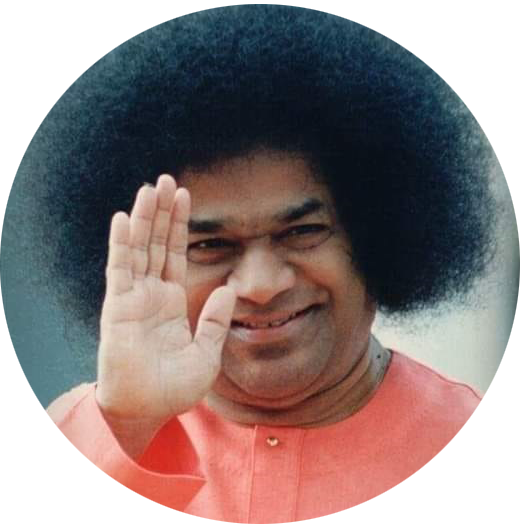
Sai Inspires – Prof. G.
Venkarataman Guru Poornima Special Offering
(Daily Episode)
Part ‐ 1
In 2006, eager to start
a service which will help everyone to connect with Bhagawan's teachings on a daily
basis, Radio Sai began 'Sai Inspires'. All who subscribed to this service, received
an email from us which had a concise message of Baba accompanied with His image.
This daily offering was received well, and soon the subscriptions grew. Today nearly
100,000 people from all corners of the world wait for this message to help them
tide over their day with peace and ease. The power inherent in these discourse capsules
is indeed tremendous. How much we benefit from it and how best we harness this energy
depends purely on how seriously we ruminate over these words and how sincerely we
put our learning into action. To help us in this noble and elevating exercise, Prof.
G. Venkataraman has taken time out to elaborate on these messages. His reflections
will not only give us a deeper understanding into what the Lord is communicating
to us but also give us tips to translate them into our daily practical life with
more ease.
The best way to value
the Master is to master His values. As we prepare to celebrate Guru Poornima
(July 19), when we pay our respects and obeisance to the Divine Master, let us work
to offer Him the tribute that the Lord loves the most from us ‐ to make our lives
His message, to make His love and wisdom shine in us. To aid us in this endeavour
we have this series where Prof. Venkataraman for the next 26 days will share his
insights on select Sai Inspires messages. We hope this will help us to understand
His teachings better and bolster our determination to walk on the sacred path.
What is Awareness Really?
There is a Divinity, higher
than humanity that is behind and beneath all man’s activities. However, man is not
aware of it and he fails to benefit by that awareness. His first task is to cognize
this source of joy and peace. That Divinity is like the thread in which the flowers
are strung; we see only the garland; we do not cognize the string that holds the
flowers together and makes a garland out of a heap of blossoms. Mankind is strung
together by this inherent Divinity.
REFLECTIONS
People usually think that
spirituality and the ‘real’ world we live in are totally unrelated. As a result,
we also keep God out of our normal lives, unless of course we run into a terrible
problem when we desperately begin calling upon God to save us, to protect us, etc.
All this is the result of a huge disconnect between humans and the Divine, concerning
which Swami has spoken often; yet, few take any notice of it. In the above quote,
Swami is explaining to us not only where we are going wrong but also why we are
doing so. Let us try to absorb slowly and carefully, what the Lord is teaching us
with so much patience and love.
Swami has often told us:
“In this Universe, there is only God and nothing but God.” We wonder: “How can that
be? I see around me a sea of devotees from all parts of the world. Then there is
this magnificent Sai Kulwant Hall in which we all are seated. And oh yes, over there
we see Swami who is God; that is granted. But how can the mikes before Swami, the
wonderful lights, the pillars, the various decorations, etc., all be God? They are
objects and entities, made up of metal, concrete, glass, etc. These material objects
are man‐made; how can they all be God? There is something here that I am totally
missing!” We sure are.
The difficulty I just
described is an old issue and does have a solution. In fact, Swami has Himself given
us a clue regarding how it must be sorted out. Swami’s clue starts with an old Vedantic
story which goes like this. There is a man in a village who opens the door of a
hut and goes inside. It is rather dark in there and far in the corner the man sees
something lying coiled up. Shouting ‘snake, snake,’ the man runs out closing the
door. The people in the village hear the cry, pick up a lamp, arm themselves with
big sticks, and cautiously enter the hut. In a far corner they too see this coiled
object. Inch by inch they move forward, holding their huge sticks up and ready to
bring it down heavily, were the snake to move and come towards them. But nothing
like that happens; and when they go close enough they find that what they thought
was a snake was nothing but a rope.
Vedanta now makes the
following observation: “There was always only a rope. It was there before the man
went in. It was there when the villagers went in to kill the snake that was supposed
to be hiding there. It was also there when they held up the lamp close to it. Now
if there was only a rope all along, where did the snake come from?” Swami says that
the snake was purely a product of the imagination of the villager who first went
in. The image of this illusory snake then got superposed on the rope that was really
there after which, instead of seeing a rope the man began to see only a snake. And
when he reported that there was a snake in there, all the others believed him, till
they held up the lamp. The moment they did so, the snake disappeared and they saw
the rope that was always there. What had happened was that the light of the lamp
destroyed the illusion born in the mind of one confused and frightened individual,
which many others also believed in. So the issue was cleared up by the light of
the lamp.
That story, says Swami,
captures the essence of the problem humans face today. Although God is immanent
in every single atom in the Universe, we who are used to looking at things merely
from a superficial and material point of view, total miss the immanent God. I can
fill volumes amplifying that remark but I shall not; instead, I shall just mention
just a few points. Let us start with the power inherent in the inert atom. Are you
aware that it took only about 5 grams of uranium 235 to be converted entirely into
energy to wipe out Hiroshima? We can talk about E = mc2 and all that
till the cows come home, but the fact is, as Krishna clearly explains, that power
or energy inherent in the atom actually comes from God.
Next, consider the wonderful
things humans do which no other living beings can. Just look at the smart phone
and the internet, two inventions that came within the last 20 years or so; and how
much the world has changed due to them! True, humans invented them and other such
wonderful gadgets. But where did humans get the intelligence for making such stunning
inventions? From God, as Krishna has declared. However, do humans give God credit
for that? Hardly ever. Instead, driven by ego, most inventors feel great about how
clever they are and so on. This goes on all the time, with man always pushing God
to back‐burner, completely forgetting the Divine Grace he has received, that has
enabled him to come to the forefront. Instead, he imagines that he alone is the
greatest of them all. If you think about it you would quickly realise that it is
ego and body‐consciousness that cause all such delusion.
In short, forgetting God
and His power that is immanent in everything there is, man superposes his own perceptions
on what his senses enable him to see and detect; thereafter, the substratum that
is God is forgotten and this superposition alone is seen as reality. All this is
in no way different from the ignorant villager superposing the image of a snake
that is non‐existent on a rope that alone existed. In short, without a lamp that
can illumine and clear up delusions, where spirituality is concerned, even a Nobel
Prize winner can be as ignorant as a simple villager.
This is not to trash the
relevance and importance of worldly recognition of achievement, etc. Those are necessary
both for encouraging good work and as a sign of civilised behaviour. At the same
time, that does not mean one should totally forget the immanent Divine power that
enabled the achievements. That is why Swami says:
There is a Divinity, higher
than humanity that is behind and beneath all man’s activities. Swami adds:
However, man is not aware
of it and he fails to benefit by that awareness.
That is the real point.
If man fails to recognize that God hiding behind everything from the atom to the
Cosmos animates the Universe, he also fails to get the benefits that come from seeing
God everywhere.
Bhagawan Himself has hinted
what these benefits would be. Consider His remark:
Man’s first task is to
cognize this source of joy and peace.
There it is. Once one
recognizes that Divinity is behind everything in the Universe, one would also learn
to be in equilibrium with the immanent God and thereby experience joy and peace.
For example, every time an evolved soul sees a beautiful thing, he immediately begins
to resonate with God who is the source of beauty, rather than merely admiring the
object he is seeing. Swami quotes Saint Purandaradasa who, after seeing a beautiful
peacock did not merely admire the beauty of the bird but exclaimed, “Who is the
one who created such a beautiful bird?” That question directly connected the saint
with God, filling him with greater joy than the thought of the bird alone could
have given.
Let us go back to snakes
for a moment, I mean real snakes! All of us are afraid of snakes; who is not? But
just consider this. You and I move with the help of legs. What about snakes? They
do not have any legs and yet they can move so fast! Have you ever wondered about
that? How’s that possible? The first person to think seriously about it from a scientific
point of view was, to my knowledge, Prof. de Gennes of France, who described it
in terms of what he called 'Reptation'. OK, snakes move around through reptation;
but who gave snakes that kind of unusual power? God!
Swami also reminds us
that way back, rishis who withdrew to the forest to engage in penance and meditation
were hardly ever bothered by snakes, scorpions, lions, etc., although the forests
were full of them. How come? Because these rishis radiated nothing but Pure Love;
and responding to this Pure Love of the rishis, the God immanent in these wild creatures,
made the creatures simply move away – that is how rishis stayed safe and the wild
creatures for their part were not bothered by evolved humans. In other words, the
Divine Love in the rishis was able to directly commune with the in‐built Divine
Love in snakes and it is this invisible Love to Love interaction that kept the rishis
safe, allowing tranquillity to prevail.
There is the lesson for
us. Just imagine how much peace and harmony there would be in the world today, if
each of us saw only God in other beings! We would then radiate love and that love,
coming as it does from the Heart would instantly dispel whatever evil thoughts might
be in the other person. Responding to the Divine Love it receives, momentarily at
least, the evil person would return the love with a smile perhaps. You know, if
one builds upon this, one can really work wonders. In this context, please also
recall what Swami has said about the purpose of Creation. He says: “I separated
Myself from Myself in order to love Myself!” Hopefully, all that I have said so
far, makes that statement easier to understand.
Dear reader, take a few
minutes off, and try to spend the next, say half an hour seeing God in everything
around you. You would immediately see what a difference that makes. Magnify that
difference and imagine now how the world would be if people in millions feel that
way. Would there not be less of conflict and more of peace and harmony in the world?
How much would it cost? Not a penny; only a lot of ego. Maybe we regard ego as worth
more than even money! Should we be so deluded, to the point of denying peace that
would otherwise be available so easily? Think about it.
Thank you. Sairam.
Part 2
Do not limit your worship
of God to festival days alone. Each and every moment should be spent in the contemplation
of God. You may think, “If every moment is spent in the contemplation of God, how
is it possible to do our work?” Do not distinguish between your work and God’s work;
your work is God’s work because you too are God. It is a mistake to think that all
that you do in the prayer hall is God’s work and outside it is your work. You should
not entertain such feelings of separateness. Consider that your Heart is the altar
of God and turn your vision inward. One who understands this truth and acts accordingly,
is a true human being.
REFLECTIONS
In this message, Swami
does two things: Firstly, He demolishes a myth that we eagerly hold on to, so that
we have a strong alibi for keeping God out of our lives, except when we desperately
need Him. The second important point Bhagawan makes is how via this delusion, self‐generated
of course, we are actually wasting an entire life turning away from a precious gift
that God is holding out in front of us all the time – the gift of Ananda. The rest
of this reflection would largely be an amplification of the two points just made.
Let us start with the
first point. Ever since the advent of globalisation, say around 25 or so years ago,
people appear to have become busier and busier. This has happened in the case of
people in the high income bracket as well as middle‐class people who have just entered
the rat race – I am here referring to India. If one talks of the West, say America
in particular, the manner in which pace of life has quickened is even more stunning.
Cut now to the year 1940.
True, World War II had run through one full year and Europe was being shaken up
like never before. But here in India we felt the pinch and the austerities imposed
by the war, since we were still very much under British rule. Apart from that and
of course the tensions generated by the Independence movement, life continued to
move at a very slow pace. People did not rush around, for we simply could not ‐
the transportation system was primitive, we had very few roads, cars were a rarity,
petrol was rationed, and buses had to run on coal which made them quite slow; add
to that the fact we did not have many bus services. Indeed, thanks to all this,
religious traditions were pretty strong and all festivals were observed with great
fervor.
In spite of all this,
at a time when no one dreamt that even in India people would, in a few short decades
start running around like headless chicken and be on the cell phone even inside
the temple where they have come to worship God, what did a young boy named Sathya
tell His small audience in a small town called Uravakonda?
Manasa Bhajare Guru Charanam
Dustara Bhava Sagara Taranam
It is the same message
He is repeating several decades later ‐ 'Don’t waste time; instead, use it wisely
for contemplating on God.' It is amazing to think that almost two thousand years
ago, the great Adi Shankara, to whom Swami makes frequent references, also gave
the same message:
Bhaja Govindam Bhaja Govindam
Govindam Bhaja Muda Mathe
Same message, given long,
long before we were all swept into the endless whirl of business travel, meetings,
video‐conferencing, juggling with three cell phones at the same time, etc. Today,
if anyone suggests that we should be spending time thinking about God rather than
how to beat the competition or whatever, pat comes an objection. Knowing this Swami
says in His quote:
O Man! I know what you
would say. You would argue, ‘Swami, if every moment is spent in the contemplation
of God, how is it possible to do our work?’
Swami has His answer ready
and tells us that we come up with this excuse because 1) We think we are different
from God, and 2) Therefore, our work is different from God’s work. This is wrong
logic and hence a meaningless excuse. Swami’s point is that since it is He who really
created us, all of us are really extensions of Him. As He puts it:
Your work is God’s work
because you too are God.
This might appear a bit
difficult to follow, which is why that great seeker John Hislop once bluntly asked,
“Swami, I shave every morning. How am I to regard that as God’s work?” Pat came
Swami’s reply. With a sweet smile, Bhagawan replied, “Hislop, why do you shave?
So that you may appear nice and smart. After you shave and bathe, what do you do?
You come here for My darshan. So, without your being aware of it, you are
actually doing all this just to please Me. So, why don’t you do it consciously?”
What does that mean? Swami explained that also. While we are getting ready, we must
consciously tell ourselves that we are getting ready because we want to appear our
best when Swami comes out for darshan.
Hearing about all this,
one day a lady asked Swami, “Baba, I live far away. In the morning, after I have
my bath and finish my worship, I start cutting vegetables, and get ready to prepare
lunch for my husband. This is routine household work. How can all this become God’s
work, Your work?” As always, Swami smiled and replied, “That’s simple! While you
are cutting vegetables, think of Me and say, ‘Baba, this is my ego, and I am cutting
it down the way I slice this vegetable – something like that!”
The message that Swami
is sending is that if we are really determined to see God in everything and all
that happens, then OUR ATTITUDE to life can and DOES change. That’s the key point,
you see. Things might not change differently but the way we begin to see does change
and that really is the starting point of it all.
Let’s say you are going
somewhere and you meet with a small mishap. You might think that it was all because
Swami did not bother about you, etc. On the other hand, two things could happen
you might not even notice. One, you suddenly start thinking of Swami and say, “Why
did You let this happen to me? Why do You want me to undergo pain?” But do you realise
that but for this mishap, your mind might have been wandering elsewhere? So mishaps
are like God‐sent mid‐course corrections on the spiritual path – that is the positive
way of looking at things. And believe me, once one goes positive, life does change
since you would be thinking more and more of Swami, who thereafter makes sure you
have much more joy than sorrow. I really cannot go into it all here, but I can assure
that I am speaking from direct, personal experience.
Let’s now look at the
last part of the quote we are reflecting on, which is that our work is God’s work
since we also are God. This is so very profound and yet people do not ever think
about it. Let’s say you suddenly slip and fall; has happened to me many, many times.
Venkataraman
Someone rushes to help;
that too happened many times to me. Actually, every time someone came to help, it
was really Swami in disguise. The question is: “How often did I understand it?”
The more we realise that people who help are Swami in disguise and people who hurt
are also Swami in disguise coming to warn us or even punish us, the sooner we would
get off the hook that binds us to this world.
May be I would have to
take a minute or two more than I had planned but I cannot let go this opportunity
to tell a nice story that late Prof. Sampath (the third Vice Chancellor of SSSIHL)
once told me, which is a reminder that God can come in many disguises to offer help.
This is how the story goes.
A man was in a river and
got caught in a sudden and fierce flood. As he was being swept away, he managed
to catch with an outstretched hand a bush growing on a small island in the river.
He pulled himself out of the water and got on to the island. However, the island
was very small, just about a couple metres in diameter and about a metre or so high,
and meanwhile the water level was beginning to rise. Desperately, the stranded man
prayed intensely to God to come and save him. Just then a river patrol boat came
and the captain said to the stranded fellow, “Here, catch this rope that I am throwing
and we shall pull you.” The man replied, “Thank you very much but God will come
and save me.” The captain shook his head and muttering ‘What a nut!’ went away.
The water level kept on rising and the situation more and more desperate. Luckily
a rescue helicopter appeared and lowered a ladder, so that this stranded chap could
be pulled in. The pilot looking out of the window shouted, “Get in quick! Don’t
waste time, the water level has left just about 20 cms of land for you to stand
on. Hurry!” The stranded man looked up and shouted back, “Thanks captain, I am waiting
for God!” Shocked, the captain flew away to rescue others, even as he wondered about
the stupidity of the fellow who was sacrificing his life to ignorance.
Well, as you would expect,
the water level rose, the man was swept away and finally drowned. He then went to
heaven, where he stood before God. Agitatedly this man asked God, “Lord, I prayed
desperately for You and yet, You did not save me? Why? What wrong did I do? Did
I not deserve to be saved? Why did You let me down so badly?”
God smiled and gently
replied, “Son, I did try to save you, not once but twice. I came as the river patrol
pilot and you rejected My offer. I made another try as a helicopter pilot and yet
again you rejected My offer. If you shut your eyes to Me, then how can I help you?”
The story is apocryphal
of course, but it does carry a message which is that a) We must see God in all,
b) We must see God in us, and c) Since we are God we ought to behave like we expect
God to! Now may be you appreciate why Swami always tells us:
YOUR LIFE MUST BE MY MESSAGE!
Think about it! Jai Sai Ram.
part 3
There was a famous sculptor
in Italy known as Michelangelo. A friend of his found him one day chiselling a big
piece of rock. The friend asked, “Why are you working so hard with this rock? Why
don’t you go home and take some rest?” Michelangelo replied: “I am trying to release
the Divine that is in the rock. I wish to bring out of this lifeless stone the living
Divinity that is embedded in it.” If that sculptor could create out of an inanimate
piece of stone a living image of God, can not human beings vibrant with life, manifest
the living Divinity that resides in the Heart?
REFLECTIONS
That was a wonderful Swami
quote, and I am sure most of you must have read it before in various forms. However,
while you might have heard it, did you ever take a minute off to reflect? Doesn’t
matter if you have not, for together let’s all make up for it now.
Let’s start with Michelangelo’s
statement:
I am trying to release
the Divine that is in the rock.
In a sense, that is the
essence of what Swami is telling us all the time via His innumerable Discourses.
What He is effectively telling us is:
O Man! You think you are
the body, but you are not merely that! In truth, you are the body plus a very powerful
Mind and the Supreme Atma, which is the greatest source of clean and pure Power
that you can ever get. If the body and Mind mesh properly and plug into the Atma
for real, quality power, there is nothing you cannot do. In particular, you can
solve almost all the mountainous problems that confront you, both in your individual
life and via society. Why do you keep forgetting that basic truth and instead allow
your Mind to connect to cheap and fake batteries that run out in no time? Have you
not seen so many people getting into trouble by using fake batteries? Why then do
you also want to do so?
That is my decoding of
Michelangelo’s remarks, of course through the lens of the teachings of Bhagawan
Baba. Several points stand out from what I just mentioned. They are:
• We must live our lives such that the Divinity
latent in us becomes patent and clear enough for all to see.
• This latent Divinity must shine through our thoughts,
body language, words and actions, and reflect the loving and compassionate nature
of the Atma within. In other words, no pushing, no bulldog‐like barking, no getting
angry, rough and violent behaviour, etc. Alas, we see a lot of it all the time,
even in the Ashram, and indeed even in the Sai Kulwant Hall. Do we really want to
pollute that holy place with our own ego wars?
• The Divinity within us must shine not merely
for others to see and admire. Rather, people and society at large must benefit from
the Atmiclight radiating from the virtuous person, enabling others also to progress
spiritually forward.
• Michelangelo talked about chipping the stone
so as to reveal Divinity, meaning that he wanted to create a statue of a god. What
does chipping mean in our case? Simple; it means removing and scrubbing away the
layers and layers of spiritual ignorance or ajnana that is covering our Heart.
It is that ajnana that is preventing the latent Divinity from shining forth,
making clearly evident that humans are really the Embodiments of the Divine.
That might have been a
heavy overload, delivered a bit too fast. So, let us digest all of the above slowly,
in the process linking them to the remarks made earlier about fake batteries, etc.
We start with the fact that as far as actions in the physical world are concerned,
it is the Mind that is the primary engine. It is when the Mind gives a command that
the physical organs and the senses go into action. Thus, the Mind is like the CPU
while the organs are like the I/O (Input/Output) devices.
Now in a computer, the
CPU as well as all the other devices require power, which usually comes from a battery.
Alternately, the computer can be plugged to the regular power source, in which case
the battery merely plays a supplementary role. Something similar happens in the
human situation also.
In the human being, the
basic power source is the Atma, meaning that the energy for all action, be it that
of the body organs including the brain and the Mind, all come from the Atma. However,
there is also in a body a kind of power source called the Prana Shakti or life force
that is like a battery.
Now this is an important
point and needs to be noted carefully. What I am saying in effect is that the body‐Mind
combination can function without having any communication with the Atma within or
the Mind can explicitly take orders from the Atma and operate. We thus have two
cases of functionality.
Case 1: The person operates
entirely on Prana Shakti, or battery power in our language. The person can go through
life, have achievements etc., but since the Mind is not connected to the Atma or
Conscience, this person is more than likely to be a rude and crude person, or even
a polished by scheming, and dishonest person. The important point is that being
battery‐driven, Divine qualities hardly radiate from such a person. He may be a
hero in worldly terms but a perfect zero in the eyes of God.
Case 2: In this case,
the person takes care to plug into the main power source, meaning he decides to
be in constant touch with the Atma within or Conscience, if you prefer. The power
cord that connects the Mind to Conscience is buddhi. If the cord is not defective,
the Mind is able to take guidance from the Atma 24/7, as a result of which, the
Divinity within constantly shines forth.
Let us now consolidate
all of the above in a few crisp points and create a do‐it‐yourself kit. The summary
of what I just said then reduces to the following:
• We have to be our own Michelangelo.
• Having made that decision, we plug the power
cord into mains power; by that is meant that care must be taken to ensure that the
buddhi is in constant touch with the Atma within, another name for which is the
familiar word Conscience.
• If this is done, the Mind would be guided by
the Conscience always; and that is when the words spoken and the actions performed
would have the flavour and fragrance of Divinity. Incidentally, all this assumes
that the power cord is in good working condition so that there is uninterrupted
power flow. What is the meaning of the power cord being in good working condition?
How do we ensure that?
That is simple. As Swami
says, there are three things we must do.
• Avoid bad company, which means everything from
bad thoughts to bad TV programs to bad friends.
• Even if by chance there is some contact and a
contamination as a result, one must scrub the Mind clean. What is usually referred
to as sadhana is nothing but a spiritual sterilisation procedure.
• The best sadhana is constant chant of the Name
of the Lord. It is such a powerful antiseptic, that no spiritual virus dare come
near!
To put it all simply,
when Swami says seek good company, what He really means is be always with God since
that is the best company possible. Since God is in our Heart, it means being in
constant touch with our Heart. That in turn means plugging the power cord called
buddhi to the Conscience; which then calls attention to keeping buddhi in working
order. In one sweep, chanting the Name takes care of all these diverse steps.
To sum up, the chisel
is in our hands; the decision to be our own Michelangelo rests with us; and it is
up to us to decide whether we would like to remain a rough rock or a living and
radiant reminder of the God who pervades everything.
Think about it!