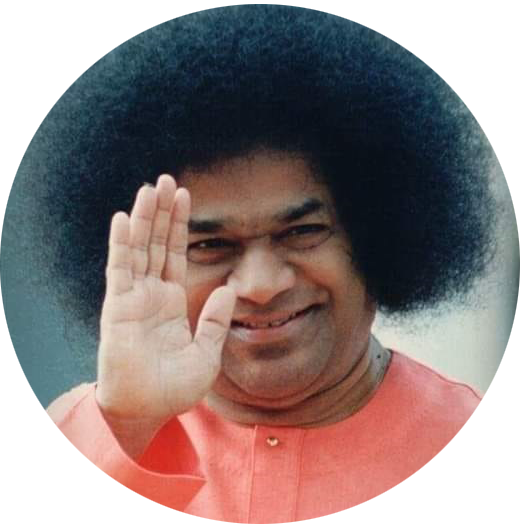
Sai Inspires – Prof. G. Venkarataman Guru Poornima Special Offering
(Daily Episode)
Part 7
To realize God, it is not
necessary to have wealth, gold or other emblems of affluence. Nor is great scholarship
necessary. All that is needed is pure, selfless devotion. Today men with selfish
and impure minds attempt to worship God. Without purity of thought, speech and action,
it is impossible to experience the Divine. God cannot be realized through ostentation
and self‐conceit. The basic‐requisite is the shedding of selfishness and possessiveness
so that one can engage oneself in actions in a disinterested spirit. Any person
is entitled to embark on this quest without regard to sex, age, caste or community.
–
Divine
Discourse, October 6, 1986.
REFLECTIONS
A very large number of
people believe in God, who also call themselves devotees of God. At the same time,
very few devotees want to know anything about God, much less to ‘realise’ Him. As
Krishna Himself declared, a large percentage of devotees worship God merely for
either getting relief from the problems they face in life or for gaining material
advantages such as wealth, power, property, etc. On the other hand, in the above
Sai Quote, Swami is asking us not to stop with merely filing various kinds of requests
but to realize God.
The question now arises:
“What exactly does realizing God mean, and what are the prerequisites for such a
realisation?” That is what we shall now examine.
People often offer prayers
like: “Oh God, I am in all kinds of trouble. Why don’t You save me?” Or, “Oh God!
I want to become the President of this country. Please help and bless me!”
Suppose you go to one
of those praying in this manner and ask that person, “Excuse me sir. This God to
whom you are praying; where is this God, how does He look, and what must we do so
that He grants our wishes?” The one who is ardently praying would hardly have any
clear cut answer. No surprise in that because most people are largely interested
in getting favours from God rather than truly knowing anything about Him or realizing
Him.
Some might protest and
say: “Look! We all know for sure that God is definitely out there. Why then bother
about knowing where exactly He is? He is there, He will definitely hear our prayers,
and He is always so ready to grant boons. What more do you want?”
This kind of a response
is no doubt quite common but that does not really answer the question raised. The
point is that we all have come from God which makes Him our ultimate Father and
Mother. Hence, just as one knows all about one’s bodily parents, surely one ought
to know something about our Eternal Parent as well, right?
OK, agreed. The question
now changes to: “But what exactly is it that one is supposed to know about Him?”
And the answer to that is: “Many things, such as how God is present everywhere,
in everything and all the time, how He is the source of all virtues and goodness.”
The doubting Thomas might
then persist and now ask: “OK, one knows all that; what good does that do?” This
is the way humans often think ‐ to seek material benefit in return for anything
we do. Thus, the question now becomes: “What benefit do I get if I do such and such
a thing?”
This is how we get things
wrong in relating to God and in realizing Him. Do you recall that back in the old
days, Swami used to begin His Discourses with the phrase: “Divyatmaswaroopalara”?
Do you know what that phrase means? It means: Embodiments of the Divine Atma. Through
that greeting, Bhagawan was reminding every one of us that at the core, all of us
are verily God. Later, Swami switched to “Premaswaroopalara!” meaning, Embodiments
of Divine Love. This phrase was meant to remind us that since we are verily God,
our feelings, thoughts, words and actions must always be saturated with Pure Love.
Let’s now go back to the quote and quickly absorb the important points made there.
Swami says:
• Anyone can seek and become one with God.
In particular that means one does not have to be rich, wealthy and famous to seek
God. The Lord is for all of us and He does not bother about our bank‐balance.
• Nor does one have to be a scholar, a learned
person with a dozen degrees, awards and so on. Even an illiterate person is entitled
to the Grace of God, as the touching story of Sabari in the Ramayana shows.
• The bottom line is that the prime qualification
for going near to God is to get rid of all ego, anger, feelings of jealousy, hatred,
cravings, desire, pride and possessiveness. In short, there must no place for anything
other than God in one’s thoughts.
In one simple sentence,
one can realize God only when one’s mind becomes immersed in God. For most of us,
this would immediately raise a huge problem. People would rush to say: “Listen!
I am the CEO of this huge multi‐national company. I have to be in Montreal one day,
in Moscow on the next and wind up in Melbourne when I am finished with the first
two. I don’t even get time to catch up with my sleep. What do you mean by immersing
my Mind in God?”
This is an old question,
and Swami gave the answer to it a long time ago as Lord Krishna when He was giving
some advice to a slightly stubborn Arjuna who suddenly forgot what was expected
of him. And in this Avatar, He has explained all this umpteen times. However, since
all that has been deleted from our hard discs, let us reload that teaching.
Swami makes it very, very
simple. He says, for example to this jet setting CEO, “Listen my dear fellow, be
a CEO, go around the world, cut your deals, and all that. I am not coming in the
way of all that. But in the midst of all that, there are certain things you could
do. Do you not often think of your family back home? Do you not pull out pictures
from your wallet, gaze at them and think of your children getting ready to go to
school or whatever? In the same way, why can’t you take a minute off to think of
God? When room service brings breakfast for you in a tray, why don’t you smile and
say a nice think you, seeing Me in that person? This is one simple way of seeing
Me in all. And when you make deals, bargain by all means, but never cheat, never
try to make an unreasonable profit, and always abide by Sathyaand Dharma.
That you would be able to do if you keep reminding yourself that I the Lord Supreme
is in your competitor also! In short, play according to the rules of the game but
above all never deviate from Sathya and Dharma.”
Just to remind you, there
is an interesting scene in the Ramayana that few may remember but which underscores
this. When Rama eventually confronts Ravana on the battle field, Ravana is in a
chariot and shooting his arrows, etc., from there; Rama, on the other hand, is standing
on the ground and giving Ravana a fight. At one stage, Ravana is unable to face
the barrage of arrows launched by the Lord, gets hurt and falls down from the chariot.
In boxing language, that was the moment for the ‘kill’. But what does Rama do? He
tells Ravana, “You are tired and exhausted. Go back home, attend to your wounds,
take some rest and come back tomorrow when we shall resume the fight!” Why did Rama
do that? Because the scriptures strictly forbid killing one who is disadvantaged
‐ that is why.
So, you see, one can lead
a normal life so called, but must do so with the feeling that all the persons we
deal with are really god in disguise. The Divine Drama might call upon us to play
many complex roles, sometimes even punishing the person we are dealing with. However,
it must always be without any trace of hatred or anger. Lincoln remembered this
in his famous Gettysburg address, which is why he used the memorable phrase, “With
malice towards none and friendship to all.” The amazing thing is that phrase is
straight out from the 12th Chapter of the Gita. Lincoln probably had
never even heard of the Gita. But the God who taught the Gita was in the Heart of
Lincoln too, which is why he spoke the way he did.
In the Gita Vahini,
Swami compresses today's quote into one simple sentence. This is how that sentence
goes:
Be in the world and act
in it in accordance with the circumstances you face and in the situation destiny
places you. However, the motivations for your actions must always be based on Eternal
Considerations, namely Sathya and Dharma. That is because while the world is transient,
you are an aspect of the Eternal Atma. Therefore, every action must carry that eternal
fragrance rather than the stench of transient selfishness and self‐interest.
Hope
that is clear. Thanks for your attention and Jai Sai Ram.
Part 8
How is the mind to be
purified? Through service to society with dedication and identification with everyone.
You have to cultivate this feeling of Ekatmabhava (oneness with all). By
engaging yourselves in service, you develop this sense of oneness. In this context,
the supreme importance of love should be recognized. Love is your true nature. But
modern man, in his preoccupation with the world of external phenomena, is failing
to discover his own true nature. Of what avail is all the knowledge about the physical
world if a man does not know what he really is? Love is the basis for this self‐discovery.
Love is the means and love is the proof.
– Divine Discourse, November 21, 1990.
REFLECTIONS
Sai Ram. This again happens
to be a Sai quote relating to the Mind. No surprise in that, since the Mind plays
an exceptionally key role in deciding which way we go, during the journey called
life. As Swami often reminds us, the Heart is the Lock and the Mind the key. Turn
the key one way and the lock snaps shut; turn it the other way, and the lock opens.
The same is true of life.
If we turn the Mind towards the external world, the Mind easily becomes so absorbed
in it, that it fails to see any connection between the world and God on the one
hand and between one’s own life and God on the other. Apart from some cursory acknowledgement
of God in a vague sort of way, the individual behaves as he has little connection
with God and thereby wastes his life. God did not put us in this world with a human
form and such superior intelligence for us to trivialise our lives in this manner.
In turn this means that our Mind must remain focussed on God and the main purpose
of life. But how is one to do that, when the Mind is so keen to wander in the world
and get lost? In the above quote, Swami offers a neat and simple trick. He says
effectively:
O man! You love to go
into the world and be with people? Fine; by all means do so. But do it My way, for
that would help you fulfil the purpose of life, besides bringing you close to Me!
Now what exactly is that
way? Swami gives the answer, and its essence is contained in the following points:
• God is in all beings, meaning He is in
you, me and everyone else, even if we do not happen to quite like them.
• Since God is in all, try to deal with all
remembering that if you hurt anyone you are actually hurting God.
• Likewise, if you serve anyone and please
that person, you are really pleasing God.
• So, why not be alike to everyone, and love
as well as serve all?
That is the simple magic
formula that Swami gives us. By serving everyone without exception, you take no
risks whatsoever, since God is present in all and every bit of service you do gets
counted for bonus points.
You may say, “Well, that’s
OK, but what has all this got to do with the Mind. The quote you started with was
all about the Mind? I do not see any mention of the Mind in your magic formula.
How do you explain that?” This is what one would call a ‘great question’.
You see, the moment one
resolves to be alike to everyone and treat all alike, one straightaway wipes prejudice,
saying this fellow is good and I like him, while this fellow is bad and I do not
like him. Such an attitude wherein one makes no distinction between friend and foe
is called ekatmabhavam, i.e., a feeling wherein one acts in the belief that
there is no difference between beings since the same God is in all.
You may find it a bit
difficult to understand this, but let me give a simple example from my own personal
knowledge. Way back in 1940, I lived for a short time in a small village in South
India, where my elderly uncle happened to be the Village Headman. These days, that
might seem like a minor post but back then the Headman was almost like God in the
village. Now one day, a cholera epidemic broke out in the entire neighbourhood,
and the District Medical Officer showed up with his entire crew, went straight to
the Headman, that is to say my uncle, and said, “I have orders to inoculate every
single man, woman and child in this village. So please spread the word around and
have the people assembled.” My uncle arranged for this by sending people who carried
drums, went round the streets, beat the drum loudly and then asked everyone to assemble
before the Headman’s house. They of course did not mention that they had to come
for a prick! The villagers were so scared of injections that they all would have
gone into hiding!
Once the villagers assembled,
officials made sure that no one would get way without an inoculation, and one by
one we had to line up, hold out our arm and take the injection, either with a smile
or howling. My uncle had to get the shot first, just to prove it was safe and the
right thing to do, and later everyone in his family had to get the prick. Now the
reason I am mentioning this is because after taking care of our village, the DMO
went to a neighbouring village, a bigger one, where there was a Police Station.
There he inoculated not only the Police Sub‐Inspector and the Constables, but also
those who were held in the lock up. In other words, where his job was concerned,
the DMO treated everyone alike –that is the point I am trying to make.
Now you may say, “Listen,
that man was a doctor, and he was just doing his routine job. And his job was such
that he HAD to treat everyone alike. You can do that always.” Technically you would
be correct. But what Swami is saying is that no matter what job one is doing one
could always be the same to all in the sense of being kind and considerate, and
always adhering to Sathya and Dharma. Furthermore, when there is spare time, one
could, instead spending it playing video games or merely watching TV for hours while
munching potato chips, one could, for example, try to visit handicapped children
and engage with them to make them happy, or visit an aged persons home and render
assistance and so on.
While some might consider
all this totally unproductive and an utter waste of time, God does not think so.
He clearly says that when you serve anyone with Love, that Love and service actually
reaches Me. In other words, this is the simplest and the easiest way to turn the
Mind towards Me, even while you are fully immersed in the world, and engaged in
what one would call worldly activities. And, by the way, when the Mind is engaged
in service, it is in fact turned towards God. Ever noticed the feel‐good feeling
that comes after an extended period of such seva? That is bliss or ananda,
that comes as the direct result of communing with God.
So, you see, when one
serves, many things come together, purification of the Mind, the chance to cultivate
the feeling that all are one or ekatmabhavam as Swami calls it, and above
all, serve God Himself. That is why we have sayings such as:
Hands that serve are
holier than lips that pray, and Service to Man is
service to God!
Think
about it! Thank you and Jai Sai Ram.
part 9
To comprehend the unity
of body, mind and Atma (spirit) is to realize a fundamental truth. The body is gross.
The Atma is subtle. It is the mind that links the two. If the Atma is ignored, man
is reduced to the level of the animal. When the body and the Atma are ignored and
the mind alone is active, the humanness comes to the fore. When the body and the
mind are kept out and the Atma alone is experienced, Divinity is attained. How is
this to be achieved? An essential requisite is Thyaga, the spirit of sacrifice.
–
Divine
Discourse, January 20, 1985.
REFLECTIONS
This Sai quote comes
from a Discourse delivered in January of 1985, the year of the sixtieth
Birthday. If you hear the audio clip carefully, you will notice that word Atma
occurred five times during that brief period, showing how focused Swami was on the
Atma even then. This should not come as a surprise, if you recall that almost
the very first thing that Swami as Lord Sri Krishna told Arjuna was,
“Arjuna, you think of
yourself almost entirely in terms of your body and all the connections it has
in this transient world. But, Arjuna, you are not merely the body, but the
Atma. Your body and your Mind are mere dressings or coverings on the Atma, to fulfil
a certain function that needs to be done right here on earth. And that job must
be done bearing in mind the fact that at the core, you are nothing but the Atma
in all its glory, while the body is but a mere trapping, a uniform you wear to
carry out the task ahead of you.”
Swami here is
repeating that same teaching imparted five thousand and odd years earlier, with
some important explanations that are vital for this Kali Age. To understand
them better, let us start with what Swami often told His students ‐ that they
were not just the gross body made up proteins and various other molecules, but
Atma, wrapped up in the gross body. The Atma was the cause while the body was
gross. Connecting the two was the mind, which is subtle, meaning you cannot
simply do a chemical analysis of it at all. Subtle means it is not really of
this Universe but beyond. We hardly realize this but it is true. Thus, Swami
tells His students,
Students! You think
you are the body, the gross body, but you are not. Truly speaking you are the
gross body, plus the subtle Mind and the causal Atma. A simple way of
remembering this is to say that you are a MBA (Mind + Body + Atma).
Let us accept that
for a moment. Now why on earth did God create such a being? Krishna explains
that in the 13th Chapter of the Gita. He says,
“Arjuna, your body is
like a chariot, while your mind is like the horses harnessed to the chariot.
And the Atma which is Me is the rider of the chariot. Life’s journey may thus
be compared to a ride I wish to take, using your body and your Mind. Now imagine
what would happen if the chariot was in repair or if the horses were unruly; I
would not be able to go where I want; right? That is exactly what happens when
people do not realize that the purpose of life is to take God where He wants to
go.”
Keeping that advice
of Krishna to Arjuna, let us go back to the Sai quote and see what it says.
Swami is telling us that if the MBA thinks he is merely the body, it is like
having a defective chariot. In practical terms, the person lives rather like an
animal, his behaviour being crude and vulgar, short‐tempered, ready to blow his
fuse, become violent, etc. If you have heard about what are called gunas, such
a person would be described as being of the tamasic type.
On the other hand,
the person may be dominated entirely by the Mind. Remember, the mind is a
bridge between the Atma and the body; and in Krishna’s language, it represents the
horses that drag the chariot. A person dominated by the mind means that
person’s mind refuses to take orders from the Atma, meaning that the horses of
the chariot would be running wild. You know what happens then, don’t you? In
practical terms, the person though clever and all that, is ambitious, ruthless,
focussed only on his success and achievement rather than anything else, and is
thus ready to do anything for achieving his goal. In today’s rat race, we see
such people all over the place; in terms of gunas, they would be classified as
rajasic. Such a person would readily trample over Sathya and Dharma
without batting an eyelid, never show even a trace of compassion.
In other words, he
would be nothing short of the devil in human form. Clearly, God would not want
us to behave in that form, would He?
Now if you remember
all that I have said thus far, it would be clear that in life, both the body
and mind must bend before the Atma, and take orders from it. In other words,
though we have a body and a Mind, we must remember that the Atma is the real
boss. Incidentally, Conscience is the word sometimes used to refer to the Atma
within, which also is why Swami often says:
Follow the Master.
Your Conscience alone is your Master!
By way of winding up,
let us revisit the last sentence of the Sai quote. It says:
When the body and the
mind are kept out and the Atma alone is experienced, Divinity is attained. How
is this to be achieved? An essential requisite is Thyaga, the spirit of
sacrifice.
What it means is that
when the body and the mind bow to Atma or Conscience, call it what you will,
then the Lord seated in the Chariot would be able to go home. In translation,
it means that the purpose of life’s journey would be fulfilled and you would be
back where you ought to be, which is to be reunited with God. And this can be
achieved only with sacrifice. Swami does not explicitly describe in this quote
what exactly is to be sacrificed but elsewhere He has done that. What is to be
sacrificed is what is called dehabhimanam or body‐consciousness. In simple
terms, we should never act as if we are the body or the mind, i.e., give in to
their preferences. The Master is the Atma within, and whatever the body and the
mind do, must be entirely in accordance with the dictates of the Atma. That
would be possible only when we give up the attachment to the body and the mind,
and giving up this attachment is what is referred to as sacrifice. It is not easy but certainly becomes possible if you love God dearly.
Think
about it! Jai Sai Ram.