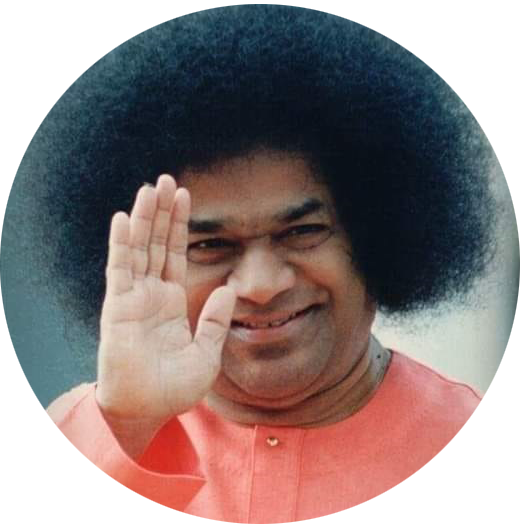
Sai Inspires – Prof. G. Venkarataman Guru Poornima Special Offering
(Daily Episode)
Part 4
It is only when the individual
is prepared to sacrifice his selfish desires and toil for the welfare of society,
that the nation will prosper. Then only will the world have peace. That is why the
Vedas proclaim that man can have peace only when he renounces selfish desires. The
Vedas express disapproval of persons who accumulate wealth and who are ever immersed
in activities that can add to their physical comfort. The man who gives, receives
even while he gives, more than what he gives.
REFLECTIONS
This quote is a very important
one for the simple reason that almost 99% of people all over the world would hardly
connect world peace with removal of selfishness. If you don’t accept that, you just
have to look back at the famous Cold War period that lasted from about 1946 to 1991,
that is to say, almost from the time World War II ended to the time when the huge
erstwhile Soviet Union collapsed almost overnight and vanished into the dustbin
of history. It was a period of tense eyeball‐to‐eyeball confrontation between America
on the one hand and Soviet Union on the other, each with about ten thousand deadly
nuclear weapons, each with an explosive power somewhere between 50 to 100 Hiroshima‐type
atom bombs. It used to be said then the each of these two Super Powers could individually
wipe out the whole of planet earth many times over.
It was an exceedingly
tense period, especially since both Super Powers could shoot missiles that could
travel across the planet in about 30 minutes. In other words, if nuclear war had
broken out, it would all have been over in less than one hour, with hardly any real
victor but lots of people simply wiped out, and 90% of the survivors exposed to
deadly radiation and what not. Young people of today would hardly have any idea
of what kind tension humanity went through. And let me tell you from personal experience
that in the early sixties when we had the so‐called Cuban crisis, no one knew what
was going to happen. If ever the world was on the brink of disaster, that was it.
Luckily, the Cuban crisis got resolved thanks to two wise leaders, President Kennedy
on the American side and Chairman Nikita Khrushchev of USSR. However, I shall not
go into all that. My main reason for bringing all that history to your notice was
to draw attention to the so‐called MAD principle on which peace was based by experts
on both sides.
I guess most of you might
not have heard about this MAD principle and so let me say a few words about it.
Let me start with what MAD really meant; it was an acronym standing for Mutually
Assured Destruction. In practical terms, the two sides maintained a tense peace
by silently telling each other: “Listen! Don’t you dare any funny stuff! We have
hundreds of missiles each equipped with many deadly bombs; and they can reach you
in between 20 to 30 minutes. We can launch from land and from sea, all over the
place. So, though you may hit us badly, you too would get the same treatment!” This
was the way the generals on the two sides warned each other. The politicians then
took the soft approach and said, “Look, we really cannot take things that far. So
let us maintain some kind of peace, without going that far.”
That about describes it;
there was no real peace but just a tense situation; mercifully though, no bombs
flying. Can that BP‐raising situation be really called peace? Obviously not. What
then would be real peace like? The answer to that lies in Swami’s quote. So, let
us try to go deeper into it. We start with conflict. Have you ever seriously wondered
why at all a conflict arises? The answer is simple. Conflict usually arises between
two people A and B say, when one of them tries to take away what both have. Or else,
it could be that both A and B do not have the desired whatever it is, say a powerful
political position, but are competing fiercely for it. For example, A and B could
be two women, a daughter‐in‐law and her mother‐in‐law, both competing to be the
prime individual in the life of the man in the middle, husband to A and son to B.
This of course is an old, old story, and is known all over the world. Though the
time and place might vary, the cause of conflict is the same ‐ a kind of selfishness.
In the familiar example
just cited, the conflict is confined to the family. What Swami is referring to concerns
selfishness of individuals impacting the entire country. Let me give a simple but
powerful example. India has a big drug industry which makes all kinds of drugs.
Indeed, where generic drugs are concerned, India has a strong reputation particularly,
after President Clinton gave the lead in picking India as a leading supplier of
generic drugs for treating HIV positive patients in Africa. At the same time, sad
to say, we also have a huge fake drug industry. What I mean is that unscrupulous
operators make packaging almost identical to that in which genuine drugs are packed.
The fakers buy these duplicate, look‐alike packaging and fill the bottles, ampoules
or whatever with just plain liquid, tablet or powder as the case may be, and sell
it to small scale drug dealers, like those you find in small towns, including Puttaparthi.
Now here is my point.
Take a life‐saving drug. A lady is having a serious medical condition and a doctor
has been called. He examines the patient and says, “I want this medicine immediately.
It has to be administered at once.” The son of this lady rushes to the nearest drug
store and buys the medicine. Unfortunately, the drug he buys is a fake and as a
result his mother dies. The fakers may make huge profits, and believe me, they in
fact do. I have read somewhere that the WHO estimates that nearly 30% of the drugs
sold in the Third World are spurious. Just imagine the large scale havoc caused.
The magnitude of this bogus industry is so huge, and poor countries have so little
infrastructure for checking the drugs sold, that ordinary people in hundreds of
thousands are subject to unwanted suffering and even death, after paying for the
drugs. This is an example of how selfishness and the greed to make money by hook
or crook can cause national havoc.
Let us dig a bit deeper.
How come these people who make fake drugs are so heartless? In part it probably
is due to the fact they were not at all exposed to values at home or in school.
In fact, there is a kind of feedback loop here. When children don’t get exposed
to values at home and school, can easily slip in later years, little realising how
much harm he or she is doing. As the number of people who are indifferent to moral
values increases, there comes a tipping point when society as a whole starts adopting
an indifferent attitude. That’s when ripples turn into big waves.
Here is an example. India
has a very large number of trucks, many of them owned by small and medium size trucking
companies. They want to maximize profits and so the first thing Venkataraman they
do is to use trucks that ought to have been junked a long time ago. The headlights
hardly work, the brakes are not in order, the reflectors on the rear side have fallen
off and so on. Next, they invariably overload the truck, that means they can easily
trip over. As if this is not enough, they hire drivers who drive badly; some of
them don’t even have proper licenses. It is not as if there are no rules; but practically
every rule on the book can be got around by paying a bribe somewhere or the other.
Turning now to the drivers, they often drink while driving which they are not supposed
to, and drive in the middle of the road instead of in the lane they are supposed
to, and cross the speed limit. Also, they hardly ever dip their lights when traffic
comes from the other side.
I guess you are seeing
where I am going. What we have here is an entire chain of selfishness, and the net
result is that in some places traffic accident is the number one killer. Can you
imagine that? Not cancer, TB, heart attack and so but road accidents! And why do
these accidents happen? Simply because of cumulative selfishness.
So, you see if people
decide to get selfish, then such selfishness would start growing without limits.
Further, if selfishness starts spreading like a deadly virus, then it can affect
large segments of society and cause harm on a large scale. This would somewhat be
similar to a body in which cancer has spread; and you know what the end result of
that is. Where society is concerned, it does not quite die but becomes very sick
and in the extreme case fails. To become a failed state is the worst fate for a
nation. Today, there is one universally acknowledged failed state, namely Somalia,
with many others on the brink of tottering.
From a spiritual point
of view, God sends the human being with a body, a Mind and the soul or Atma. As
Krishna has said and Swami has explained in detail, it is the duty of the body and
the Mind to safely take the Atma back to God. If the Mind and body gang up and act
selfishly, then it means that humans have massively failed the purpose of life.
Do we want to let down God that way, especially when we constantly proclaim, “WE
LOVE YOU SWAMI!”? Think about it!
Part 5
Men regard Dharma (right
conduct) as merely ethical conduct in daily life. But this is not so. Dharma really
means recognition of the Universal Consciousness that is in each individual and
act on the basis of the unity of that Consciousness. When this Consciousness in
man is enveloped in the ego, it assumes the form of three gunas or attributes (Satwa,
Rajas, Tamas). When the Divine nature of this Consciousness is realized, it is transformed
into Atma Dharma ‐ the Dharma of the Self. True Dharma is the realization of the
unity of the Omni‐Self.
–
Divine
Discourse, November 23rd, 1986.
REFLECTIONS
Sai Ram. I would like
to begin by drawing attention to two specific words in the opening line of this
Sai quote; they are 1) Dharma and 2) ethics. The word Dharma is one of the five
we commonly hear as human values namely, Sathya, Dharma, Santhi, Prema, Ahimsa.
Though referred to as human values they are actually Divine in origin, and that
is the first fact we ought to be clear about.
What do I mean by saying
Sathya, Dharma, etc., are Divine in origin? Basically the following. Now God in
the ultimate is nameless, formless and is supposed to be without attributes, there
are in fact attributes latent in God. Indeed, every religion proclaims God as the
most compassionate one. If compassion was not latent in God, how would He show it
to a devotee who is in deep trouble and prays intensely for help?
OK, we agree that latent
in God are many attributes. What are they? There are many, but five that readily
come to mind are indeed Sathya, Dharma, Santhi, Prema, and Ahimsa. Further, when
God incarnates in human form, He manifests these attributes all the time, in some
manner or the other. We all know that Rama was the embodiment of Sathya and Dharma
and of course the others as well; the same was true of Krishna, and currently, we
all adore Swami as the embodiment of Prema.
So, God not only has certain
values latent in Him but also makes them patent, especially when He comes down in
human form. Fine, and we can now appreciate why Sathya, Dharma, etc., ought to be
called Divine in origin. But why are they called human values? Because God expects
humans to exhibit those same values in life; indeed, He expects that during their
entire life, humans would put these values always on display. By the way, that exactly
is why Swami often reminds us: YOUR LIFE SHOULD BE MY MESSAGE. Which makes abundantly
clear that all of us ought to live our lives strongly adhering to Sathya and Dharma
every moment of our lives.
So far, we have not brought
the word ethics into the picture. Now what exactly is 'ethics'? The dictionary defines
the word as: 'Moral principles that govern a person's or group's behaviour. It is
quite possible that historically, ethics and morality meant the same thing, that
is to say, adherence to ethics also meant strictly following Dharma. Over a period
of time, however, in the Western world, ethics has come to mean socially accepted
set of codes and norms regarding behaviour. And since socially acceptable practices
and behaviour change with time, so do ethical standards.
You see this, for example,
in the movies. I do not know how it is these days, but way back in the fifties;
for example, every single movie produced for commercial distribution had to be first
certified by a film board of censors. The censors had a strict code and movie producers
always tried to stay around the edge of the code, getting stuff past the censors,
if they could get away with it. From what I gather, current standards are so different,
that so‐called sleazy stuff of the past would be regarded today as absolutely saintly!
The point I am making is simply that the code of ethics is elastic and varies with
time and the attitude of the society concerned. Moral values on the other hand,
are immutable, since virtue which is the practical manifestation of moral values
in action, is Divine in nature and origin.
In short, Dharma means
much more than ethics. Based on this, one could draw up a rule book that says: Following
Dharma means that thou shalt do this, this, and this, etc., followed by another
set of rules that clearly draws red lines saying that thou shalt NOT do this, this,
and this, etc. Now this is the beautiful and subtle message of Swami, and needs
very careful attention. Bhagawan says, effectively:
O man! Dharma is not merely
a rule with green and red lines. Dharma is the very Nature of God, and in as much
as God is Consciousness itself – remember, the scriptures declare that God is verily
Consciousness, Prajnanam Brahma! – you can claim to be following Dharma only if
you recognize the presence of Consciousness everywhere, in everything, all the time!
If you think about it,
that declaration raises the bar for Dharmic behaviour rather high. In other words,
whatever we do, we must make sure that our actions do not hurt any being, for God
is in that being. It must not harm society, for society is God. It must not harm
Nature, for Nature is God, and it must not go against our own Conscience, for Conscience
is the Ultimate Master of each and every one of us!
Swami makes this clear
by adding [effectively of course]:
O man! As long as you
remain bound by the gunas, you would also have some kind of prejudice, dislike,
tendency to become angry, jealous, greedy, selfish, etc.
All such negativity binds
you and chains you from strictly following Dharma in the sense I have defined. So,
if you truly wish to be Dharmic, then follow the golden rules:
• Rise above the gunas. This won’t happen
in a day, but keep trying and trying hard.
• See God everywhere and all the time, so
that all of your actions become pleasing to God.
• And never go against your Conscience, since
Conscience is verily God!
That is essentially what
Swami is telling us, and that is the essence of the quote we started with.
These days, Spirituality
has been reduced to a seemingly simple drill. Just say, “I love you Swami,” and
everything gets taken care of. At least a large number of people believe so. All
this is happening because most people choose to ignore the fine print and tune the
definition to suit their own, particular convenience. Swami is reminding us that
that action alone is Dharmic, which pleases God. Thus, pleasing God doesn't mean
merely doing what we like and shouting, “WE LOVE YOU SWAMI!” It means paying careful
attention to what Swami is telling us and following them as strictly as possible
in daily life.
Think
about it!