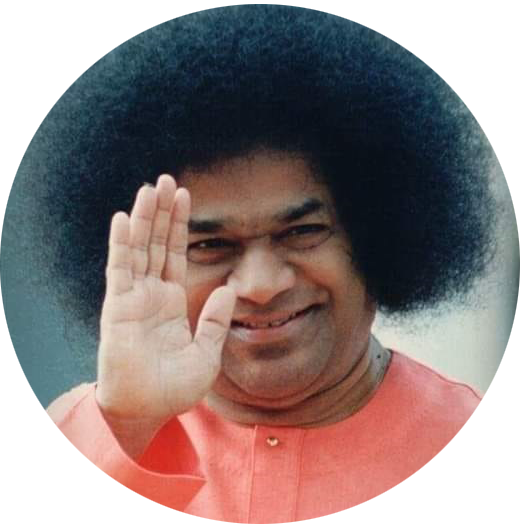
Sai Inspires – Prof. G. Venkarataman Guru Poornima Special Offering
(Daily Episode)
Part 19
Human virtues cannot
be acquired from others. They cannot be nourished from mere study of books. Nor
can they be acquired ready‐made from teachers. They have to be cultivated by
each person and the resulting joy has to be experienced by him. Today the world
sorely needs human values. Attempts are being made to promote these values in
the educational field. But they cannot be promoted through materialistic,
worldly or scientific means. Without developing devotion to God no human
quality can grow. The first requisite is faith in God.
–
Divine
Discourse, September 26, 1987.
REFLECTIONS ON THE
ABOVE
Sai Ram. I wonder how
many of you noticed that as always, Swami’s teachings are so very down to earth
and utterly practical. In fact, they are so simple that we often mutter, “Is
that all?” and promptly forget them; and that precisely is where all our
problems start. As Swami often reminds us, spirituality is not at all
difficult; what we find difficult is to get started. Why do we find getting
started difficult? Because, in order to be serious about spirituality, we have
to give lower priority to things we now give a lot of importance to. Let me
amplify on that by considering two groups of people who can make a lot of difference
if only they took spirituality as seriously as it ought to be. They are 1)
highly‐placed people who are also opinion makers and 2) students, who would be
taking charge of society tomorrow and shaping its future. People in both groups
are talented and have their own special leverage to make a lot of difference to
the way things are, steering the future to where it ought to go. However, and this
is the key point, they have their own priorities which are dictated by three
crucial words used by Swami. Those words are: joy, values, and materialistic.
All of them want joy ‐ who doesn’t, and really speaking one cannot complain
about that ‐ all of them have their own sense of values which, unfortunately,
happens to be almost entirely materialistic; and that is the third of the three
words I referred to.
Let us now turn to
what Swami says. He observes that the first priority for all without exception
is the cultivation of virtues. And what is the best way of developing virtues?
This is how:
They have to be
cultivated by each person and the resulting joy has to be experienced by him.
The world sorely needs today human values. Attempts are being made to promote
these values in the educational field. But they cannot be promoted through
materialistic, worldly or scientific means.
Let us now carefully
study what Swami is telling us. First and foremost, says Swami, joy is not
necessarily to be found through the pursuit of materialistic ends but through
the cultivation of virtues. Yes, achieving worldly success and being able to
buy a BMW beauty and a matching glittering BENZ might give thrill of filling
others with envy. But then, how much better and more fulfilling it is to make
someone else happy through an act of kindness even if it is small, and
experience joy via the smile of the person who has received the help? As
someone said, that smile comes not merely from the beneficiary who feels
thankful but also from the God within that person who is saying through that
smile, “Well done, my boy! Keep it up!”
Nowhere is something
we must note carefully. Owning a BMW and helping a person in distress can both
give a person a ‘high feeling’. However, the joy that comes from a glittering
and luxurious BMW is not true happiness but a sense of pleasure that springs
from the pride of ownership and the privilege of being exclusive. That pleasure
titillates the mind and is invariably short‐lived; I mean how long can that
BENZ or the BMW hold the attention of all around? Every year new models appear,
and someone else is going to steal the show with his acquisition. Indeed, that
person may dazzle with a diamond‐studded Rolls and a corporate jet; that would
be a double whammy! This is what happens all the time in the material world.
Which is why, cautioning humans Adi Shankara said two thousand years ago:
Wealth, high family
connections, youth and pride,
Every one of them is
transient and would vanish in time;
O man! Why hanker
after that which is temporary and deludes?
Seek instead the
safety that the Lord confers at His Lotus Feet!
Swami has quoted this
any number of times to us and the question really is how much attention do we
pay to it? The answer is: Very little. Why? Because, truly speaking, while we hunger
greatly for Swami’s darshan, we do not pay one‐tenth that attention to His
words. Why? For an important reason which is that we are driven basically by
our head rather than our Heart. The Heart craves for the vision of Bhagawan and
when that is had, the head pushes back the Heart to get into the driver’s seat.
The moment that happens, we revert to valuing the material more than the
Eternal, and start believing that joy lies in wealth, power, exulting in our
youth or whatever.
So, what is the
answer? What’s the medicine for this ailment of attachment to things material?
Swami says the remedy is to love God. Love God? Our response is, “OK, no problem;
I’ll do that right away,” and off we go to plunge into sadhana, chanting
the Vedas, or whatever. But that would not work. As Swami has said many times
in the past:
You may declare that
you love God. But does God love you? The question now becomes: “When does God
love the devotee?” The answer to that has been given in detail by Krishna in
the Twelfth Chapter of the Gita, and repeated by Swami on umpteen occasions. He
has written an entire Vahini on that subject. He gave 35 Discourses on that
subject in 1984. He has, on many occasions, given an entire Discourse on just
one sloka of the 12th Chapter; I distinctly remember one such that He delivered
during the Summer Course of 2000. I would not go deep into all that since the
essence is contained in one single word, tyaga or sacrifice.
For us humans, the
word sacrifice sounds unattractive and uninviting because it smacks of inconvenience,
the difficulty of giving up, having to do with less, even pain and suffering. But
you know something? The word tyaga or sacrifice simply does not exist in
God’s dictionary. He may in fact perform an act which you and I would describe
as sacrifice. But ask Him and He would just smile and reply, “Whatever I did
was an expression of My Love for you.” The classic example of this has been
provided by Jesus, who died on the Cross. We say Jesus sacrificed His life to
save humanity. In truth, He did it as an act of Love, as indeed all His acts
were. Swami is repeating that same lesson to us today. Seeing through the limited
vision of unevolved souls, we keep ourselves busy with all sorts of
interpretations about Swami’s various actions. For Him however, all His actions
are born in Pure Love, and meant entirely for our own good. Which leads me to
the last line of the quote we started with. Just to remind you, this is what
Swami says:
Without developing
devotion to God no human quality can grow. The first requisite is faith in God.
What does this mean?
The clue to the answer is in the word devotion. Translate it first into the
word Bhakti, which is the word that Swami always uses. Next, recall that
for Swami, the word Bhakti means true Love for God. Add to that the fact that
God is present in all. When this packaging is done, what is it that we get? The
following; for ease of understanding, I have phrased it as if Swami is speaking
to us:
O man! You keep
saying you love Me. Ask yourself: “Am I loving this form before me in the
saffron colored robe, or am I loving the Atma of which Swami is the
embodiment?” If you think it is the latter, then why are you so jealous of so
many? Why are you angry with so many? And why are you rude to so many? Admit
that you have faults! I know that you like Me but that liking is restricted to
this Form alone. Unfortunately, that does not translate into love for God. To
love God, you must first become virtuous. This virtue cannot be cultivated by
enrolling in some course and paying some fees. It has to come from within. But
nothing would come from the within, unless it is first cleaned of all the muck
you have stored in there, in terms of your desires, anger, jealousy, greed and
what not. Throw them all out, wash the place, and spray the fragrance of faith.
You are now ready to cultivate Bhakti, not the way you define it, but the way I
do. And when you do that, I shall help you to feel blissful always. It is guaranteed.
Do you know why? You don’t? Have I not said many times that True Happiness is
Union with God?
In my view, that is
the message that Bhagawan is giving us via the quote we read. And remember,
after the cleaning is all done, the first thing we start with is the fragrance
of total faith!
Think
about it! Jai Sai Ram.
Part 20
Be assured that the
Lord has come to save the world from calamity. Your duty is to keep calm, to
pray for the happiness and prosperity of all. Do not pray for your own
exclusive happiness and say, “Let the rest of the world go to pieces.” You
cannot be happy when the rest of mankind is unhappy. You are an organic part of
the human community. Share your prosperity with others; strive to alleviate the
sufferings of others. That is your duty.
–
Divine
Discourse, March 17, 1961.
REFLECTIONS ON THE
ABOVE
Sai Ram. The quote
that you just read is short but tremendously full of meaning. Let us therefore
take a few minutes off to absorb the profundity of Swami’s advice to us. There
are basically four key words in this short paragraph: 1) the individual 2)
humanity 3) happiness and 4) prosperity. Swami not only links them all but also
places them in a higher dimension to which He makes only a tangential
reference. It is that placement which gives depth to this short paragraph and
so much meaning to it. Our job is to unravel that hidden word and use it to
explore further.
Let us start with
happiness. The famous Declaration of Rights of America ‐ shall refer to it as DORA
‐ begins with a powerful reference to life, liberty and the pursuit of
happiness. Interestingly, those three words have a lot to do with what Swami is
saying, but NOT in the way most people might imagine. The authors of the DORA
were making an explicit reference to the rights of the individual. Swami, on
the other hand, is telling us about the responsibility which the individual
owes to humanity. Now why did DORA refer to the rights of the individual while
Swami is telling us about his/her responsibilities? Ah, therein lies the whole
mystery of life, liberty and happiness! Sounds confusing? Don’t bother; we
shall sort it all out.
Let us start with
happiness because it really is the key word to everything that both DORA and
Swami have said. Almost everyone thinks of happiness entirely in terms of
material objects and the feelings connected with them. As Swami emphatically
points out, this is totally wrong; and what Swami says is not difficult to
understand either.
Let us say a man has
just become very rich. He is highly conscious of his new wealth and, wanting to
show off, buys a shiny new BENZ. People gape in awe and wonder as he proudly drives
around, and that makes the man very happy. Two years later, another man in the same
neighbourhood becomes even richer and he buys a Rolls, say. Now a BENZ is a
great status symbol no doubt, but a Rolls is a Rolls, and there is very little
to beat it. All of a sudden, people stop admiring either this man or his BENZ
which by now has also become two years old and been superseded by later models.
But this new rich man has a Rolls which any day is superior to the BENZ. No
wonder the man with the BENZ has stopped being a hero, and that hurts him a
lot. The point Swami makes is this. If happiness is in the BENZ, why should the
man suddenly become unhappy? He still has the BENZ, does he not? And yet he is
feeling miserable. Why? Because, happiness is not in the object; rather, it is
in the mind, and his mind has now been disturbed by another man becoming richer
than him and buying a Rolls to show off his new status.
What we learn from
all this is that the happiness that people seek and indeed DORA espouses is
material happiness, which refers essentially to a state of mind connected with material
well‐being, material wealth, material possessions and so on. Almost everything about
happiness as it is usually spoken about has a material connection. And that connection
can never give permanent happiness, as we just saw in the example of a man who
tried to become happy via a BENZ.
OK, now what does
Swami say? Interestingly, Swami also refers to life, liberty and the pursuit of
happiness. He says, effectively that is:
O man! Life in human
form is one of the most precious gifts you can get from God. The Lord knows you
want to be happy. Further, He WANTS you to be happy. Do you know why? Because,
True Happiness is your real nature. Now there is another word for this True
Happiness; it is Ananda and it means Bliss. Worldly happiness has an opposite
namely, sorrow. Bliss, on the other hand, has no opposite. Do you know why?
Because, it is connected with God. God is Bliss and Bliss is God. God is Pure
Oneness and there are no opposites associate with Him. So, what you should
really be seeking is Ananda and not happiness as you people understand it. This
Ananda which means Eternal Bliss can be attained when you become united with
Me. That is why I always say: Happiness is Union with God! Do you follow?
Bearing in mind that
True Happiness comes from union with God, let us now look at the other two
words, namely, life and liberty. Consider first the question: “How does one find
Ananda in life?” Swami has already given the hint; He says, try to seek union
with Me; find ways of becoming one with Me.” Fortunately, Swami has already
described in detail how that is to be done; in fact, He repeats that advice in
the quote of the day, though only in a brief manner. Read once more this part,
carefully please! Swami says:
You are an organic
part of the human community. Share your prosperity with others; strive to
alleviate the sufferings of others. That is your duty.
Why is Swami saying
this? How does this help the individual to achieve union with God?
How is it connected
with the individual attaining Bliss or Ananda? Here is the answer. First and
foremost, we must realize that God is within us. Remember how often Swami tells
us, “I am in you?” Next, if Swami is in me, He is also in you, that fellow over
there and indeed in all created objects, both living and inert. The story of
Shirdi Baba coming as a dog was meant to teach the lesson that God is in all
beings, which also means we must never torture or hurt any animal, something
animal activists are very passionate about.
OK, God is in all; so
what? Well, if I am happy and God is in all, then can one pray for one’s own
exclusive happiness and say, “Let the rest be damned, I don’t care?” As
Swami emphatically reminds us, “You cannot be happy when the rest of mankind
is unhappy.” That’s because every entity is connected to every entity. Why?
Because God is in all. It is precisely here that we must recall Swami’s famous
saying, Bulbs are many but current is one!
People are many, but
the same God resides in all. Once we truly grasp that, we would straight away
change our attitude to others. If we get money, we would try to share it with others
in ways appropriate; not necessarily by going out and distributing currency
notes but by helping someone to buy medicine, pay school fees or whatever. So,
you see, this is how life and the pursuit of happiness get connected, happiness
in this case meaning Bliss or Ananda. That still leaves the word liberty; where
does that come in? In a very beautiful manner, as Swami explains. He says,
O man, by seeking
happiness and pleasure in material objects, you become bonded to the transient
world. Thanks to this bondage, you would be born again and again and again, and
every time you do, you would go through the same boring and miserable cycle of
joy and sorrow. Therefore, why don’t you seek freedom from this material
bondage and become truly liberated? That freedom is associated with giving up
attachment to the world and becoming detached from it. That is true liberty!
And that liberated state brings you the following:
• Union with God.
• Ananda or Bliss or
permanent happiness since you are now always with God.
• Since you have
lived your life in order to achieve union with God, your life becomes fulfilled!
So, you see, DORA
shows only the material side of life, liberty and happiness. But if you raise it
to a spiritual dimension, then those same three words of DORA help us
understand better the quote we started with.
Hope you have been
able to follow all that I have said. Maybe not, in which case, please do not
worry. Just think about it for some time, linking it to other Swami teachings.
Slowly, all the doubts would unravel and everything would become clear.
Give
it a try! All the best and Jai Sai Ram.
Part 21
Man has the rare good
fortune of adoring Nature as the Body of God and offering grateful worship to
God. But, is he conscious of God being the Source and Sustenance? Does he give
God the first place in his thoughts which is His due? Or, is he engaged in the
activities of life in total disregard of God? It is a pity that, instead of
paying attention to God, Nature and Man, in that order, men today are concerned
most with themselves, more with Nature and very much less with God. From birth
to death, from dawn till night, man pursues fleeting pleasures by the
exploitation, the despoiling, the desecration of Nature, ignoring the truththat
it is the property of God, the Creator, and any injury caused to it is a
sacrilege which merits dire punishment.
–
Divine
Discourse, July 11, 1985.
REFLECTIONS ON THE
ABOVE
Sai Ram. Speaking to
students many, many years ago, Swami said, These days, man thinks he is very
advanced and civilized. Advanced he might be in terms of science and
technology, he is less civilised than the ancients. I can see you are looking rather
surprised. Well, look around and see what man is doing. He is not merely
cutting trees but wiping out entire forests. He is not merely killing animals
for food but wiping out so many species like the tiger, the lion, elephants,
and so on. He is polluting the air, the rivers and so on. Now look at the
ancients. They did cut trees, but only to a minimum; other than that, they
worshipped trees. In fact, they worshipped everything ‐ plants, animals, even
snakes, land, mountains, rivers, air, sky... you name it. Why? Because they saw
God in everything. Modern man laughs at ancients and calls them barbaric. Who
is barbaric and uncivilised? The ancients? Or the modern man who disrespects,
tramples down upon, pollutes and even destroys Nature on such a massive scale?
Modern man has no time even for his aged parents, whereas ancients revered
their parents and took care of them in their old age? And after all this,
modern man gives himself a medal for being civilised and laughs at ancients,
describing them as barbaric. Now tell me, who is more civilised, modern man or
ancients?
By the way, what
Swami said about ancients, applied in a sense to ancients all over the world
and not only in India. By way of substantiating it, let me quote parts of a
letter written by Chief Seattle, when about a century and half ago, the tribe
he headed was compelled by pressure to sell its land to the Government in
Washington. This is what Chief Seattle said in part, and his anguish is
unmistakable:
Every part of this
earth is sacred to my people. Our dead never forget this beautiful earth, for
it is the mother of the red man. We are part of the earth and it is part of us.
This shining water that moves in the streams and rivers is not just water but
the blood of our ancestors.
The rivers are our
brothers, they quench our thirst. The air is precious to the red man for all things
share the same breath ‐ the beast, the tree, the man, they all share the same
breath. The wind that gave our grandfather his first breath also receives his
last sigh. Whatever befalls the earth befalls the sons of earth. If men spit
upon the ground, they spit upon themselves. This we know; the earth does not
belong to man; man belongs to the earth. This we know. All things are connected
like the blood which unites one family.
The Almighty is above
all. He is the God of all men, and His compassion is equal for the red man and
the white. The earth is precious to Him, and to harm the earth is to heap
contempt on its Creator.
The fears that Chief
Seattle expressed then have unfortunately come true. Let us go back to three
key phrases in the Sai Quote we are trying to understand today. They are
• Nature as the
Body of God,
• God, Nature and
Man, and
• The truth that it
[i.e., Nature] is the property of God, the Creator.
Let us spend some
time going behind these, in order to understand better what Swami is telling
us. We shall start with the second of these, namely, God, Nature and man. In
Swami’s University, they have a course called Awareness, which is essentially a
structured course on Spirituality. One of the many things they teach is the
relationship between God, Nature and man. As we know, God first created the
Universe, then filled it with inanimate entities and finally introduced living
beings on earth. Slowly the living species evolved and finally humans appeared,
just recently, say about a million years ago, which is a very short time on
Nature’s scale. To teach the relationship between these three entities, we draw
a triangle, identify the top vertex with God, the bottom right vertex with
Nature and at the bottom left vertex with man. This way we show that (i) both
Nature and man came from God who is the Master of all, and (ii) man and Nature
are interconnected. We usually call this the Golden Triangle.
Now what’s the big
idea of introducing this Golden Triangle? What the teacher would do after
drawing the triangle on the board is first wipe out the bond between God and
Nature; the triangle is gone and there are only one two lines making an angle.
The teacher would then segment this angle into two lines, one which shows God
and man at two ends and another which shows man and Nature at two ends. He
would then say:
Boys, do you see what
modern man does? He dissociates Nature from God, claims a direct relationship
between himself and God, that is what the God‐man line shows, and then a separate
relationship between himself and Nature. Why does he do this? Because it allows
him to do the following. First, he would worship God devoutly, or at least
claim to do with all his ostentatious rituals. Having done that, he would then
enter the business world and merrily pollute air, water, land, kill animals,
destroy forests, and so on, all for making money.
If such is the
contradiction in the case of those who believe in God, imagine how much worse
it would be if the person did not believe in God. In today’s world, a very
large number of people do not, and that’s how humanity has landed up with so
many difficult and almost insoluble problems.
So, what’s the
solution? Let’s go back to Swami again. He says,
O man! Remember,
Nature came from God and you came from Nature, who is really your Mother. In
the same way, Nature can be regarded as the dress of God; all of which means you
not only owe respect to Nature but also must understand that Nature having come
from God is really the property of God. He is its Creator and not you!
In the language of
the Golden Triangle which was meant to highlight the triangular sort of inter‐relationship
between God, Nature and man, today’s situation can be described as the breaking
up of this sacred triangle in three different fragments. That obviously is
going to upset the balance ordained by God quite a lot, and when Divine balance
is disturbed what can we expect except trouble?
Incidentally, Swami
has drawn an interesting analogy between modern man’s attitude and that of the
demon king Ravana, who is the main villain of the epic, the Ramayana. If you recall,
the Ramayana is the story of the Rama Avatar, with Sita His consort
representing the Universal Mother. What does Ravana do? He abducts Sita, trying
to make her his own. And what happens to him eventually? He pays a very heavy
price. His kingdom is destroyed, thousands of his followers get annihilated in
the big war between Rama and Ravana, he loses all his sons, and finally his
life.
The moral of it all
is clear. This is what Swami once told students:
Ravana is to be seen
as a caricature of modern man, who is so greedy that he is ready to grab
everything he can from Nature but is not willing to even offer her minimal
respect. In fact, he has gone to the extent of causing grievous harm. Is this
how you show respect and gratitude to the Universal Mother?
I shall conclude by
drawing your attention to a) what Chief Seattle said towards the end of his
letter and what Swami says towards the end of the Sai Quote. First the Chief:
The Almighty is above
all. He is the God of all men, and His compassion is equal for the red man and
the white. The earth is precious to Him, and to harm the earth is to heap
contempt on its Creator.
And now Swami’s
concluding remarks:
The despoiling, the
desecration of Nature, ignoring the truth that it is the property of God, the
Creator, and any injury caused to it is a sacrilege which merits dire
punishment.
Bearing these two
quotes in mind, please think about what is going on right now as regards pollution
of air, land and water. Is this how we should show our gratitude to God who not
only gave us air, water and land free but in a pristine condition? Think about
it.
Jai Sai Ram.
Part 22
Time waits for no
one. Concentrate all your efforts on the realization of God. The primary requisite
is the elimination of the ego. Without getting rid of the ego, the bliss of
Divinity cannot be experienced. Ostentatious worship is of no use. Wealth,
power and position are of no avail in the spiritual quest. They cannot confer
peace or remove the fear that haunts man all the time. Only the man of faith is
completely free from fear. Hence, develop faith in God and lead a God‐directed
life... What is happening now is that men are forgetting God in the pursuit of
wealth. They are seeking annam (food) instead of Atma (Self). When the
Atma is realized all other things will be got without any great effort.
–
Divine
Discourse, December 25, 1987.
REFLECTIONS ON THE
ABOVE
Sai Ram and
greetings. I am sure there is hardly anyone who has not heard the proverb, “Time
and tide wait for no man.” The Sai Quote above deals with the same theme
but goes further to explain why that old saying is of crucial importance to
everyone without exception. And the key to understanding that importance is an
important phrase in the Gita in which Krishna makes a reference to action in
inaction and inaction in action; and so let me start with that.
Swami says:
What is happening now
is that men are forgetting God in the pursuit of wealth.
Lots and lots of
devotees come here everyday, and almost all of them would strongly contend,
including all the wealthy ones, that this criticism does NOT apply to them.
Alas, that is sadly untrue. Before I discuss this issue further, let me first
focus your attention on another remark that Swami makes, which is:
Wealth, power and
position are of no avail in the spiritual quest.
Many would strongly
protest arguing, “Come on, you know for a fact that there were many kings who
were deeply spiritual. There was Emperor Janaka going back a long time, and then
there was Ashoka whose contributions towards spreading the philosophy of Ahimsa
are still there for all to see.” Very true, and this really is where Krishna’s
profound remark comes into play.
If you study Swami’s
teachings carefully, you would find that He never condemns wealth per se; the
same is true of the Gita and the Upanishads. In fact, the ancients of India
worshipped Lakshmi as the Goddess of Wealth. All of this says that it is not
wealth which is at fault, but our attitude to it. Please keep that in mind as I
try to unravel the Sai Quote of the day.
Let us start with the
obvious fact that people are eager to make money, acquire wealth and property,
achieve fame, etc. Individually, people might give various answers if you ask
them why they are after all this, but the fact is that almost everyone
subconsciously imagines that all these are the best means of achieving
happiness. Swami says that such a belief is nothing short of delusion. A man of
wealth, power, etc., may undoubtedly experience thrill and pleasure about what
his money and prestige might be able to command; however, he is also worried
all the time about competition that might pull him down. It is this fear that
drives the high and mighty to become hyperactive in preserving what they have
and, if possible, improve their power and status, so that they are able to
command more prestige, etc. That is why one sees so much of activity on the
part of the big shots of the corporate world, for example.
OK, there is all this
constant wheeling and dealing, jetting round the world, and so on; but does it
make these corporate tycoons feel more secure? Are they able to get rid of the
fear nagging them all the time deep within? Hardly. Why? Swami has the answer;
He says:
They (meaning wealth,
power, etc.,) CANNOT confer peace or remove the fear that haunts man all the
time.
What it means is that
all the hyperactivity that I referred to is really of no avail, and that is why
Krishna says that all such action amounts to zero or inaction. If so, what is
the fix? How to get rid of the latent nagging fear? How to act in a meaningful
manner? Those are the questions Swami is answering for us. What He is telling
us is the following:
O man, stop being
foolish. Sustained happiness and a life free from fear are not possible, if you
waste your time chasing wealth, power and so on. They may titillate you for a
while, but you would be gnawed by fear and insecurity from within. Seek instead
the Bliss of Divinity. That is available in unlimited amount in the Atma within
you, and the road to Atma is spirituality. Hence, make life a spiritual
pilgrimage in quest of the Atma, but, while doing so, you do not carry the
excess baggage called ego. This is what Krishna would describe as REAL Action.
Unaware of all this, humans today are forgetting God and are busy chasing
wealth. You are going after wealth because subconsciously you are thinking that
is where happiness lies. No real happiness or Ananda would be available unless
you realize that you are the Atma; and to get to that state, give up ego,
develop strong faith in God, and keep moving. You know something? God may even
shower wealth, power, fame, position, etc. But do not let that fill you with
ego. Accept these with humility as tools meant to serve humanity. Serve in that
spirit and offer all that service to God. This way, you would not only be not
wasting Time but in fact sanctifying it precisely the way God wants.
So live in the world.
Be a part of it. Be active in it. But don’t lose control of Time by being swallowed
by it. That would be possible only when you make life a spiritual journey; and
in that journey the only thing you are allowed to carry is faith; if you try to
smuggle in ego, your boarding pass would be revoked! This life is given to you
to make that all‐important journey, and the question before you is: “Do you
want to be on board or not? If you waste time and do not get ready the way you
do, then you would get left behind, with all that useless baggage you were busy
picking up! I have warned you, and now, it is entirely up to you!”
So dear reader! That
in brief is a free translation of today’s Sai Quote. Think about it! By the
way, some of you might have noticed that I have not explained the phrase
‘action in inaction’ used by Krishna in Gita. That is reserved for another day!
All
the best and Jai Sai Ram.