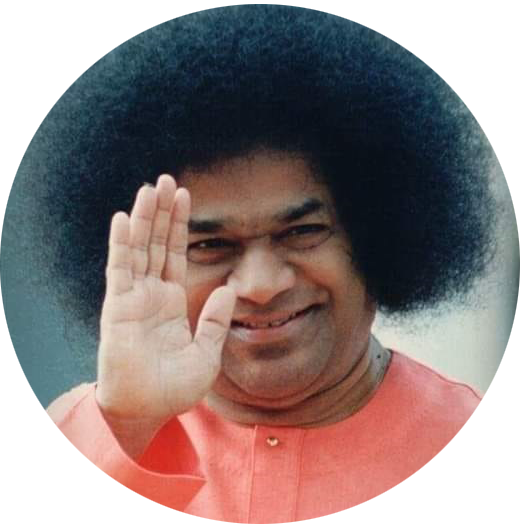
Bhagavan Baba – Spiritual directions/advice on Operation of Sai Centers
Questions & Answers
Published by Sri Sathya Sai Central Council of Malaysia in conjunction with the MINI CONFERENCE of FAR EASTERN Sai Centers Kuala Lumpur, Malaysia, July 1984
OTHER CENTRE ACTIVITIES: STUDY CIRCLE & MISCELLANEOUS
Q: Swami we are
conducting study circles in our center, and we would like your advice to all
aspirants?
A: You must be
guarded against pride that infests that scholar who has mastered a certain
number of ancient texts. Do not judge others as inferior because they do not
participate in your type of study circles. You can be very wrong, if you
estimate a person's spiritual development, by mere externals. Inner purity
cannot express itself through pompous shows. Delve into the significance and
the meaning of what you read and always have before you the goal of putting
what you read into practice. Unless you do so, the study circle will remain
half circle forever, it cannot be full circle.
Pay attention to
another point also. Do not confine your studies to this circle and these books.
The whole universe is a university for you. You can imbibe wisdom from the sky,
the clouds, the mountains, the rivers, the daily phenomena of sunrise and sunset,
the seasons, birds, trees, flowers, insects, in fact all beings and things in
nature. Approach these teachers with awe, reverence and humility, they will
respond with their lessons. Do not worry that you have no mastery of Samskrith;
Samskar is enough equipment for the university that lies around you. Samskrith
is the language of the ancient scriptures and of classical literature; Samskar
is the language of the heart, the refined medium of fruitful communication with
nature, in all the manifold outpourings of Divinity.
(Sathya
Sai Speaks, Vol. IX, Page 53-54)
Q: When I can get
knowledge from reading books, why should I attend study circles?
A: Knowledge about
what this author says or what that sage teaches is not what your study circle
must aim to acquire. Not information, but transformation; not instruction, but
construction should be the aim.
(Sathya
Sai Speaks, Vol. X, Page 51)
Q: How do we make “study
circle” produce results?
A: Question yourself
calmly and decide to benefit by practicing the processes mentioned in them.
This is the proper plan of study - Reading, Reflection and Regular Application
in life. Studying is work. Inquiry into the value and Applicability of what is
studied is WORSHIP; the experience of the validity and value of the practice is
WISDOM.
(Sathya
Sai Speaks, Vol. X, Page 51)
Q: What kind of books
should one read Swami?
A: Good books
pertaining to any religion could be read and maybe read by others. Distribute
good books to some. To the illiterate people you should read out from the books
and impart to them some good (spiritual) knowledge.
Many of the members
of Sathya Sai Organizations think that they are only to promote Sathya Sai
ideals and the name of Sathya Sai. It is not correct. Through the name of
Sathya Sai, what has to be promoted is Goodness, Faith in God and God-lines.
The name and form of God is not that important, because His names and forms are
countless and whichever name and form one takes to, all belong to the ONE God
only. What is required is faith.
(Seva
Dal, 4/83, Page 9)
MISCELLANEOUS
Q: What is the
highest form of sadhana, Swami?
A: The highest
sadhana is the recitation of the name of God with full intensity of thought and
feelings, and with deep faith, and also the loud singing of the glory of God.
(Spiritual
Diary, Page 183)
Q: What are Sai
ideals in daily life?
A: There are two
aspects to the question: spiritual life and the life in the role of the
individual as a member of society. Spiritually, divinity is in everyone. The
divine, God, is love. Love is my form and so is yours. If you allow lesser
feelings like hatred, resentment, envy, fear, anger, etc., then you have filled
your hearts and minds with that which creates a false separation from your real
self - LOVE. The task of your spiritual life then becomes a concentrated effort
to purify the mind and heart. When the heart and mind are purified, the truth
of man's divinity ·is revealed in a flash. The Sai teaching directs you to see
all diversity as transient and ephemeral, and to look always to the ONE
Reality. The practice of the constant presence of the divine is equally
necessary and equally beneficial.
Besides spiritual
life, you have also a duty to the people amongst whom you live, a duty to mold
society into a spiritual community. Society can be influenced only through
personal example. Through your righteous conduct and harmonious life, you would
prompt others to enquire into your source of this undisturbed peace and
happiness. You should elevate society through service to the weaker members of
the society. Love must be the basis for service to society.
(Sanathana
Sarathi, 12/83, Page 302)
Q: Bhagawan, please
enlighten us as to the correct relationship between the Individual and Society.
A: The individual and
society are intertwined inextricably. There must be illumination for both.
Ananda must surge out of the individual and fill the lake of society, and from
thence, stream into the ocean of Grace. Society is just a name for a group of
individuals; but it has no corporal body. Individuals are the limbs that
nourish and support the 'corpus' called society.
Society shapes the
individual, provides the arena for his development and sets the ideals he
should plant before himself When the individual is stronger, more intelligent,
more service minded and more efficient as a worker, society benefits; when
society is more aware of its role and the need to cleanse that role with
humility and wisdom, the individual benefits.
Sai has resolved to
transform the individual and society by promoting this mutual regeneration, by
the action of one on the other. Hence the formation of this Sai Organization
and the establishment of its units in all countries, for the sublimation of the
human into the Divine.
(Sathya
Sai Speaks, Vol. IX, Page 11)
Q: Swami, is it
enough to enjoy the vibration when praying, using mantras and singing bhajans
without understanding the meanings?
A: While praying and
using mantras, formulas or such expressions, one must know the real meaning and
significance of the words and their deep implications. One individual for
example did not know the full implication of the word “Siva”. He meant by that
word, the form of God - who is supposed to live in Kailas with his consort and
family. He told me that “Siva” meant “I am Siva” and was shocked when asked. “Then
what is Parvathi to you?”
Many people do japa
and join bhajans, but they are not aware of the meaning and value of the words
they utter mechanically. Elders who propagate mantras and pose as spiritual
teachers do not themselves know the inner meanings of what they recommend to
others or hand on to their disciples. Sivoham
means that you are Divine.
(Sathya
Sai Speaks, Vol. IX)
Q: What is the
importance of silence, Swami?
A: Be silent
yourself, that will induce silence in others. Do not fall into the habit of
shouting, talking long and loudly. Reduce contacts to a minimum. Carry with you
an atmosphere of quiet contemplation, wherever you happen to be. There are some
who live in a perpetual hullabaloo, in a tornado of noise. Whether they are in
an exhibition or in a fair or in a hotel, or a temple or the Prasanthi Nilayam,
they wag their tongues and will not stop. These will not proceed far on the
Godward path.
(Sadhana
Inward Path, Page 169)
Q: What are the
virtues of silence Baba?
A: One of the first
principles of straight living is the practice of silence. For the voice of God
can be in the region of the heart only when the tongue is stilled. Conserve
sound, since it is the treasure of the element akasa, an emanation from
God Himself. Silence is the speech of the spiritual seeker. Soft sweet speech
is the expression of genuine love. Love sings lullabies. It soothes. It applies
to balm.
(Sathya Sai Speaks,
Vol. Vll, Page 207)